 뒤로
CH15 - Chromosomal Basis of Inheritance and Extensions of Mendelian Genetics
스터디 가이드 - 스마트 노트
 자료에 맞춘 맞춤형 노트, 핵심 정의, 예시, 맥락을 확장해 제공합니다.
Mendelian Genetics and Chromosomal Inheritance
Introduction to Mendelian Genetics
Mendelian genetics forms the foundation of classical genetics, describing how traits are inherited from one generation to the next. Gregor Mendel, through his experiments with pea plants, established the basic laws of heredity, which were later connected to the behavior of chromosomes during meiosis.
Trait: A specific characteristic, such as flower color or seed shape.
Gene: A unit of heredity that encodes information for a trait.
Allele: Alternative forms of a gene found at the same locus on homologous chromosomes.
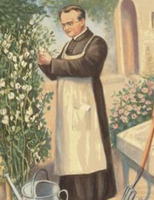
Image: Mendel tending pea plants, the organism used in his foundational experiments.
Mendel's Experiments and Laws
Mendel used controlled crosses between pea plants to study inheritance patterns. He tracked traits such as flower color, pea color, and pea shape, leading to the formulation of two key laws:
Law of Segregation: Each individual has two alleles for each gene, which segregate during gamete formation so that each gamete carries only one allele.
Law of Independent Assortment: Genes for different traits assort independently of one another during gamete formation.
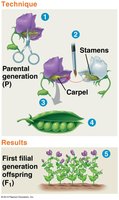
Image: Mendel's technique for crossing pea plants and observing the first filial (F1) generation.
Molecular Basis of Mendelian Inheritance
Modern genetics has revealed that genes are located on chromosomes and that alleles correspond to different DNA sequences at a gene locus. The presence or absence of specific enzymes, encoded by these alleles, determines the phenotype.
Locus: The specific physical location of a gene on a chromosome.
Enzyme: Proteins that catalyze biochemical reactions, often determining phenotypic traits.
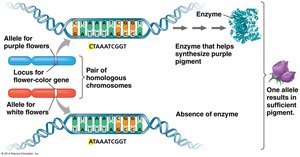
Image: The relationship between alleles, gene loci, and enzyme production in determining flower color.
Chromosomal Theory of Inheritance
Genes and Chromosomes
The chromosomal theory of inheritance states that genes are located on chromosomes, which segregate and independently assort during meiosis, mirroring Mendel's laws. Fluorescent tagging techniques allow scientists to trace genes to specific chromosomes.
Chromosome: A structure composed of DNA and proteins that carries genetic information.
Homologous Chromosomes: Chromosome pairs, one from each parent, that have the same genes at the same loci.
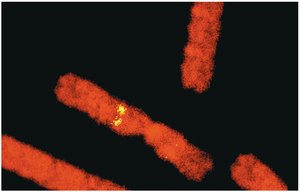
Image: Chromosomes visualized with fluorescent tags to identify gene locations.
Inheritance and Meiosis
Meiosis is the process by which gametes are formed, reducing the chromosome number by half and ensuring genetic diversity. The behavior of chromosomes during meiosis explains the segregation and independent assortment of alleles.
During anaphase I of meiosis, homologous chromosomes separate, leading to the segregation of alleles.
During metaphase I, the random orientation of chromosome pairs leads to independent assortment.
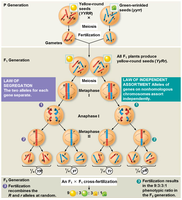
Image: Diagram showing how meiosis underlies Mendel's laws of segregation and independent assortment.
Sex-Linked Inheritance and Chromosome Behavior
Sex Chromosomes and Sex Determination
Sex chromosomes (X and Y) determine the biological sex of an organism. In many species, including humans and fruit flies, females have two X chromosomes (XX) and males have one X and one Y chromosome (XY). The SRY gene on the Y chromosome triggers male development.
Sex-linked gene: A gene located on a sex chromosome, often the X chromosome.
SRY gene: The sex-determining region of the Y chromosome responsible for initiating male development.
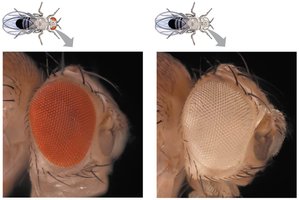
Image: Comparison of wild type (red) and mutant (white) eye color in fruit flies, a classic example of sex-linked inheritance.
Morgan's Experiments with Fruit Flies
Thomas Hunt Morgan's work with Drosophila melanogaster (fruit flies) provided the first evidence that genes are located on chromosomes. He discovered that the gene for eye color is located on the X chromosome, demonstrating sex-linked inheritance.
Wild-type alleles are denoted with a '+' (e.g., w+ for red eyes).
Mutant alleles are denoted by a letter (e.g., w for white eyes).
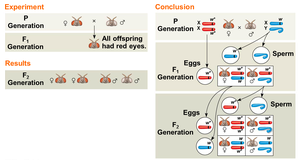
Image: Morgan's cross between red-eyed female and white-eyed male fruit flies.
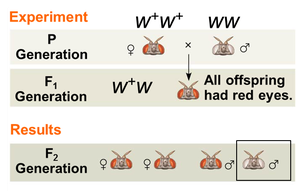
Image: Results of Morgan's cross, illustrating the inheritance of eye color in the F1 and F2 generations.
Human Sex Chromosomes
In humans, the X and Y chromosomes differ in size and gene content. Only a small region of homology allows them to pair during meiosis. Most X-linked genes are unrelated to sex determination, while Y-linked genes are primarily involved in male development.
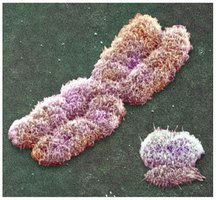
Image: Human X and Y chromosomes, showing their size difference and structure.
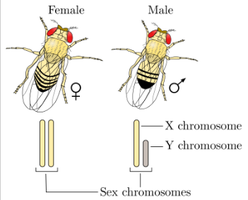
Image: Diagram of sex chromosomes in male and female fruit flies.
Linked Genes and Genetic Recombination
Linked Genes
Genes located close together on the same chromosome tend to be inherited together and are called linked genes. However, crossing over during meiosis can separate linked genes, resulting in recombinant offspring with new combinations of traits.
Linked genes: Genes that are inherited together because they are located near each other on the same chromosome.
Recombinant types: Offspring with combinations of traits not found in either parent, due to crossing over.
Genetic Mapping
The frequency of recombination between genes can be used to map their relative positions on a chromosome. The further apart two genes are, the more likely a crossover will occur between them.
Map unit (centimorgan): A unit of measurement for genetic linkage; one map unit corresponds to a 1% recombination frequency.
Linkage map: A genetic map based on recombination frequencies.
Alterations of Chromosome Number and Structure
Aneuploidy and Polyploidy
Errors during meiosis can lead to abnormal numbers of chromosomes (aneuploidy) or extra sets of chromosomes (polyploidy). Aneuploidy can result in disorders such as Down syndrome (trisomy 21), Klinefelter syndrome (XXY), and Turner syndrome (XO).
Aneuploidy: The presence of an abnormal number of chromosomes in a cell.
Polyploidy: The condition of having more than two complete sets of chromosomes.
Alterations of Chromosome Structure
Chromosome breakage can lead to structural changes such as deletions, duplications, inversions, and translocations. These alterations can cause genetic disorders, such as cri du chat syndrome (deletion on chromosome 5) and chronic myelogenous leukemia (translocation between chromosomes 9 and 22).
Exceptions to Mendelian Inheritance
Genomic Imprinting and Epigenetics
Some genes are subject to genomic imprinting, where the expression of an allele depends on the parent that contributed it. Epigenetic modifications, such as DNA methylation, can silence genes without altering the DNA sequence.
Genomic imprinting: The phenomenon where certain genes are expressed in a parent-of-origin-specific manner.
Epigenetics: Heritable changes in gene expression that do not involve changes to the underlying DNA sequence.
Inheritance of Organelle Genes
Some genes are located in organelles such as mitochondria and chloroplasts. These extranuclear genes are usually inherited maternally, as the zygote's cytoplasm comes from the egg. Mutations in these genes can lead to diseases affecting energy production and other cellular functions.
Mitochondrial inheritance: The transmission of genes located in the mitochondria, typically from mother to offspring.
