뒤로
Lecture 14 (Unit 2)-Chromosome Replication, Repair, and the Molecular Definition of the Gene
스터디 가이드 - 스마트 노트
 자료에 맞춘 맞춤형 노트, 핵심 정의, 예시, 맥락을 확장해 제공합니다.
Chromosome Replication: Principles and Mechanisms
Semi-Conservative Replication
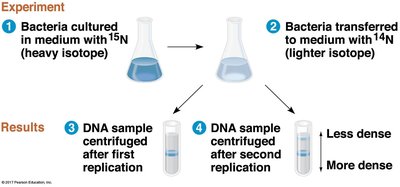
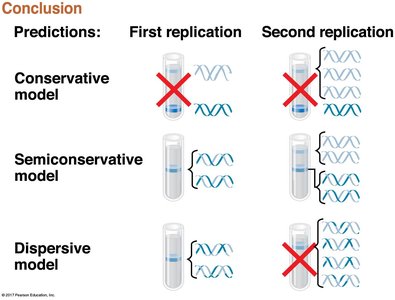
Chromosome replication is a fundamental process in all living cells, ensuring the accurate transmission of genetic information. The semi-conservative model describes how each daughter chromosome contains one parental (old) strand and one newly synthesized strand. This mechanism was experimentally confirmed by the Meselson-Stahl experiment, which distinguished between conservative, semi-conservative, and dispersive models of DNA replication.
Semi-conservative replication: Each new DNA molecule consists of one old strand and one new strand.
Conservative replication: Parental strands remain together; new strands form a separate duplex.
Dispersive replication: DNA strands are a mix of old and new segments.
Meselson-Stahl experiment: Used isotopes of nitrogen (N15 and N14) to track DNA replication and confirm the semi-conservative model.
Bidirectional Replication
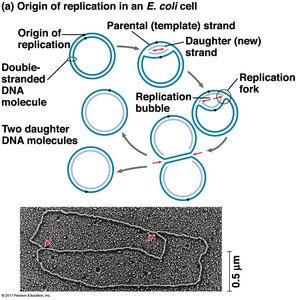
Replication proceeds bidirectionally from a single origin in circular bacterial chromosomes and from multiple origins in linear eukaryotic chromosomes. This ensures rapid and efficient duplication of large genomes.
Circular chromosomes: Replication starts at a single origin and proceeds in both directions, forming replication bubbles.
Linear chromosomes: Multiple origins of replication create several replication bubbles along the DNA molecule.
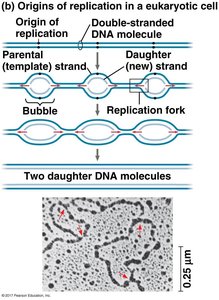
Discontinuous Replication and Okazaki Fragments
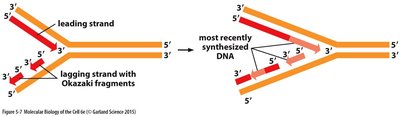
Due to the antiparallel nature of DNA strands, replication occurs continuously on the leading strand and discontinuously on the lagging strand, producing short DNA fragments known as Okazaki fragments.
Leading strand: Synthesized continuously in the 5' to 3' direction.
Lagging strand: Synthesized discontinuously as Okazaki fragments, later joined by DNA ligase.
Primase: Synthesizes short RNA primers to initiate DNA synthesis.
Enzymes Involved in DNA Replication
Key Proteins at the Replication Fork
Several specialized enzymes facilitate the unwinding, stabilization, and synthesis of DNA during replication.
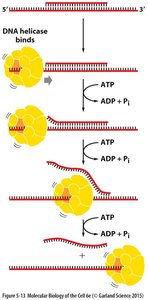
DNA helicase: Unwinds the DNA double helix using ATP.
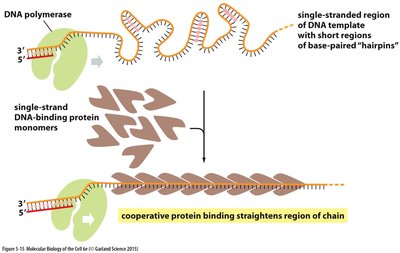
Single-strand binding protein: Stabilizes unwound DNA, preventing secondary structures.
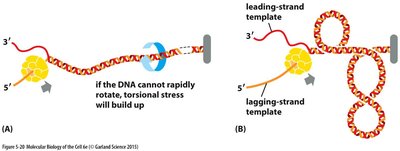
DNA topoisomerase: Relieves supercoiling ahead of the replication fork by introducing transient nicks.
Polymerization and Energetics
DNA polymerases catalyze the addition of nucleotides to the growing DNA chain, using nucleoside triphosphates as substrates. The energy for bond formation comes from the hydrolysis of phosphoanhydride bonds.
DNA polymerase: Adds nucleotides to the 3' end of the growing strand.
RNA primase: Initiates synthesis by creating RNA primers.
DNA ligase: Joins Okazaki fragments to form a continuous strand.
Equation: The polymerization reaction can be represented as:
DNA Repair and Replication Fidelity
Mechanisms Ensuring High Fidelity
Multiple layers of proofreading and repair mechanisms ensure the integrity of the genome during replication.
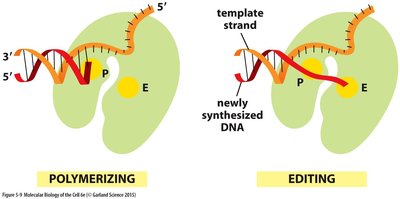
Intrinsic proofreading: DNA polymerase edits mismatches by removing incorrect bases.
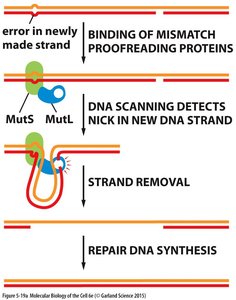
Mismatch repair: Specialized proteins (e.g., MutS and MutL) scan for errors and initiate repair.
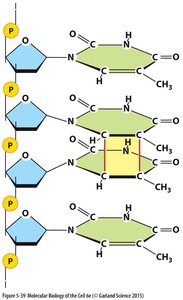
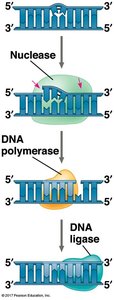
Thymine dimer repair: UV-induced thymine dimers are excised and replaced by DNA polymerase and ligase.
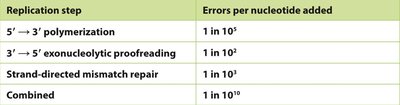
Fidelity: Combined mechanisms reduce error rate to 1 in 1010 nucleotides.
Replication Step | Errors per Nucleotide Added |
|---|---|
5' → 3' polymerization | 1 in 105 |
3' → 5' exonucleolytic proofreading | 1 in 102 |
Strand-directed mismatch repair | 1 in 103 |
Combined | 1 in 1010 |
Telomeres and Chromosome End Protection
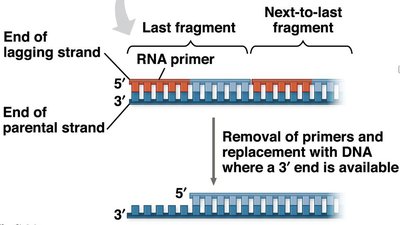
Linear chromosomes face the "end-replication problem," where the removal of the last RNA primer leaves a single-stranded 3' tail. Telomerase solves this by adding repetitive DNA sequences to chromosome ends, preventing loss of genetic information.
Telomeres: Repetitive DNA sequences at chromosome ends.
Telomerase: Enzyme that extends telomeres using an RNA template.
Importance: Maintains chromosome stability; telomere shortening is associated with aging and cancer.