 뒤로
Community Ecology: Structure, Interactions, and Diversity
스터디 가이드 - 스마트 노트
 자료에 맞춘 맞춤형 노트, 핵심 정의, 예시, 맥락을 확장해 제공합니다.
Community Ecology
Definition and Scope
Community ecology is the branch of biology that examines how populations of different species interact within a shared habitat, and how these interactions shape the structure, function, and dynamics of the community.
Ecological community: A group of interacting species or populations living in the same habitat.
Habitat: The specific local environment providing the resources and conditions necessary for organisms to survive.
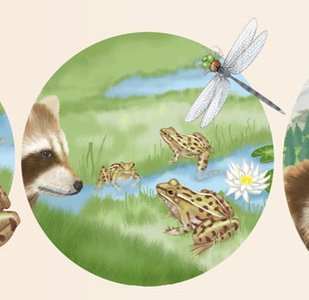
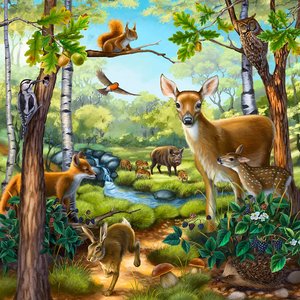
Examples of Ecological Communities
Ecological communities can be found in various environments, each with unique species interactions.
Forest community: Includes all plants, animals, insects, and microbes living in a forest habitat.
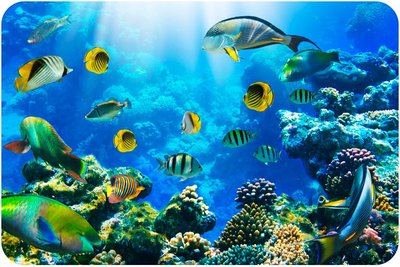
Aquatic community: Comprises all organisms inhabiting aquatic environments.
Microbial community: Consists of all microbes within a specific microhabitat.
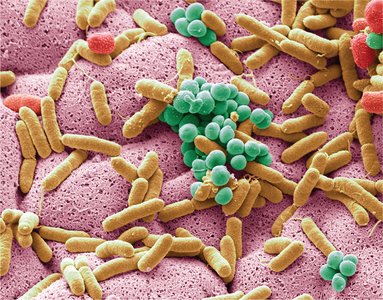
Types of Species Interactions
Overview of Interactions
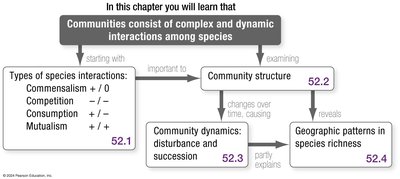
Species interactions are fundamental to community ecology and can be classified based on their effects on the fitness of the organisms involved.
Commensalism (+/0): One species benefits, the other is unaffected.
Competition (–/–): Both species are negatively affected as they compete for resources.
Consumption (+/–): One species benefits by consuming another (includes predation, herbivory, parasitism).
Mutualism (+/+): Both species benefit from the interaction.
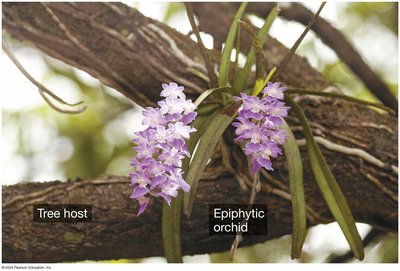
Consumption Interactions
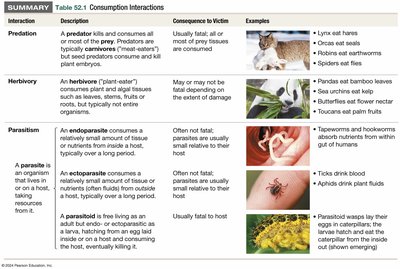
Consumption interactions include predation, herbivory, and parasitism, each with distinct consequences for the victim and examples.
Interaction | Description | Consequence to Victim | Examples |
|---|---|---|---|
Predation | A predator kills and consumes prey. | Usually fatal for prey. | Lynx eat hares, Cows eat seeds, Robins eat earthworms |
Herbivory | Herbivore consumes plant tissues. | May or may not be fatal. | Pandas eat bamboo leaves, Bees eat pollen, Butterflies feed on nectar |
Parasitism | Parasite consumes host resources. | Varies; can be fatal or non-fatal. | Ticks drink blood, Tapeworms infect intestines |
Mutualism
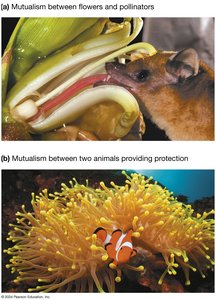
Mutualistic interactions benefit both species involved and can take many forms, such as pollination and protection.
Example: Clownfish and sea anemone protect each other from predators.
Example: Bats pollinate flowers using their long tongues.
Competition and Niche Differentiation
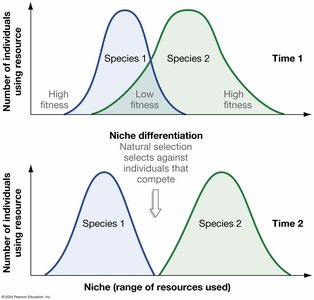
Competition occurs when species use overlapping resources, leading to niche differentiation and resource partitioning.
Niche differentiation: Natural selection reduces competition by favoring individuals that use different resources.
Resource partitioning: The process by which competing species use different resources or occupy different conditions.
Character Displacement
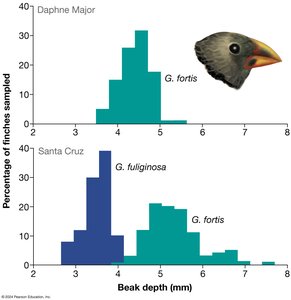
Character displacement is observed when competing species evolve differences in traits, such as beak size in Galápagos finches, to minimize competition.
Example: Finches on different islands show distinct beak depths, reducing resource overlap.
Community Structure
Components of Community Structure
Community structure describes the composition and organization of species within a community.
Richness: The number of unique species present.
Abundance: The total number of individuals.
Diversity: A measure combining richness and abundance.
Species Diversity
Species diversity is a measure of community complexity, reflecting both richness and abundance.
Evenness: How evenly individuals are distributed among species.
Diversity-stability relationship: Highly diverse communities are more stable and resilient to environmental disturbances.
Foundation and Keystone Species
Foundation species: Usually abundant and create or modify habitats, supporting many other species (often primary producers).
Keystone species: May be uncommon but have a disproportionately large effect on community balance through their interactions.
Factors Influencing Community Structure and Diversity
Geography, Climate, and Environmental Disturbances
Geography: Location and spatial arrangement affect community composition.
Climate: Temperature, precipitation, and seasonality influence species richness and abundance.
Environmental disturbances: Events such as fires, storms, or human activities can alter community structure.
Latitudinal Gradient in Species Richness
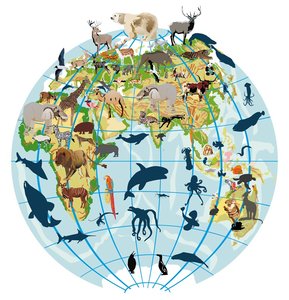
Species richness often increases toward the equator due to warmer temperatures, longer growing seasons, greater solar energy, and more available habitats.
Example: Bird and mammal species richness is higher in tropical regions.
Community Function
Natural Processes and Services
Community function encompasses the processes, products, and services provided by a community, including:
Oxygen production: Photosynthetic organisms contribute to atmospheric oxygen.
Carbon sequestration: Photosynthetic organisms reduce greenhouse gases.
Water cycling: Plants and microbes purify and sustain water resources.
Nutrient cycling: Decomposers and microbes recycle essential nutrients.
Soil formation: Plants, microbes, and invertebrates contribute to soil development.
Energy flow: All living things participate in energy transfer through food webs.
Levels of Ecological Study
Hierarchy and Types of Questions
Ecology is studied at multiple levels, each addressing distinct questions:
Organismal ecology: How do individual organisms interact with their environment?
Population ecology: How and why does population size change over space and time?
Community ecology: How do populations of different species interact, and what are the consequences?
Ecosystem ecology: How do living organisms interact with each other and the non-living environment?
Global ecology: How is the biosphere affected by global changes in nutrient cycling and climate?
Summary Table: Species-Species Interactions
Type of Interaction | Fitness Effect | Short-term Impact | Long-term Impact |
|---|---|---|---|
Commensalism | +/0 | Population size and range of commensal may depend on host | Strong selective pressure on commensal; none on host |
Competition | –/– | Reduces population size of both; weaker competitor may retreat or go extinct | Niche differentiation via selection |
Consumption | +/– | Impact on prey depends on density and defenses | Coevolutionary arms race between prey and consumer |
Mutualism | +/+ | Population size and range depend on each other | Selection to maximize benefits and minimize costs |
Key Equations and Concepts
Species Diversity Index (Shannon Index)
The Shannon diversity index is commonly used to quantify species diversity:
Where H' is the diversity index, S is the number of species, and pi is the proportion of individuals in the ith species.
Resource Partitioning and Niche Differentiation
Resource partitioning reduces competition and allows coexistence:
Character displacement is an evolutionary response to competition:
Conclusion
Community ecology provides insight into the complex and dynamic interactions among species, the structure and function of communities, and the factors influencing diversity and stability. Understanding these principles is essential for studying ecosystems, biodiversity, and conservation.
