 뒤로
Comprehensive Study Guide: Energy, Enzymes, and Metabolism in General Biology
스터디 가이드 - 스마트 노트
 자료에 맞춘 맞춤형 노트, 핵심 정의, 예시, 맥락을 확장해 제공합니다.
Q1. Explain the flow of energy and chemical recycling in the universe and the role of light energy.
Background
Topic: Energy Flow and Chemical Cycling in Ecosystems
This question tests your understanding of how energy moves through biological systems and how matter is recycled, with a focus on the role of light energy in these processes.
Key Terms:
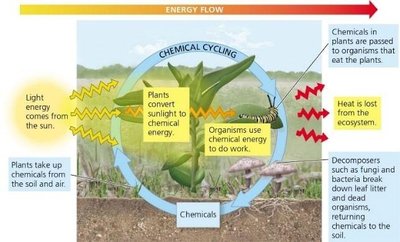
Energy flow: The movement of energy through an ecosystem, typically entering as sunlight and leaving as heat.
Chemical cycling: The reuse of chemical elements (like carbon, nitrogen) within ecosystems.
Light energy: Energy from the sun, captured by plants during photosynthesis.
Step-by-Step Guidance
Describe how light energy from the sun is captured by producers (plants) and converted into chemical energy through photosynthesis.
Explain how this chemical energy is transferred to consumers (animals) when they eat plants or other animals.
Discuss how decomposers break down dead organisms, returning chemicals to the soil for reuse by plants.
Note that energy flows in one direction (sun → organisms → heat), while chemicals are recycled within the ecosystem.
Consider how heat is lost from the system and why energy flow is not cyclic like chemical cycling.
Try solving on your own before revealing the answer!
Final Answer:
Energy enters ecosystems as sunlight, which plants convert to chemical energy via photosynthesis. This energy is transferred to consumers and decomposers as organisms eat and break down organic matter. While energy flows through and is eventually lost as heat, chemicals like carbon and nitrogen are recycled by decomposers, making them available again for producers. Light energy is essential as the initial energy source driving these processes.
Q2. Define metabolism.
Background
Topic: Metabolism
This question is about understanding what metabolism means in biological systems.
Key Terms:
Metabolism: The sum of all chemical reactions that occur within a living organism to maintain life.
Step-by-Step Guidance
Think about all the chemical reactions that happen in cells, including those that build up molecules and those that break them down.
Consider how these reactions are organized into metabolic pathways.
Remember that metabolism includes both energy-releasing and energy-consuming processes.
Try solving on your own before revealing the answer!
Final Answer:
Metabolism is the total of all chemical reactions that occur within an organism, including both the breakdown of molecules to release energy (catabolism) and the synthesis of complex molecules from simpler ones (anabolism).
Q3. Describe the difference between anabolic and catabolic pathways. Be sure to give an example.
Background
Topic: Metabolic Pathways
This question tests your understanding of the two main types of metabolic pathways: anabolic (building up) and catabolic (breaking down).
Key Terms:
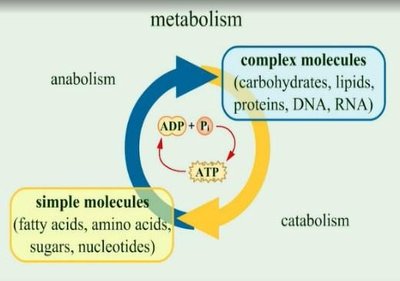
Anabolic pathway: A series of reactions that build complex molecules from simpler ones, usually requiring energy input.
Catabolic pathway: A series of reactions that break down complex molecules into simpler ones, releasing energy.
Step-by-Step Guidance
Define anabolic pathways and give an example (e.g., synthesis of proteins from amino acids).
Define catabolic pathways and give an example (e.g., breakdown of glucose during cellular respiration).
Explain how energy is involved in each type of pathway (anabolic requires energy, catabolic releases energy).
Relate these pathways to the overall concept of metabolism.
Try solving on your own before revealing the answer!
Final Answer:
Anabolic pathways build complex molecules (like proteins or DNA) from simpler ones and require energy input (e.g., protein synthesis). Catabolic pathways break down complex molecules (like glucose) into simpler ones, releasing energy (e.g., cellular respiration). Both types of pathways are essential parts of metabolism.
Q4. What is energy? Describe the difference between the different types of energy listed below. Be sure to give an example.
Background
Topic: Types of Energy in Biology
This question asks you to define energy and distinguish between kinetic, potential, and chemical energy, with examples.
Key Terms and Definitions:
Energy: The capacity to do work or cause change.
Kinetic energy: Energy of motion (e.g., a moving car).
Potential energy: Stored energy due to position or structure (e.g., water behind a dam).
Chemical energy: Potential energy stored in chemical bonds (e.g., glucose molecules).
Step-by-Step Guidance
Define energy in the context of biology.
Describe kinetic energy and provide a biological example (e.g., muscle contraction).
Describe potential energy and provide a biological example (e.g., concentration gradient across a membrane).
Describe chemical energy and provide a biological example (e.g., ATP or glucose).
Try solving on your own before revealing the answer!
Final Answer:
Energy is the ability to do work. Kinetic energy is energy of motion (e.g., a falling leaf), potential energy is stored energy (e.g., a stretched bow), and chemical energy is stored in chemical bonds (e.g., glucose in cellular respiration).
Q5. Using the figure above describe which processes are anabolic and catabolic and the types of energy for each.
Background
Topic: Anabolic vs. Catabolic Processes and Energy Types
This question asks you to interpret a diagram of metabolism, identifying anabolic and catabolic processes and the types of energy involved.
Key Concepts:
Anabolism: Building complex molecules from simpler ones, requires energy (usually ATP).
Catabolism: Breaking down complex molecules into simpler ones, releases energy (often captured as ATP).
ATP: The main energy currency in cells.
Step-by-Step Guidance
Identify which arrow in the diagram represents anabolism (simple to complex molecules) and which represents catabolism (complex to simple molecules).
Describe the direction of energy flow for each process (input or output of ATP).
Explain how ATP is involved in both processes (used in anabolism, produced in catabolism).
Relate the types of molecules involved (e.g., proteins, sugars, amino acids).
Try solving on your own before revealing the answer!
Final Answer:
Anabolic processes build complex molecules from simple ones and require energy input (ATP), while catabolic processes break down complex molecules into simple ones, releasing energy (which is used to make ATP). The diagram shows ATP cycling between these processes.
Q6. Describe the structure of ATP and how it is able to drive biological reactions.
Background
Topic: ATP Structure and Function
This question tests your understanding of ATP's molecular structure and its role in cellular energy transfer.
Key Terms and Structure:
ATP (adenosine triphosphate): A nucleotide with three phosphate groups, ribose sugar, and adenine base.
High-energy phosphate bonds: The bonds between phosphate groups store significant energy.
Step-by-Step Guidance
Describe the three main components of ATP (adenine, ribose, three phosphates).
Explain why the bonds between phosphate groups are considered "high-energy."
Discuss how ATP hydrolysis (breaking a phosphate bond) releases energy that can be used to drive cellular reactions.
Relate this to the concept of energy coupling in metabolism.
Try solving on your own before revealing the answer!
Final Answer:
ATP consists of adenine, ribose, and three phosphate groups. The high-energy bonds between the phosphates release energy when broken (hydrolysis), which is used to power cellular reactions by transferring a phosphate group to other molecules (phosphorylation).
Q7. Describe how ATP is regenerated.
Background
Topic: ATP Regeneration
This question focuses on how cells recycle ADP and inorganic phosphate to make new ATP.
Key Terms and Formula:
ADP (adenosine diphosphate): ATP with two phosphates.
Pi: Inorganic phosphate.
ATP synthesis:
Step-by-Step Guidance
Explain that ATP is regenerated from ADP and Pi through cellular respiration or photosynthesis.
Describe the role of enzymes like ATP synthase in this process.
Discuss where in the cell this regeneration occurs (e.g., mitochondria, chloroplasts).
Try solving on your own before revealing the answer!
Final Answer:
ATP is regenerated by adding a phosphate group to ADP, a process powered by energy from cellular respiration (in mitochondria) or photosynthesis (in chloroplasts). The enzyme ATP synthase catalyzes this reaction.
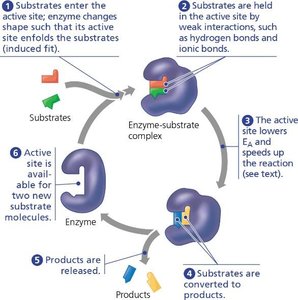
Q8. What are enzymes and describe how they work. Use the figure to the left.
Background
Topic: Enzyme Structure and Function
This question tests your understanding of what enzymes are and how they catalyze reactions, using a diagram of the enzyme-substrate complex.
Key Terms:
Enzyme: A protein that speeds up chemical reactions by lowering activation energy.
Substrate: The molecule upon which an enzyme acts.
Active site: The region of the enzyme where the substrate binds.
Step-by-Step Guidance
Define enzymes and their role as biological catalysts.
Describe how substrates bind to the enzyme's active site, forming an enzyme-substrate complex.
Explain how the enzyme changes shape (induced fit) to facilitate the reaction.
Discuss how the enzyme lowers the activation energy and converts substrates to products.
Note that the enzyme is released unchanged and can catalyze more reactions.
Try solving on your own before revealing the answer!
Final Answer:
Enzymes are proteins that speed up chemical reactions by binding substrates at their active site, lowering the activation energy needed for the reaction. After converting substrates to products, the enzyme is free to catalyze additional reactions.
