 뒤로
CH16 - DNA Structure, Replication, and Repair
스터디 가이드 - 스마트 노트
 자료에 맞춘 맞춤형 노트, 핵심 정의, 예시, 맥락을 확장해 제공합니다.
DNA Structure and Its Role in Inheritance
Historical Foundations of DNA as Genetic Material
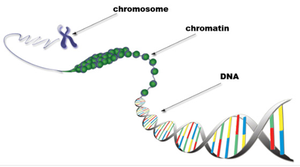
The discovery that DNA is the hereditary material was a pivotal moment in biology. Early geneticists, such as Thomas Hunt Morgan, demonstrated that genes are located on chromosomes, which are composed of both DNA and protein. However, it was not immediately clear which macromolecule was responsible for inheritance.
Chromosomes are structures within cells that contain genetic material.
Chromosomes are made of DNA and protein.
Viruses, such as bacteriophages, provided key evidence that DNA is the genetic material.
Evidence from Viruses and Bacteriophages
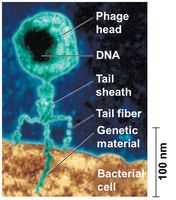
Bacteriophages (phages) are viruses that infect bacteria and are composed of DNA (or sometimes RNA) enclosed in a protein coat. They cannot replicate independently and must infect a host cell to reproduce. Experiments with phages helped confirm that DNA, not protein, is the genetic material.
Bacteriophage structure: Consists of a head containing DNA, a tail sheath, and tail fibers.
Phages inject their DNA into bacterial cells, directing the host to produce new viruses.
Hershey-Chase Experiment
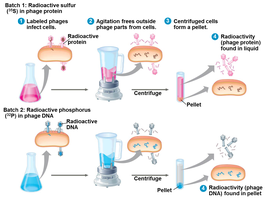
The Hershey-Chase experiment used radioactive labeling to show that DNA, not protein, is the genetic material transferred by phages into bacteria.
Radioactive sulfur labeled phage proteins; radioactive phosphorus labeled phage DNA.
After infection and centrifugation, only radioactive DNA entered bacterial cells, confirming DNA's role in heredity.
DNA Structure
Components and Organization
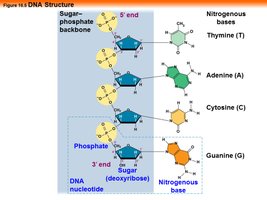
DNA is a polymer made of nucleotide monomers, each consisting of a phosphate group, a deoxyribose sugar, and a nitrogenous base. The structure of DNA is essential for its function in storing and transmitting genetic information.
Nucleotides: The building blocks of DNA, each containing a phosphate, deoxyribose sugar, and one of four nitrogenous bases (adenine, thymine, cytosine, guanine).
Sugar-phosphate backbone: Forms the structural framework of DNA strands.
Base pairing: Adenine pairs with thymine (A-T), and guanine pairs with cytosine (G-C).
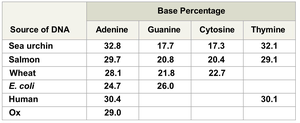
Chargaff's Rules
Erwin Chargaff discovered that the base composition of DNA varies between species, but the amount of adenine always equals thymine, and the amount of guanine equals cytosine.
Rule 1: The base composition of DNA varies between species.
Rule 2: %A = %T and %G = %C in any given species.
Source of DNA | Adenine | Guanine | Cytosine | Thymine |
|---|---|---|---|---|
Sea urchin | 32.8 | 17.7 | 17.3 | 32.1 |
Salmon | 29.7 | 20.8 | 20.4 | 29.1 |
Wheat | 28.1 | 21.8 | 22.7 | 27.4 |
E. coli | 24.7 | 26.0 | 25.7 | 23.6 |
Human | 30.4 | 19.6 | 19.6 | 30.1 |
Ox | 29.0 | 21.2 | 21.2 | 28.6 |
Double Helix Model
Rosalind Franklin's X-ray crystallography images revealed that DNA is a double helix with two antiparallel sugar-phosphate backbones and nitrogenous bases paired in the interior. Watson and Crick used this data to build their model of DNA.
Antiparallel strands: The two DNA strands run in opposite directions (5' to 3' and 3' to 5').
Complementary base pairing: Ensures accurate replication and transmission of genetic information.
DNA Replication
Overview and Mechanism
DNA replication is the process by which a cell copies its DNA before cell division. The double helix structure allows each strand to serve as a template for a new complementary strand.
Semiconservative replication: Each new DNA molecule consists of one parental strand and one newly synthesized strand.
Replication origins: Specific sequences where replication begins, forming replication bubbles.
Replication fork: The Y-shaped region where the DNA is split into two separate strands for copying.
Enzymes and Proteins Involved
Helicase: Unwinds the DNA double helix at the replication fork.
Single-strand binding proteins: Stabilize unwound DNA strands.
Topoisomerase: Relieves tension ahead of the replication fork by cutting and rejoining DNA strands.
Primase: Synthesizes short RNA primers to provide a starting point for DNA polymerase.
DNA polymerase: Adds nucleotides to the 3' end of the new DNA strand; requires a primer and template.
DNA ligase: Joins Okazaki fragments on the lagging strand.
Leading and Lagging Strands
Because DNA polymerase can only add nucleotides in the 5' to 3' direction, replication is continuous on the leading strand and discontinuous on the lagging strand, forming Okazaki fragments.
Leading strand: Synthesized continuously toward the replication fork.
Lagging strand: Synthesized in short segments (Okazaki fragments) away from the fork, later joined by DNA ligase.
Directionality and Nucleotide Addition
DNA polymerases add nucleotides only to the free 3' hydroxyl end of a growing strand, so new DNA is always synthesized in the 5' to 3' direction. Each added nucleotide is a nucleoside triphosphate (dNTP), which loses two phosphates as pyrophosphate during incorporation.
Proofreading and Repair
Ensuring Fidelity in DNA Replication
DNA polymerases have proofreading ability, correcting errors during replication. Additional repair mechanisms fix mismatches and damage caused by environmental factors.
Proofreading: DNA polymerase checks and corrects mismatched bases as DNA is synthesized.
Mismatch repair: Enzymes correct errors missed by DNA polymerase.
Nucleotide excision repair: Damaged DNA is cut out by nucleases and replaced by DNA polymerase; DNA ligase seals the strand.
Replicating DNA Ends: The Telomere Problem
Challenges in Eukaryotic DNA Replication
Linear chromosomes in eukaryotes present a problem: DNA polymerase cannot fully replicate the 5' ends, leading to progressive shortening of DNA with each cell division. This is not an issue for prokaryotes, which have circular DNA.
Telomeres: Repetitive nucleotide sequences at chromosome ends that protect genes from erosion.
Shortening of telomeres is associated with aging and cell senescence.
Summary Table: Key Proteins in DNA Replication
Protein/Enzyme | Function |
|---|---|
Helicase | Unwinds DNA at the replication fork |
Single-strand binding protein | Stabilizes single-stranded DNA |
Topoisomerase | Relieves overwinding strain ahead of the fork |
Primase | Synthesizes RNA primer |
DNA polymerase | Adds nucleotides to the 3' end of the new strand |
DNA ligase | Joins Okazaki fragments |
Key Equations and Concepts
Base pairing: ,
Direction of synthesis:
Semiconservative replication: Each daughter DNA molecule contains one parental and one new strand.
