 뒤로
Energetic Coupling and Enzyme Function in Cellular Metabolism
스터디 가이드 - 스마트 노트
 자료에 맞춘 맞춤형 노트, 핵심 정의, 예시, 맥락을 확장해 제공합니다.
Energetic Coupling in Biological Systems
Overview of Energetic Coupling
Energetic coupling is a fundamental concept in cellular metabolism, describing how cells drive non-spontaneous (endergonic) reactions by linking them to spontaneous (exergonic) reactions. This process ensures that the overall change in free energy (ΔG) is negative, making the combined reaction spontaneous.
Requirement 1: The sum total ΔG must be less than 0. The energy released by the exergonic process must be sufficient to power the endergonic process.
Requirement 2: The processes must be physically linked, allowing energy transfer between them.
Application: Exergonic reactions are used to "pay for" endergonic reactions in living cells.
Mechanisms of Energetic Coupling
Cells utilize three main mechanisms to couple exergonic and endergonic reactions:
ATP Hydrolysis: The breakdown of ATP releases energy that can drive endergonic reactions.
Redox Reactions: Electron transfer reactions can release energy for cellular processes.
Moving Ions Down Electrochemical Gradients: The movement of ions from high to low concentration releases energy.
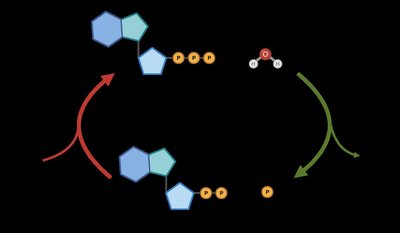
ATP Hydrolysis and Energetic Coupling
ATP Cycle
ATP (adenosine triphosphate) is the primary energy currency of the cell. Its hydrolysis to ADP (adenosine diphosphate) and inorganic phosphate is highly exergonic, releasing energy that can be used to drive endergonic reactions.
ATP Hydrolysis: (exergonic)
ADP Phosphorylation: (endergonic)
Example: ATP hydrolysis is used to power muscle contraction, active transport, and biosynthetic reactions.
Redox Reactions in Metabolism
Definition and Principles
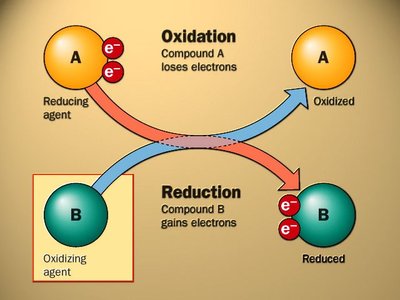
Redox reactions involve the transfer of electrons between molecules. Oxidation is the loss of electrons, while reduction is the gain of electrons. These reactions are always paired: when one molecule is oxidized, another is reduced.
Oxidation: Loss of electrons; the molecule becomes more positive.
Reduction: Gain of electrons; the molecule becomes more negative.
Redox Pair: The oxidizing agent accepts electrons, and the reducing agent donates electrons.
Some redox reactions are exergonic: They release energy that can be harnessed by the cell.
Moving Ions Down Electrochemical Gradients
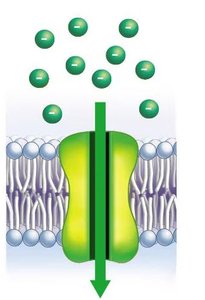
Electrochemical Gradients
Cells maintain gradients of ions across membranes. The movement of ions down their electrochemical gradient is a spontaneous, exergonic process that can be used to drive other cellular activities.
ΔG < 0: Movement is spontaneous and releases energy.
Example: ATP synthesis in mitochondria is powered by the flow of protons down their gradient.
Enzymes: Protein Catalysts in Metabolism
Characteristics of Enzymes
Enzymes are biological catalysts that accelerate chemical reactions in cells. They possess three key characteristics:
Catalytic Power: Enzymes can increase reaction rates by 106 to 1012 times.
Specificity: Most enzymes catalyze only one specific reaction.
Regulation: Enzyme activity can be modulated by cellular conditions and regulatory molecules.
How Enzymes Work
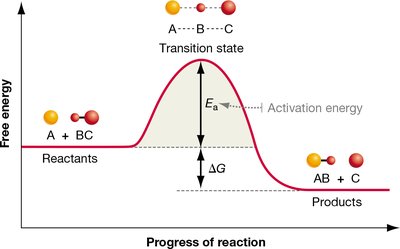
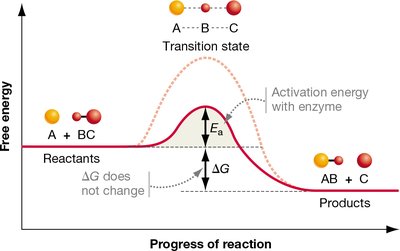
Enzymes speed up reactions by bringing substrates together in the correct orientation and lowering the activation energy required for the reaction. They stabilize the transition state, making the reaction proceed faster.
Enzymes do not change ΔG: They only affect the rate, not the spontaneity, of a reaction.
Cannot convert nonspontaneous to spontaneous: Enzymes only catalyze reactions that are already thermodynamically favorable.
Enzyme Specificity and Induced Fit
Enzymes are highly specific for their substrates. The active site binds substrates, forming an enzyme-substrate complex. The enzyme may change shape (induced fit) to facilitate the reaction, resulting in the formation of products.
Active Site: Region of the enzyme where substrate binding and catalysis occur.
Induced Fit: Enzyme changes shape upon substrate binding to optimize the reaction.

Regulation of Enzyme Activity
Environmental Optimization
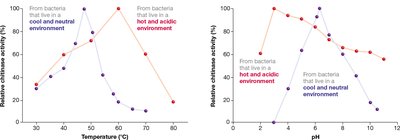
Enzymes are evolutionarily optimized for specific temperatures and pH levels. Their activity can vary dramatically depending on these conditions.
Temperature: Each enzyme has an optimal temperature for activity.
pH: Each enzyme has an optimal pH range.
Mechanisms of Enzyme Regulation
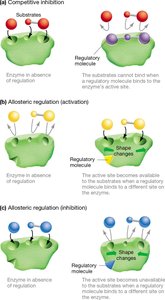
Enzyme activity can be regulated by noncovalent interactions with other molecules. The main mechanisms include:
Competitive Inhibition: Regulatory molecules compete with substrates for binding to the active site, blocking the reaction.
Allosteric Activation: Regulatory molecules bind to a site other than the active site, causing a conformational change that activates the enzyme.
Allosteric (Non-competitive) Inhibition: Regulatory molecules bind to a site other than the active site, causing a conformational change that inhibits the enzyme.
Summary Table: Energetic Coupling Mechanisms
Mechanism | Type of Reaction | ΔG | Example |
|---|---|---|---|
ATP Hydrolysis | Exergonic | Negative | Muscle contraction, biosynthesis |
Redox Reaction | Exergonic/Endergonic | Varies | Cellular respiration |
Ion Movement | Exergonic | Negative | ATP synthesis |
Key Equations
Free Energy Change:
ATP Hydrolysis:
Redox Reaction:
Additional info: Academic context was added to clarify the mechanisms and regulatory principles of enzymes, as well as to provide self-contained explanations suitable for exam preparation.
