 뒤로
Energy and Metabolism: Laws of Thermodynamics, Gibbs Free Energy, and Cellular Processes
스터디 가이드 - 스마트 노트
 자료에 맞춘 맞춤형 노트, 핵심 정의, 예시, 맥락을 확장해 제공합니다.
Energy in Biological Systems
Introduction to Energy
All organisms require energy to stay alive and perform work. Cellular chemical reactions involve energy conversions, breaking and making molecules. Energy is defined as the capacity to perform work, and metabolism encompasses all chemical reactions that sustain life, including those that convert molecules and transfer energy.
Types of Energy
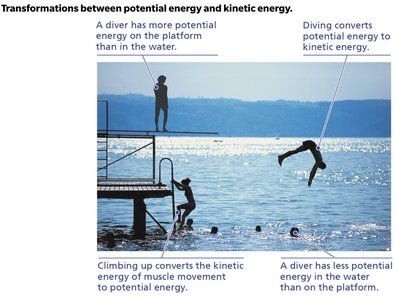
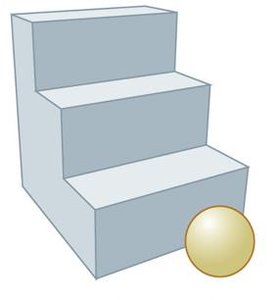
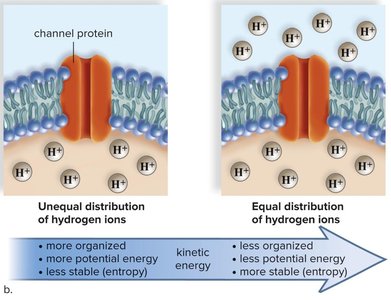
Potential Energy: Stored energy, such as chemical energy in bonds or concentration gradients across membranes.
Kinetic Energy: Energy of motion, including light, heat, sound, and muscle movement.
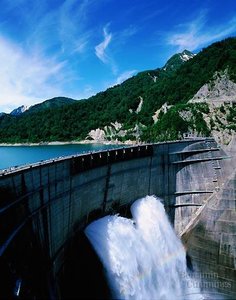
Example: Water behind a dam represents potential energy, while the flow of water is kinetic energy.
The Laws of Thermodynamics
First Law of Thermodynamics
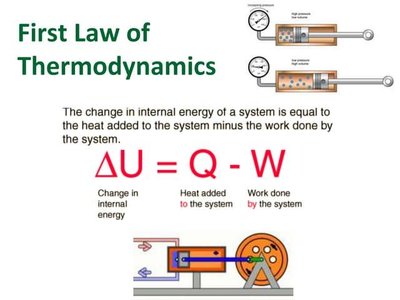
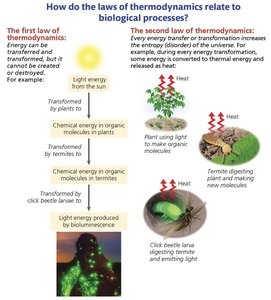
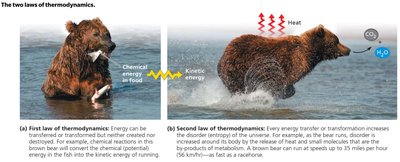
The first law states that energy can be changed from one form to another, but it cannot be created nor destroyed. This principle is fundamental to biological systems, where energy is transferred and transformed during cellular processes.
Equation: $\Delta U = Q - W$ Where $\Delta U$ is the change in internal energy, $Q$ is heat added, and $W$ is work done by the system.
Second Law of Thermodynamics
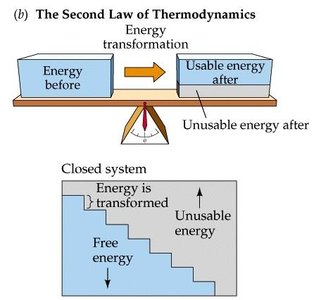
The second law states that energy changes are not 100% efficient. Energy conversions increase disorder (entropy), and some energy is lost as heat. Every energy transformation decreases the usable free energy of the system.
Entropy: A measure of disorder; events in the universe proceed toward maximum entropy.
Cell reactions increase order within the cell but overall increase entropy by releasing heat.
Cells require input of energy (light or food) to build and maintain order.


Gibbs Free Energy and Reaction Directionality
Gibbs Free Energy ($G$)
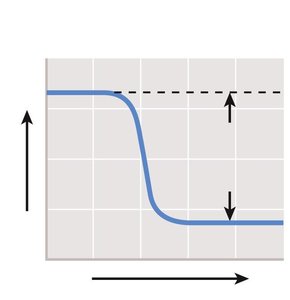
Gibbs free energy is the amount of energy available to do work in a system. The change in free energy ($\Delta G$) determines whether a reaction is energetically favorable.
Equation: $\Delta G = G_{products} - G_{reactants}$
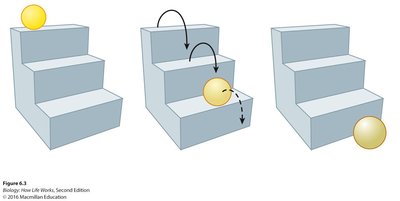
If $\Delta G$ is negative, energy is released (exergonic reaction).
If $\Delta G$ is positive, energy is required (endergonic reaction).

Exergonic vs. Endergonic Reactions
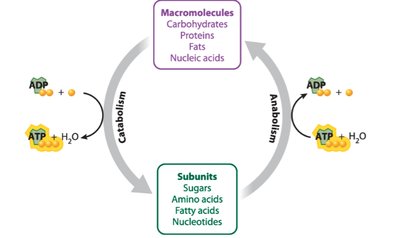
Exergonic Reactions: Release energy, $\Delta G$ is negative. Example: breaking down macromolecules (catabolic pathways).
Endergonic Reactions: Require energy input, $\Delta G$ is positive. Example: building macromolecules (anabolic pathways).
Energy Coupling and ATP
ATP: The Energy Currency of the Cell
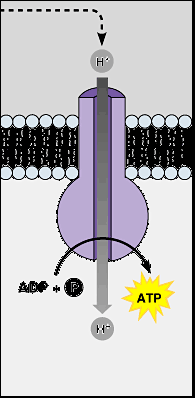
Adenosine triphosphate (ATP) powers nearly all forms of cellular work. ATP molecules are key to energy coupling, allowing cells to "pay" for endergonic reactions with energy released from exergonic reactions.
ATP is composed of three parts: adenine, ribose, and three phosphate groups.
Hydrolysis of ATP releases energy due to electrostatic repulsion between phosphate groups.
ATP is recycled thousands of times per day in cells.
Enzymes and Activation Energy
How Enzymes Work
Enzymes are proteins that serve as catalysts, speeding up chemical reactions by lowering the activation energy barrier. They do not change the $\Delta G$ of a reaction, but make reactions occur more rapidly.
Enzymes hold substrates in their active site, stressing covalent bonds to facilitate breaking or making bonds.
Enzymes accelerate reactions by reducing activation energy ($E_a$).
Redox Reactions in Metabolism
Oxidation and Reduction
Redox reactions involve the transfer of electrons from an electron donor to an electron acceptor.
Oxidation: Loss of electrons, energetically favorable ($-\Delta G$).
Reduction: Gain of electrons, energetically unfavorable ($+\Delta G$).
Cellular respiration is a net exergonic process, using the energy released from oxidation to make ATP.
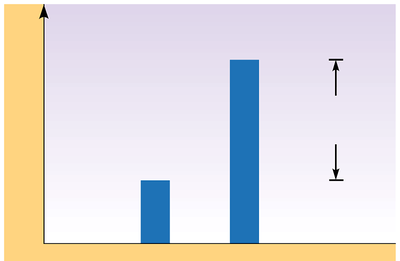
Summary Table: Exergonic vs. Endergonic Reactions
Reaction Type | $\Delta G$ | Energy Flow | Example |
|---|---|---|---|
Exergonic | Negative | Energy released | Catabolic pathways (e.g., glucose breakdown) |
Endergonic | Positive | Energy required | Anabolic pathways (e.g., protein synthesis) |
Key Concepts for Exam Preparation
Distinguish between exergonic and endergonic reactions, and between catabolic and anabolic pathways.
Understand the relationship between $\Delta G$, redox reactions, and predicting chemical reaction directionality.
Describe the function of a catalyst and the role of enzymes in metabolism.
Explain the physical attributes of ATP and other nucleoside triphosphates that result in large energy release during hydrolysis.
Interpret redox values to predict reaction directionality.
