 뒤로
4.1 Energy Coupling, ATP, and Redox Reactions in Cellular Metabolism
스터디 가이드 - 스마트 노트
 자료에 맞춘 맞춤형 노트, 핵심 정의, 예시, 맥락을 확장해 제공합니다.
Energy Coupling in Cells
ATP and Energy Transfer
Cells require energy to perform endergonic (energy-consuming) reactions. To drive these reactions, cells couple them with exergonic (energy-releasing) reactions, most commonly the hydrolysis of ATP (adenosine triphosphate). ATP acts as the primary energy currency in biological systems, providing readily usable energy for cellular activities.
ATP Structure: ATP consists of adenine, ribose (a five-carbon sugar), and three phosphate groups. The bonds between the phosphate groups, especially the bond connecting the terminal (third) phosphate, are high-energy linkages due to negative charge repulsion.
ATP Hydrolysis: When the terminal phosphate bond is broken (hydrolyzed), a large amount of energy is released, which can be used to power endergonic reactions.
ATP Cycle: ATP is continuously regenerated from ADP (adenosine diphosphate) and inorganic phosphate (Pi) using energy derived from the breakdown of glucose and other high-energy molecules.
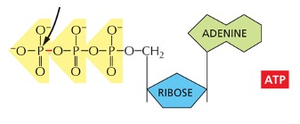
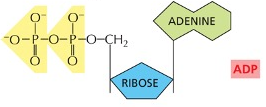
Energy Coupling Mechanism
Endergonic reactions (such as biosynthesis) require an input of energy, while exergonic reactions (such as ATP hydrolysis) release energy. By coupling these reactions, cells ensure that the energy released from ATP hydrolysis is directly used to drive necessary cellular processes.
Example: The synthesis of macromolecules (proteins, nucleic acids) is endergonic and is powered by the hydrolysis of ATP.
Redox Reactions and Energy Transfer
Oxidation and Reduction (Redox) Reactions
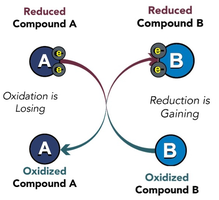
Redox reactions involve the transfer of electrons between molecules, which is a key mechanism for energy transfer in cells. In these reactions, one molecule loses electrons (oxidation) and another gains electrons (reduction).
Oxidation: Loss of electrons or electrons moving farther from the atom (often associated with the addition of oxygen or removal of hydrogen).
Reduction: Gain of electrons or electrons moving closer to the atom (often associated with the addition of hydrogen or removal of oxygen).
Energy Transfer: Electrons carry energy; when transferred from one molecule to another, the energy can be harnessed to synthesize ATP.
Electron Carriers: Molecules such as NAD+ and FAD act as electron carriers, temporarily holding electrons during cellular respiration.
Glucose as an Energy Source
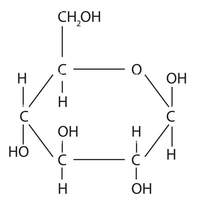
Glucose is a high-energy molecule due to its numerous C-H and C-C bonds, which store potential energy. During cellular respiration, these bonds are broken, and the electrons are transferred to electron carriers, ultimately leading to the production of ATP.
Glucose Breakdown: The breakdown of glucose to CO2 and H2O is highly exergonic, releasing energy stored in the chemical bonds.
Energy Extraction: The energy released from glucose is used to re-energize ADP to ATP in mitochondria.
Summary Table: Key Concepts in Energy Coupling and Redox Reactions
Concept | Description | Example |
|---|---|---|
ATP Hydrolysis | Breaking the terminal phosphate bond of ATP to release energy | ATP + H2O → ADP + Pi + energy |
Energy Coupling | Using energy from exergonic reactions to drive endergonic reactions | ATP hydrolysis powers protein synthesis |
Oxidation | Loss of electrons | Glucose oxidation in cellular respiration |
Reduction | Gain of electrons | NAD+ reduced to NADH |
Electron Carrier | Molecule that temporarily holds electrons during redox reactions | NAD+, FAD |
Key Equations
ATP Hydrolysis:
General Redox Reaction:
Glucose Oxidation (Cellular Respiration):
Additional info: The process of extracting energy from glucose via redox reactions and using it to synthesize ATP is central to cellular metabolism and will be explored in detail in the next unit on aerobic cellular respiration.
