 뒤로
Fungi: Structure, Diversity, and Ecological Roles
스터디 가이드 - 스마트 노트
 자료에 맞춘 맞춤형 노트, 핵심 정의, 예시, 맥락을 확장해 제공합니다.
Fungi: Kingdom Overview
General Characteristics
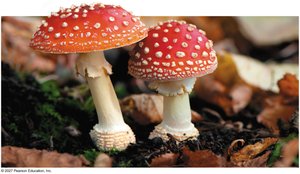
The kingdom Fungi comprises a diverse group of eukaryotic organisms, ranging from microscopic molds and yeasts to large mushrooms. Fungi are mostly multicellular, except for yeasts, which are unicellular. They reproduce both sexually and asexually, and their cell walls are composed of chitin, a strong, flexible polysaccharide. Fungi are absorptive heterotrophs, meaning they obtain nutrients by absorbing them from their environment after breaking down organic material with extracellular enzymes. Their ecological roles include decomposers, mutualists, and parasites.
Fungal Diversity and Evolution
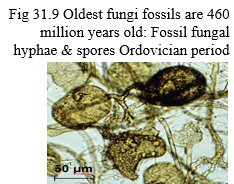
Fungi radiated into a diverse set of lineages during the adaptive radiation that began when multicellular life colonized land. There are approximately 145,000 known species, with estimates ranging up to 3.8 million. Fossil evidence shows fungi existed as early as 460 million years ago, and mutualistic relationships with plants likely facilitated early land colonization.
Fungal Structure and Nutrition
Absorptive Heterotrophy
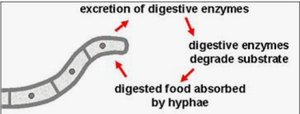
Fungi feed by absorption, secreting enzymes to break down complex molecules outside their bodies and then absorbing the resulting simple compounds. This method allows them to exploit a wide range of food sources and contributes to their ecological success.
Body Structure: Hyphae and Mycelium
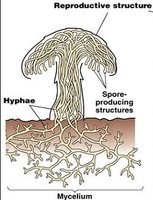
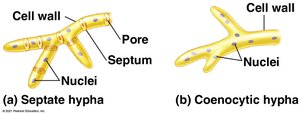
The most common fungal body structures are multicellular filaments called hyphae and single cells (yeasts). Hyphae form a network called mycelium, which infiltrates the substrate and maximizes surface area for efficient nutrient absorption. Hyphae may be divided by septa (with pores for organelle movement) or be coenocytic (continuous cytoplasm with many nuclei).
Fungal Cell Wall
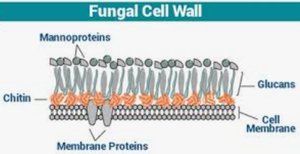
Fungal cell walls are primarily composed of chitin, which provides structural strength and flexibility. Other components include glucans and mannoproteins.
Specialized Hyphae and Symbiosis
Mycorrhizal Fungi
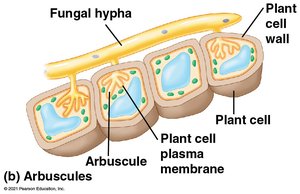
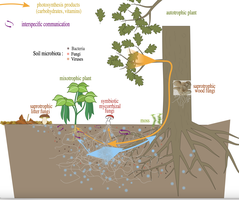
Mycorrhizal fungi form mutualistic associations with plant roots, enhancing nutrient and water uptake for the plant while receiving carbohydrates in return. Specialized hyphae called haustoria allow parasitic fungi to penetrate host tissues, while arbuscules facilitate nutrient exchange in mycorrhizal relationships.
Fungal Reproduction
Sexual and Asexual Life Cycles
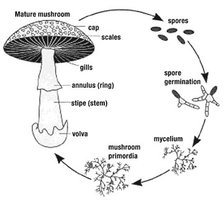
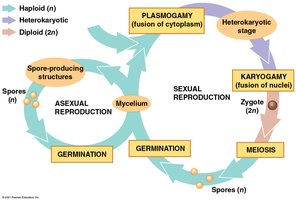
Fungi reproduce via spores, which may be produced sexually or asexually. Sexual reproduction involves the fusion of hyphae from different mycelia (plasmogamy), followed by a period where haploid nuclei coexist (heterokaryon), and eventual nuclear fusion (karyogamy) to form a diploid zygote. Asexual reproduction occurs through mitosis, producing spores or, in yeasts, by budding.
Fungal Lineages and Evolutionary Relationships
Major Fungal Groups
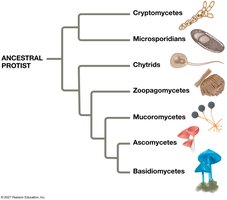
Fungi are classified into several major groups based on molecular and morphological evidence: Cryptomycetes, Microsporidians, Chytrids, Zoopagomycetes, Mucoromycetes, Ascomycetes, and Basidiomycetes. The evolutionary tree shows their relationships, with some lineages still unresolved.
Opisthokonts and Fungal Evolution
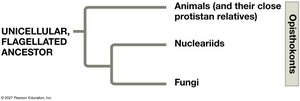
Fungi and animals are more closely related to each other than to plants, forming the clade Opisthokonts. Both evolved from a unicellular, flagellated ancestor, and multicellularity arose independently in each lineage.
Ecological Roles of Fungi
Decomposers
Fungi are essential decomposers, breaking down organic material and recycling nutrients in terrestrial ecosystems. They compete with bacteria for this role.
Mutualists
Fungi form mutualistic relationships with plants (mycorrhizae and endophytes), animals (digestive symbiosis), and photosynthetic microorganisms (lichens). These relationships are vital for nutrient cycling and ecosystem stability.
Parasites and Pathogens
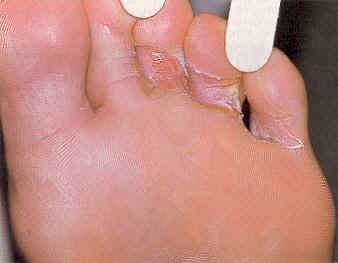
About 30% of fungal species are parasites or pathogens, primarily affecting plants but also animals and humans. Fungal infections in humans are called mycoses, with examples including ringworm and athlete's foot.
Practical Uses of Fungi
Human Applications
Fungi are used in food production (bread, cheese, alcoholic beverages), antibiotic production (e.g., Penicillium for penicillin), and biotechnology (e.g., genetically engineered yeast for pharmaceuticals and biofuels).
Summary Table: Major Fungal Groups
Group | Key Features | Ecological Role |
|---|---|---|
Cryptomycetes | Unicellular, flagellated spores | Parasites of protists/fungi |
Microsporidians | Unicellular, reduced mitochondria | Parasites of animals/protists |
Chytrids | Flagellated zoospores | Decomposers, mutualists, parasites |
Zoopagomycetes | Non-flagellated spores, zygosporangium | Parasites, symbionts |
Mucoromycetes | Zygosporangium, decomposers | Decomposers, mutualists, pathogens |
Ascomycetes | Ascospores in asci, conidia | Decomposers, pathogens, symbionts |
Basidiomycetes | Basidia, basidiospores | Decomposers, mutualists, parasites |
Additional info: Fungi are crucial for ecosystem functioning, human health, and biotechnology. Their diversity and adaptability make them a key subject in general biology.
