 뒤로
Gene Expression: From Gene to Protein (Transcription, Translation, and Mutations)
스터디 가이드 - 스마트 노트
 자료에 맞춘 맞춤형 노트, 핵심 정의, 예시, 맥락을 확장해 제공합니다.
Gene Expression: From Gene to Protein
Overview of Gene Expression
Gene expression is the process by which information encoded in DNA directs the synthesis of proteins, which are responsible for an organism's traits. This process involves two main stages: transcription and translation. Proteins serve as the link between genotype and phenotype, and the central dogma of molecular biology describes the flow of genetic information as DNA → RNA → protein.
Transcription: Synthesis of RNA from a DNA template.
Translation: Synthesis of a polypeptide (protein) from an mRNA template.
RNA Processing: In eukaryotes, pre-mRNA is modified before translation.
Transcription: DNA-Directed Synthesis of RNA
Basic Principles of Transcription
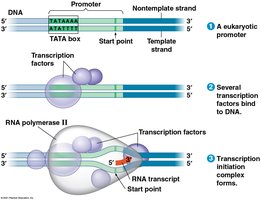
Transcription is the first stage of gene expression, where RNA polymerase synthesizes RNA using a DNA template. The resulting RNA is complementary to the template strand and does not require a primer. The process follows base-pairing rules, with uracil (U) replacing thymine (T) in RNA.
Promoter: DNA sequence where RNA polymerase binds to initiate transcription.
Transcription Unit: Stretch of DNA transcribed into RNA.
Stages: Initiation, Elongation, Termination.
Transcription in Prokaryotes vs. Eukaryotes
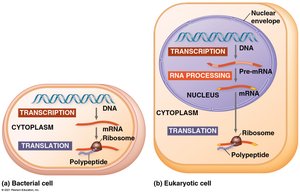
In prokaryotes, transcription and translation occur simultaneously in the cytoplasm. In eukaryotes, transcription occurs in the nucleus, and RNA processing modifies the transcript before it is exported to the cytoplasm for translation.
Prokaryotes: No RNA processing; translation begins before transcription ends.
Eukaryotes: RNA processing (5' cap, poly-A tail, splicing) occurs before translation.
RNA Processing in Eukaryotes
Modification of mRNA Ends
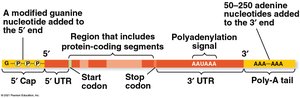
Before leaving the nucleus, eukaryotic pre-mRNA undergoes modifications at both ends. The 5' end receives a modified guanine nucleotide (5' cap), and the 3' end receives a poly-A tail. These modifications facilitate export, protect mRNA, and help ribosomes attach for translation.
5' Cap: Modified guanine nucleotide added to the 5' end.
Poly-A Tail: 50–250 adenine nucleotides added to the 3' end.
RNA Splicing: Removal of Introns
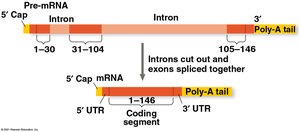
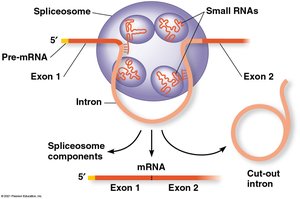
Most eukaryotic genes contain noncoding regions called introns that are removed from the pre-mRNA. The remaining coding regions, exons, are spliced together to form mature mRNA. This process is carried out by spliceosomes, which are complexes of proteins and small RNAs.
Introns: Noncoding regions removed from pre-mRNA.
Exons: Coding regions joined together after splicing.
Spliceosome: Catalyzes the removal of introns and joining of exons.
Alternative RNA Splicing and Protein Domains
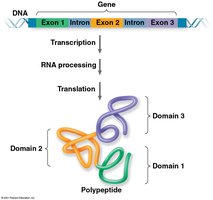
Alternative splicing allows a single gene to code for multiple polypeptides by varying which segments are treated as exons. Proteins often have modular domains, and different exons may encode different domains, contributing to protein diversity.
Alternative Splicing: Generates multiple polypeptides from one gene.
Protein Domains: Discrete functional regions within a protein.
Translation: RNA-Directed Synthesis of Polypeptides
Genetic Code and Codons
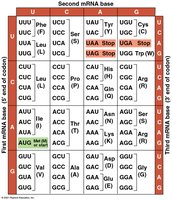
The genetic code is based on triplets of nucleotides called codons. Each codon specifies an amino acid or a stop signal. The code is redundant but not ambiguous, and must be read in the correct frame.
Codon: Three-nucleotide sequence in mRNA.
Start Codon: AUG (methionine).
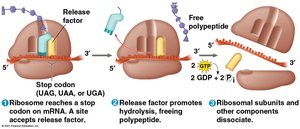
Stop Codons: UAA, UAG, UGA.
Translation Mechanism
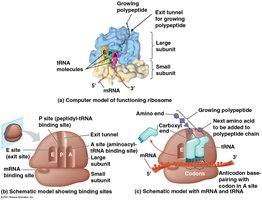
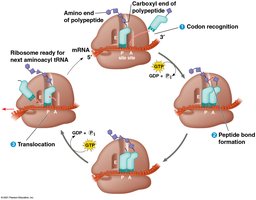
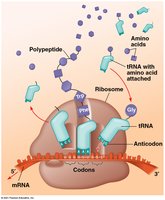
Translation occurs in three stages: initiation, elongation, and termination. Transfer RNA (tRNA) brings amino acids to the ribosome, matching its anticodon to the mRNA codon. Ribosomes facilitate the assembly of the polypeptide chain.
Initiation: Small ribosomal subunit binds mRNA and initiator tRNA.
Elongation: Amino acids added to the growing chain.
Termination: Stop codon signals release of the polypeptide.
Structure and Function of tRNA
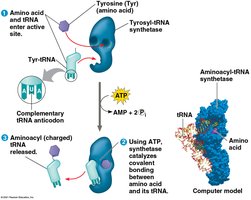
Each tRNA molecule carries a specific amino acid and has an anticodon that pairs with the mRNA codon. The enzyme aminoacyl-tRNA synthetase ensures the correct amino acid is attached to the tRNA.
Anticodon: Three-nucleotide sequence on tRNA complementary to mRNA codon.
Aminoacyl-tRNA Synthetase: Enzyme that attaches amino acid to tRNA.
Post-Translational Modifications and Protein Targeting
Protein Folding and Modifications
After translation, polypeptides fold into their functional three-dimensional shapes. Post-translational modifications, such as glycosylation and methylation, may be required for proper function.
Folding: Spontaneous formation of secondary and tertiary structure.
Modifications: Addition of functional groups (e.g., sugars, methyl groups).
Targeting Proteins to Specific Locations
Proteins are synthesized by free or bound ribosomes. Signal peptides direct polypeptides to specific cellular locations, such as the endoplasmic reticulum or other organelles.
Signal Peptide: Short sequence marking destination.
SRP: Signal-recognition particle guides ribosome to ER.
Polyribosomes and Efficiency of Protein Synthesis
Polyribosome Formation
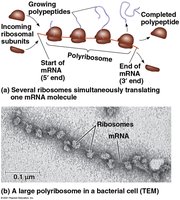
Multiple ribosomes can translate a single mRNA simultaneously, forming a polyribosome. This allows rapid production of many copies of a polypeptide.
Polyribosome: Cluster of ribosomes translating the same mRNA.
Mutations: Effects on Protein Structure and Function
Types of Mutations
Mutations are changes in the genetic information of a cell. Point mutations affect a single nucleotide pair and can result in silent, missense, or nonsense mutations. Insertions and deletions can cause frameshift mutations, often leading to nonfunctional proteins.
Point Mutation: Change in a single nucleotide pair.
Silent Mutation: No effect on protein sequence.
Missense Mutation: Changes one amino acid.
Nonsense Mutation: Changes codon to stop codon.
Frameshift Mutation: Alters reading frame due to insertion/deletion.
Mutagens and Carcinogens
Mutations can occur spontaneously or be induced by mutagens, which are physical or chemical agents. Many mutagens are also carcinogens, substances that cause cancer.
Mutagen: Agent that causes mutations.
Carcinogen: Cancer-causing agent, often a mutagen.
Summary Table: Comparison of Prokaryotic and Eukaryotic Gene Expression
Feature | Prokaryotes | Eukaryotes |
|---|---|---|
Location of Transcription | Cytoplasm | Nucleus |
RNA Processing | None | 5' cap, poly-A tail, splicing |
Coupling of Transcription and Translation | Simultaneous | Separate |
Polyribosomes | Yes | Yes |
