 뒤로
General Biology II Unit 3 Practice Assessment Study Guidance
스터디 가이드 - 스마트 노트
 자료에 맞춘 맞춤형 노트, 핵심 정의, 예시, 맥락을 확장해 제공합니다.
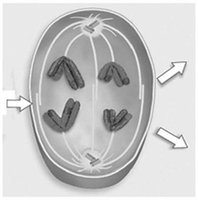
Q36. What phase of meiosis is seen in the figure to the right?
Background
Topic: Meiosis Phases
This question tests your ability to identify the specific stage of meiosis based on the arrangement and movement of chromosomes within the cell.
Key Terms:
Meiosis: A type of cell division that reduces the chromosome number by half, producing four gamete cells.
Anaphase: The stage where chromosomes are pulled apart toward opposite poles.
Metaphase: The stage where chromosomes align at the cell's equator.
Sister chromatids: Identical copies of a chromosome connected by a centromere.
Homologous chromosomes: Chromosome pairs, one from each parent, that are similar in shape and gene content.
Step-by-Step Guidance
Observe the image carefully. Notice the arrangement of chromosomes and the direction in which they are moving.
Recall the key differences between Anaphase I and Anaphase II in meiosis. In Anaphase I, homologous chromosomes separate; in Anaphase II, sister chromatids separate.
Look for clues: Are the chromosomes being pulled apart as pairs (homologs) or as individual chromatids?
Compare the image to textbook diagrams of meiosis phases to determine which phase matches the observed chromosome movement.
Try solving on your own before revealing the answer!
Final Answer: D) Anaphase II
The image shows sister chromatids being pulled apart to opposite poles, which is characteristic of Anaphase II in meiosis. In this phase, the chromatids separate, resulting in daughter chromosomes moving toward the spindle poles.
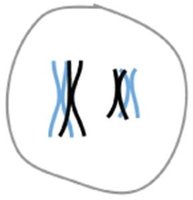
Q48. Fill in the model below showing what the cell would look like throughout meiosis. Make sure that you accurately represent whether chromosomes are unreplicated or replicated, cell ploidy level.
Background
Topic: Chromosome Behavior in Meiosis
This question tests your understanding of chromosome number, replication status, and ploidy changes during the stages of meiosis.
Key Terms:
Chromosome: A DNA molecule with part or all of the genetic material of an organism.
Replicated chromosome: Chromosome that consists of two sister chromatids joined at the centromere.
Unreplicated chromosome: Chromosome consisting of a single chromatid.
Diploid (2n): Cell with two sets of chromosomes.
Haploid (n): Cell with one set of chromosomes.
Step-by-Step Guidance
Examine the starting cell diagram. Count the number of chromosomes and note their replication status (X-shaped means replicated).
Determine the ploidy: Is the cell diploid (2 sets) or haploid (1 set)? At the start, it should be diploid.
For the end of Meiosis I, recall that homologous chromosomes separate, but chromatids remain together. Count chromosomes and note if they are still replicated.
For the end of Meiosis II, recall that sister chromatids separate, resulting in unreplicated chromosomes. Count chromosomes and determine ploidy.
Fill in the blanks for each stage: number of chromosomes, replicated/unreplicated, haploid/diploid.
Try solving on your own before revealing the answer!
Final Answer:
Starting cell: 4 chromosomes, replicated, diploid
End of Meiosis I: 2 chromosomes per cell, replicated, haploid
End of Meiosis II: 2 chromosomes per cell, unreplicated, haploid
This reflects the reduction in chromosome number and change in replication status as meiosis progresses.
