 뒤로
General Biology Study Notes: Photosynthesis, Cellular Respiration, and Metabolism
스터디 가이드 - 스마트 노트
 자료에 맞춘 맞춤형 노트, 핵심 정의, 예시, 맥락을 확장해 제공합니다.
Photosynthesis
Overview of Photosynthesis
Photosynthesis is the process by which autotrophic organisms convert light energy into chemical energy, producing glucose and oxygen from carbon dioxide and water. - Equation: - Location: Occurs in chloroplasts, specifically within the thylakoid membranes and stroma. - Importance: Provides energy and organic molecules for nearly all life forms. 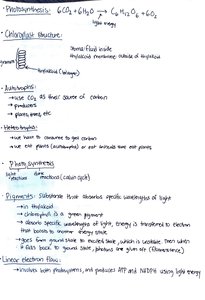
Chloroplast Structure
Chloroplasts are the site of photosynthesis in plant cells. - Stroma: Fluid matrix where the Calvin cycle occurs. - Thylakoid Membrane: Location of light-dependent reactions. - Grana: Stacks of thylakoids.
Light Reactions
Light reactions capture solar energy and convert it to chemical energy in the form of ATP and NADPH. - Occurs in: Thylakoid membranes - Inputs: Light, water, ADP, NADP+ - Outputs: Oxygen, ATP, NADPH - Photosystems: Complexes that absorb light and transfer electrons. 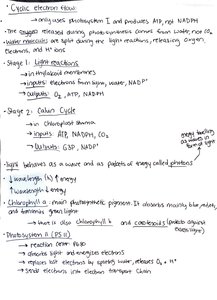
Calvin Cycle
The Calvin cycle uses ATP and NADPH to fix carbon dioxide and produce glucose. - Occurs in: Stroma of chloroplast - Inputs: CO2, ATP, NADPH - Outputs: Glucose, ADP, NADP+ - Key enzyme: Rubisco catalyzes the addition of CO2 to RuBP. 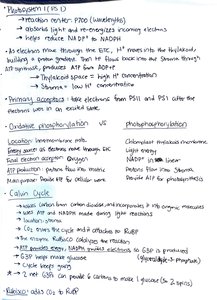
Pigments
Pigments absorb specific wavelengths of light, enabling photosynthesis. - Chlorophyll: Main pigment, absorbs blue and red light, reflects green. - Carotenoids: Accessory pigments, absorb additional wavelengths.
Electron Flow
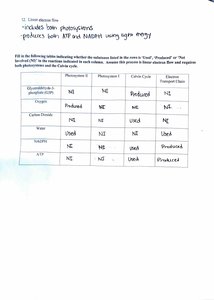
- Linear Electron Flow: Produces both ATP and NADPH using light energy. - Cyclic Electron Flow: Only uses Photosystem I, produces ATP but not NADPH.
Photorespiration
Photorespiration occurs when Rubisco incorporates O2 instead of CO2, reducing photosynthetic efficiency. - Minimization strategies: C4 and CAM plants have adaptations to minimize photorespiration. 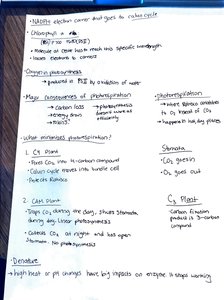
Summary Table: Photosynthesis Products and Reactants
Substance | Light Reactions | Calvin Cycle |
|---|---|---|
Oxygen | Produced | Not used |
Carbon Dioxide | Not used | Used |
ATP | Produced | Used |
NADPH | Produced | Used |
Glucose | Not produced | Produced |
Cellular Respiration
Overview of Cellular Respiration
Cellular respiration is the process by which cells extract energy from glucose, producing ATP, carbon dioxide, and water. - Equation: - Location: Cytoplasm and mitochondria 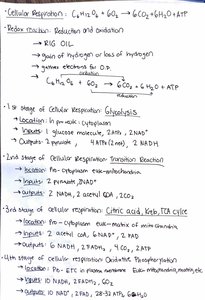
Stages of Cellular Respiration
1. Glycolysis: - Occurs in cytoplasm - Breaks down glucose into pyruvate - Produces 2 ATP, 2 NADH 2. Transition Reaction: - Converts pyruvate to acetyl-CoA - Produces NADH, CO2 3. Citric Acid Cycle (Krebs Cycle): - Occurs in mitochondrial matrix - Produces 2 ATP, 6 NADH, 2 FADH2, 4 CO2 4. Electron Transport Chain (ETC): - Occurs in inner mitochondrial membrane - Uses NADH and FADH2 to produce ATP - Oxygen is final electron acceptor 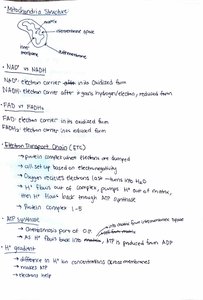
ATP Production
- Substrate-level phosphorylation: Direct transfer of phosphate to ADP - Oxidative phosphorylation: Uses ETC and chemiosmosis to produce ATP
Fermentation
Fermentation is an anaerobic process that allows glycolysis to continue in the absence of oxygen. - Types: Alcoholic (produces ethanol), Lactic acid (produces lactate)
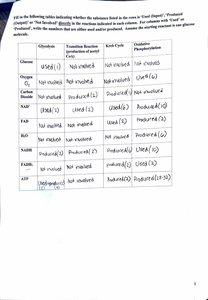
Summary Table: Cellular Respiration Products and Reactants
Substance | Glycolysis | Transition Reaction | Krebs Cycle | Oxidative Transport Chain |
|---|---|---|---|---|
Glucose | Used | Not involved | Not involved | Not involved |
Oxygen | Not involved | Not involved | Not involved | Used |
Carbon Dioxide | Not produced | Produced | Produced | Not produced |
ATP | Produced | Not produced | Produced | Produced |
NADH | Produced | Produced | Produced | Used |
FADH2 | Not produced | Not produced | Produced | Used |
Water | Not produced | Not produced | Not produced | Produced |
Metabolism and Energy
Catabolic and Anabolic Pathways
Metabolic pathways are classified as catabolic (breaking down molecules, releasing energy) or anabolic (building molecules, requiring energy). - Catabolic: Cellular respiration - Anabolic: Photosynthesis 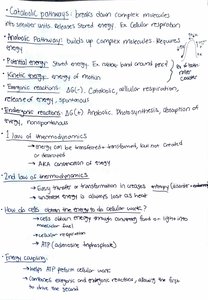
Energy Types and Laws
- Potential energy: Stored energy (e.g., chemical bonds) - Kinetic energy: Energy of motion - First Law of Thermodynamics: Energy cannot be created or destroyed - Second Law of Thermodynamics: Energy transformations increase entropy
Free Energy and Spontaneity
Free energy determines whether a reaction is spontaneous. - Gibbs Free Energy: - Negative indicates a spontaneous reaction 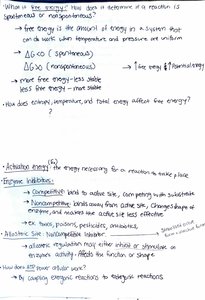
Enzymes and Catalysis
Enzymes are biological catalysts that lower activation energy, speeding up reactions. - Active site: Region where substrate binds - Enzyme inhibitors: Competitive (binds active site), Noncompetitive (binds elsewhere) - Factors affecting activity: Temperature, pH, substrate concentration 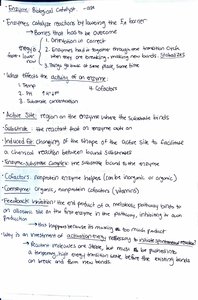
Energy Coupling
Cells couple exergonic and endergonic reactions to drive cellular processes, often using ATP as the energy currency.
Additional Info
- Photosystem I and II: Work together in light reactions to produce ATP and NADPH. - Primary electron acceptors: Accept electrons from excited chlorophyll molecules. - CAM and C4 plants: Adaptations to minimize water loss and photorespiration. - Denature: High heat or pH changes can denature enzymes, affecting their function. ----------------------------------------
