 뒤로
Lipids, Membranes, and Cell Compartments: Structure and Function
스터디 가이드 - 스마트 노트
 자료에 맞춘 맞춤형 노트, 핵심 정의, 예시, 맥락을 확장해 제공합니다.
Lipids: Structure and Types
Fatty Acids
Fatty acids are long hydrocarbon chains with a terminal carboxyl group. They are key building blocks of many lipids and are classified based on the presence or absence of double bonds in their hydrocarbon tails.
Saturated fatty acids: Contain no double bonds; all carbons are fully saturated with hydrogen atoms. These are typically solid at room temperature (e.g., butter, animal fat).
Unsaturated fatty acids: Contain one or more double bonds, causing kinks in the hydrocarbon chain. These are usually liquid at room temperature (e.g., olive oil, corn oil).
Hydrophobicity: Fatty acids are largely hydrophobic due to their long nonpolar hydrocarbon chains, but the carboxyl group is hydrophilic.

Triacylglycerols (Triglycerides)
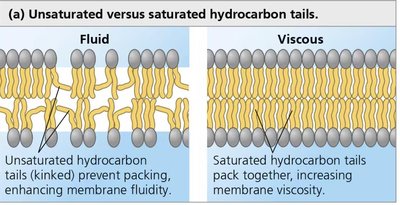
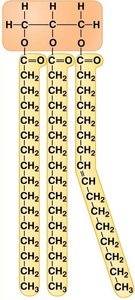
Triacylglycerols are the main form of energy storage in animals and plants. They are composed of one glycerol molecule esterified to three fatty acid chains.
Function: Serve as long-term energy storage molecules.
Structure: Glycerol backbone with three fatty acids attached via ester bonds.
Phospholipids
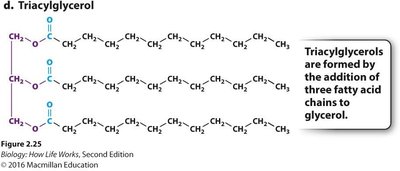
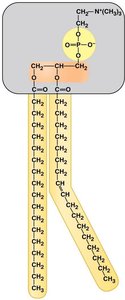
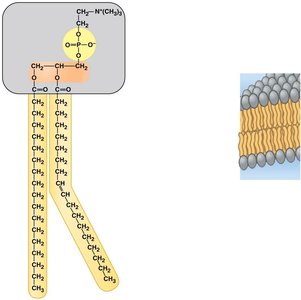
Phospholipids are amphipathic molecules, meaning they have both hydrophilic (polar) and hydrophobic (nonpolar) regions. They are the primary components of cellular membranes.
Structure: Glycerol backbone, two fatty acid tails (hydrophobic), and a phosphate group (hydrophilic) attached to the third carbon of glycerol.
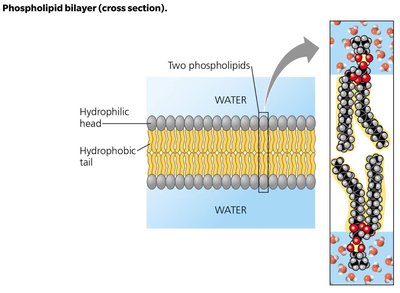
Amphipathic nature: Drives the formation of bilayers in aqueous environments, with hydrophobic tails facing inward and hydrophilic heads facing outward.
Membrane Structure and Properties
Phospholipid Bilayer
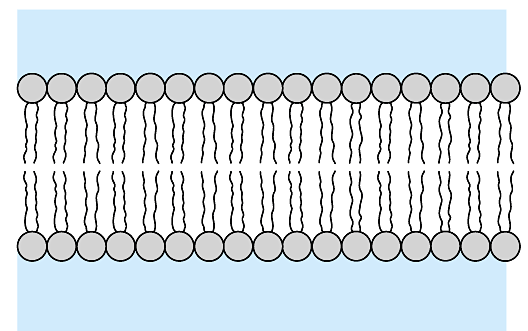
The cell membrane is primarily composed of a phospholipid bilayer, which forms spontaneously in water due to the amphipathic nature of phospholipids.
Hydrophilic heads: Face the aqueous environments inside and outside the cell.
Hydrophobic tails: Face inward, away from water, forming the membrane's core.
Fluid Mosaic Model
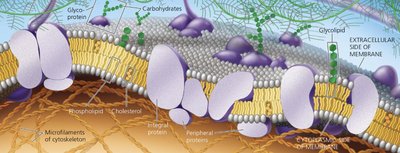
The fluid mosaic model describes the dynamic and heterogeneous nature of biological membranes. Lipids and proteins move laterally within the layer, and the membrane is a mosaic of different molecules.
Fluidity: Lipids and some proteins can move laterally; rarely, lipids flip-flop between layers (requires enzymes called flippases).
Mosaic: Membranes contain a variety of lipids, proteins, and carbohydrates.
Membrane Fluidity and Fatty Acid Composition
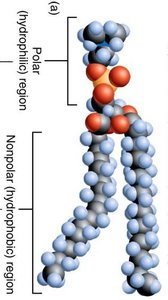
Membrane fluidity is influenced by the types of fatty acids present in phospholipids:
Unsaturated fatty acids: Kinked tails prevent tight packing, increasing fluidity.
Saturated fatty acids: Straight tails allow tight packing, making the membrane more viscous.
Membrane Function
Selective Permeability
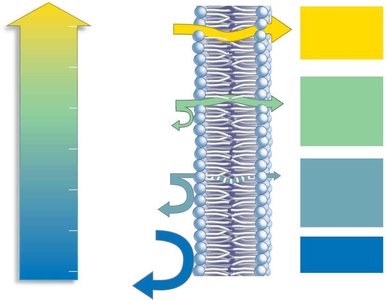
Biological membranes are selectively permeable, allowing some substances to cross more easily than others. This property is essential for maintaining cellular homeostasis.
High permeability: Small, nonpolar molecules (e.g., O2, CO2, N2).
Moderate permeability: Small, uncharged polar molecules (e.g., H2O, glycerol).
Low permeability: Large, uncharged polar molecules (e.g., glucose, sucrose).
Very low permeability: Ions (e.g., Na+, K+, Cl-).
Membrane Proteins
Proteins embedded in the membrane perform a variety of functions, including transport, signaling, enzymatic activity, and structural support.
Integral (transmembrane) proteins: Span the entire membrane and are involved in transport and signaling.
Peripheral proteins: Attached to the membrane surface, involved in signaling and maintaining cell shape.
Amphipathic nature: Many membrane proteins have both hydrophilic and hydrophobic regions, allowing them to interact with both the lipid bilayer and the aqueous environment.
Transport Across Membranes
Passive Transport
Passive transport does not require energy and relies on the concentration gradient.
Simple diffusion: Movement of small, nonpolar molecules directly through the lipid bilayer.
Facilitated diffusion: Movement of molecules via specific membrane proteins (channels or carriers) down their concentration gradient.
Osmosis: Diffusion of water across a semipermeable membrane.
Active Transport
Active transport requires energy (usually from ATP) to move substances against their concentration gradient.
Primary active transport: Direct use of ATP to transport molecules (e.g., Na+/K+ pump).
Secondary active transport (cotransport): Uses the energy stored in concentration gradients established by primary active transport to move other substances.
Endomembrane System
Components and Functions
The endomembrane system is a network of membranes within the cell that compartmentalizes functions and facilitates the synthesis, modification, and transport of proteins and lipids.
Includes: Endoplasmic reticulum (smooth and rough), Golgi apparatus, lysosomes, peroxisomes, vesicles, and the plasma membrane.
Protein synthesis and trafficking: Proteins destined for membranes or secretion are synthesized on ribosomes bound to the rough ER, processed in the Golgi, and transported to their final destinations.
Key Terms and Concepts
Amphipathic: Molecules with both hydrophilic and hydrophobic regions (e.g., phospholipids).
Bilayer: Double layer of phospholipids forming the basic structure of cell membranes.
Selective permeability: Property of membranes that allows some substances to cross more easily than others.
Fluid mosaic model: Describes the dynamic and heterogeneous nature of biological membranes.
Summary Table: Types of Lipids and Their Functions
Lipid Type | Structure | Main Function | Example |
|---|---|---|---|
Fatty Acid | Long hydrocarbon chain with carboxyl group | Building block for other lipids | Palmitic acid |
Triacylglycerol | Glycerol + 3 fatty acids | Energy storage | Animal fat, vegetable oil |
Phospholipid | Glycerol + 2 fatty acids + phosphate group | Membrane structure | Phosphatidylcholine |
Key Equations
Surface Area of a Sphere:
Volume of a Sphere:
Review Questions
Explain how the amphipathic nature of phospholipids leads to the formation of bilayers in water.
Describe the differences between saturated and unsaturated fatty acids and their effects on membrane fluidity.
What are the main functions of membrane proteins?
How does the endomembrane system contribute to protein processing and transport?
