 뒤로
Meiosis and the Sexual Life Cycle: Mechanisms, Stages, and Genetic Variation
스터디 가이드 - 스마트 노트
 자료에 맞춘 맞춤형 노트, 핵심 정의, 예시, 맥락을 확장해 제공합니다.
Chapter 13: Meiosis and Sexual Life Cycle
Big Idea
Meiosis is a specialized form of cell division that reduces the chromosome number by half, producing haploid cells in sexually reproducing organisms. This process is essential for maintaining chromosome number across generations and generating genetic diversity.
Concept 13.1: Offspring Acquire Genes from Parents by Inheriting Chromosomes
Inheritance and Heredity
Inheritance (Heredity): The transmission of traits from one generation to the next.
Genetics: The scientific study of heredity and variation among individuals.
Offspring inherit genes, which are segments of DNA located at specific loci on chromosomes, from their parents.
Variation among offspring arises due to the unique combination of genes inherited from both parents.
Genes, Chromosomes, and Gametes
Genes: Units of heredity made up of DNA.
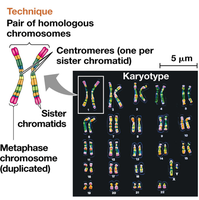
Chromosomes: Structures that organize and package DNA; humans have 46 chromosomes in somatic cells.
Gametes: Reproductive cells (sperm and eggs) that carry genes to the next generation.
Locus: The specific location of a gene on a chromosome.
Comparison of Asexual and Sexual Reproduction
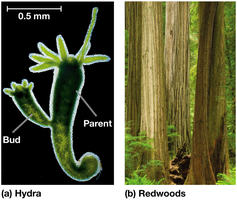
Asexual Reproduction: A single individual produces offspring genetically identical to itself (clones), without the fusion of gametes.
Sexual Reproduction: Two parents contribute genes to produce genetically unique offspring.
Concept 13.2: Fertilization and Meiosis Alternate in Sexual Life Cycles
Life Cycles and Chromosome Sets
Life Cycle: The sequence of stages in the reproductive history of an organism, from conception to production of offspring.
Somatic Cells: All body cells except gametes; diploid (2n) in humans with 46 chromosomes.
Homologous Chromosomes: Pairs of chromosomes with the same genes but possibly different alleles; one from each parent.
Autosomes: Non-sex chromosomes (22 pairs in humans).
Sex Chromosomes: X and Y chromosomes that determine sex (XX in females, XY in males).
Haploid and Diploid Cells
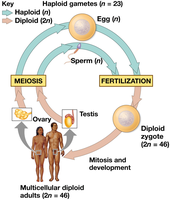
Diploid (2n): Cells with two sets of chromosomes (somatic cells).
Haploid (n): Cells with one set of chromosomes (gametes); n = 23 in humans.
Fertilization restores the diploid number by combining two haploid gametes to form a zygote.
Types of Sexual Life Cycles
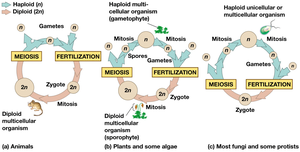
Animal Life Cycle: Gametes are the only haploid cells; fertilization produces a diploid zygote that divides by mitosis.
Alternation of Generations (Plants and Some Algae): Includes both multicellular diploid (sporophyte) and haploid (gametophyte) stages.
Fungi and Some Protists: The only diploid stage is the zygote; meiosis produces haploid cells that divide by mitosis.
Concept 13.3: Meiosis Reduces the Number of Chromosome Sets from Diploid to Haploid
Overview of Meiosis
Meiosis consists of two consecutive cell divisions: Meiosis I and Meiosis II.
Results in four haploid daughter cells, each genetically distinct from the parent cell and from each other.
Preceded by chromosome replication during interphase.
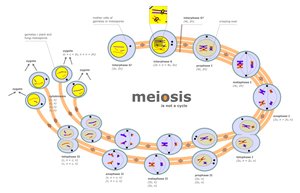
Phases of Meiosis
Meiosis I: Homologous chromosomes separate, reducing chromosome number by half.
Meiosis II: Sister chromatids separate, similar to mitosis.
Key Events Unique to Meiosis
Synapsis and crossing over during Prophase I
Alignment of homologous pairs at the metaphase plate during Metaphase I
Separation of homologs during Anaphase I
Comparison of Mitosis and Meiosis
Mitosis: Produces two genetically identical diploid cells; conserves chromosome number.
Meiosis: Produces four genetically unique haploid cells; reduces chromosome number by half.
Concept 13.4: Genetic Variation Produced in Sexual Life Cycles Contributes to Evolution
Sources of Genetic Variation
Mutations: The original source of genetic diversity; create new alleles.
Independent Assortment: Random orientation of homologous pairs during Metaphase I leads to many possible combinations of chromosomes in gametes.
Crossing Over: Exchange of genetic material between nonsister chromatids during Prophase I creates recombinant chromosomes.
Random Fertilization: Any sperm can fuse with any egg, further increasing genetic variation.
Mathematical Representation of Independent Assortment
The number of possible chromosome combinations due to independent assortment is given by:
where n is the haploid number. For humans, possible combinations.
Significance for Evolution
Genetic variation is essential for evolution by natural selection, as it provides the raw material for adaptation and speciation.
Key Terms and Definitions
Gene: A segment of DNA that codes for a protein or RNA molecule.
Allele: Different versions of a gene.
Homologous Chromosomes: Chromosome pairs, one from each parent, with genes for the same traits.
Sister Chromatids: Identical copies of a chromosome connected by a centromere after DNA replication.
Synapsis: Pairing of homologous chromosomes during Prophase I of meiosis.
Chiasmata: Sites where crossing over occurs between homologous chromosomes.
Zygote: The diploid cell formed by the fusion of two gametes.
