 뒤로
Membrane Structure and Function: Transport and Cell Signaling
스터디 가이드 - 스마트 노트
 자료에 맞춘 맞춤형 노트, 핵심 정의, 예시, 맥락을 확장해 제공합니다.
Membrane Structure and Function
Overview of Membrane Structure
The plasma membrane is a dynamic structure composed primarily of lipids and proteins. It acts as a selective barrier, regulating the movement of substances into and out of the cell, and facilitates communication with the environment.
Phospholipids are the most abundant lipids in the plasma membrane. They are amphipathic, containing both hydrophobic (water-repelling) and hydrophilic (water-attracting) regions.
The fluid mosaic model describes the membrane as a fluid structure with a "mosaic" of various proteins embedded in or attached to a bilayer of phospholipids.
Membrane Fluidity
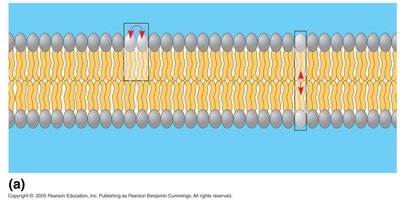
Membrane fluidity is essential for proper membrane function, allowing for the movement of proteins and lipids within the bilayer.
Phospholipids can move laterally within the layer, which occurs frequently, while "flip-flop" movement (from one leaflet to the other) is rare.
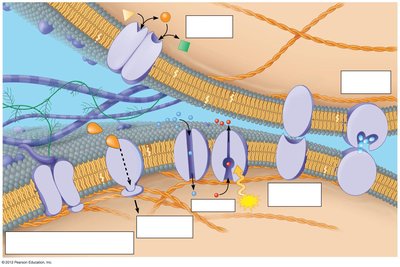
Functions of Membrane Proteins
Membrane proteins perform several critical functions:
Transport: Move substances across the membrane.
Enzymatic activity: Catalyze specific reactions at the membrane surface.
Attachment to the cytoskeleton and extracellular matrix (ECM): Maintain cell shape and stabilize protein location.
Cell-cell recognition: Allow cells to identify each other, important for immune response.
Intercellular joining: Form junctions between adjacent cells.
Signal transduction: Relay signals from the external environment to the cell's interior.
Membrane Transport Mechanisms
Passive Transport
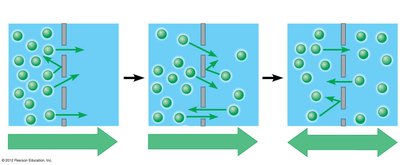
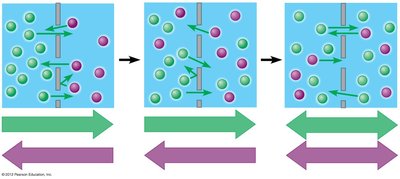
Passive transport is the movement of substances across the membrane without energy input from the cell. It occurs down the concentration gradient.
Diffusion: The net movement of molecules from an area of higher concentration to an area of lower concentration.
Facilitated diffusion: Transport proteins help specific molecules cross the membrane more efficiently.
Osmosis
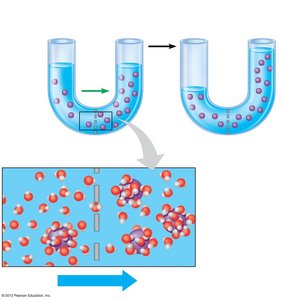
Osmosis is the diffusion of water across a selectively permeable membrane. Water moves from regions of low solute concentration to regions of high solute concentration.
The direction of osmosis is determined by the total solute concentration on either side of the membrane.
Tonicity and Water Balance
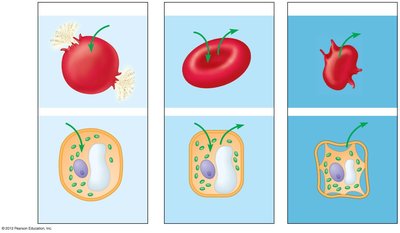
Tonicity describes the ability of a surrounding solution to cause a cell to gain or lose water.
Isotonic solution: Solute concentration is equal inside and outside the cell; no net water movement.
Hypertonic solution: Higher solute concentration outside the cell; cell loses water.
Hypotonic solution: Lower solute concentration outside the cell; cell gains water.
Plant cells have cell walls that help maintain water balance. In a hypotonic environment, plant cells become turgid (firm); in a hypertonic environment, they undergo plasmolysis (membrane pulls away from the wall).
Facilitated Diffusion
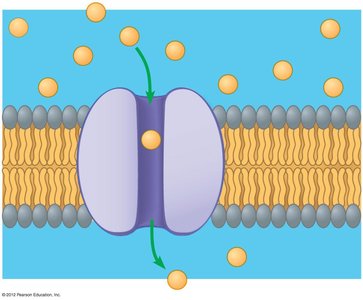
Facilitated diffusion uses transport proteins to move substances across the membrane without energy input.
Channel proteins and carrier proteins are two main types of transport proteins involved in facilitated diffusion.
Active Transport
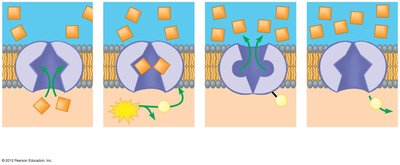
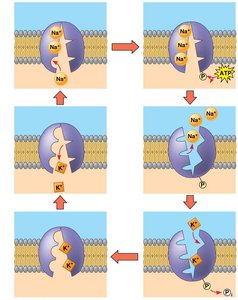
Active transport moves substances against their concentration gradient and requires energy, usually in the form of ATP.
Specific membrane proteins, such as pumps, carry out active transport.
The sodium-potassium pump (Na+/K+ pump) is a classic example, maintaining different concentrations of Na+ and K+ inside and outside animal cells.
Electrogenic Pumps
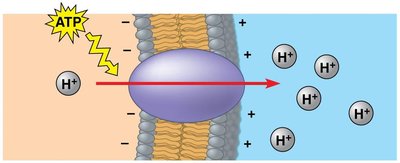
Electrogenic pumps are transport proteins that generate voltage across a membrane.
The Na+/K+ pump is the main electrogenic pump in animal cells.
In plants, fungi, and bacteria, the proton pump (H+ pump) is the primary electrogenic pump.
Bulk Transport: Endocytosis and Exocytosis
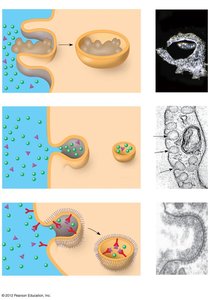
Large molecules, such as polysaccharides and proteins, cross the membrane via vesicles in processes called endocytosis and exocytosis.
Endocytosis: The cell takes in macromolecules by forming vesicles from the plasma membrane. Types include phagocytosis ("cell eating"), pinocytosis ("cell drinking"), and receptor-mediated endocytosis.
Exocytosis: Transport vesicles fuse with the plasma membrane, releasing their contents outside the cell. Many secretory cells use exocytosis to export products.
Cell Signaling and Signal Transduction
Types of Cell Signaling
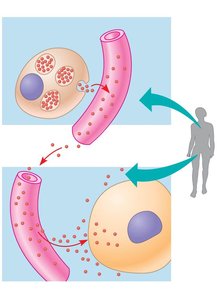
Cells communicate via chemical signals that can act locally or over long distances.
Local signaling: Includes direct contact and local regulators (e.g., neurotransmitters).
Long-distance signaling: Involves hormones traveling through the circulatory system.
Stages of Cell Signaling
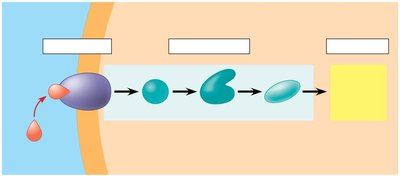
Cellular response to signals occurs in three main stages:
Reception: The target cell detects a signaling molecule that binds to a receptor protein on the cell surface.
Transduction: The binding of the signaling molecule alters the receptor and initiates a signal transduction pathway.
Response: The transduced signal triggers a specific cellular response.
Second Messengers and Signal Amplification
Many signal transduction pathways involve second messengers, such as cyclic AMP (cAMP), which amplify the signal within the cell.
Adenylyl cyclase is an enzyme that converts ATP to cAMP in response to an extracellular signal.
cAMP activates protein kinases, which phosphorylate target proteins to elicit a cellular response.
Regulation of Gene Expression
Many signaling pathways ultimately regulate gene expression by activating or inactivating transcription factors in the nucleus, thereby controlling the transcription of specific genes.
Additional info: The notes above integrate and expand upon the provided material, ensuring a comprehensive, self-contained study guide for college-level General Biology students.
