 뒤로
Membrane Transport and Cell Signaling: Study Notes for General Biology
스터디 가이드 - 스마트 노트
 자료에 맞춘 맞춤형 노트, 핵심 정의, 예시, 맥락을 확장해 제공합니다.
The Membrane
Active Transport and Membrane Potential
Active transport is a fundamental cellular process that uses energy to move solutes against their concentration gradients, allowing cells to maintain internal conditions distinct from their environment.
Active Transport: The movement of substances across a cell membrane against their concentration or electrochemical gradient, mediated by carrier proteins and requiring energy expenditure, usually from ATP hydrolysis.
Carrier Proteins: Transport proteins that move solutes against their gradient are carrier proteins, not channel proteins.
Membrane Potential: All cells have a voltage across their plasma membrane, typically ranging from -50 to -200 mV, with the cytoplasmic side being negative relative to the extracellular side.
Electrochemical Gradient: Ion diffusion is driven by both the concentration gradient (chemical force) and membrane potential (electrical force).
Electrogenic Pump: An active transport protein that generates voltage across a membrane while pumping ions. The main electrogenic pump in plants, fungi, and bacteria is the proton pump, which uses ATP to transport H+ ions out of the cell.
Example: The sodium-potassium pump in animal cells and the proton pump in plant cells are classic examples of electrogenic pumps. 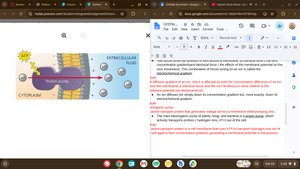
Cotransport
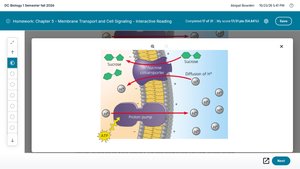
Cotransport is a mechanism where the "downhill" diffusion of one substance is coupled to the "uphill" transport of another against its gradient.
Cotransport: The coupling of the movement of one molecule down its gradient to the movement of another molecule up its gradient via a membrane protein.
Bulk Transport: Exocytosis and Endocytosis
Bulk transport allows cells to move large molecules or particles across the plasma membrane using vesicles, requiring energy.
Exocytosis: The process by which cells secrete biological molecules by the fusion of vesicles with the plasma membrane.
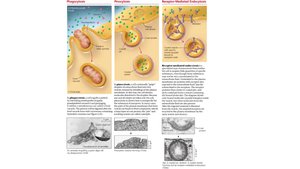
Endocytosis: The process by which cells take in molecules and particulate matter by forming new vesicles from the plasma membrane. Includes phagocytosis (cell eating) and pinocytosis (cell drinking).
Example: Secretion of neurotransmitters and uptake of nutrients by intestinal cells. 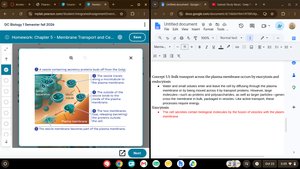
Cell Signaling
The Plasma Membrane in Cell Signaling
The plasma membrane is central to cell signaling, enabling communication between cells in multicellular organisms and coordinating cellular activities.
Local Signaling: Cells communicate by direct contact (gap junctions in animals, plasmodesmata in plants) or by local regulators that affect nearby cells.
Long-Distance Signaling: Hormones are secreted chemicals that travel through body fluids to target cells far from their origin.
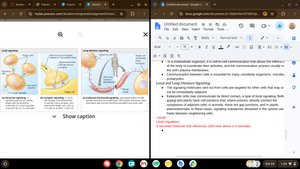
The Three Stages of Cell Signaling
Cell signaling involves three main stages: reception, transduction, and response.
Reception: The detection of a signaling molecule by a receptor protein, usually at the cell surface or inside the cell.
Transduction: Conversion of the signal into a form that can trigger a specific cellular response, often involving a signal transduction pathway with relay molecules.
Response: The activation of a specific cellular activity, such as enzyme catalysis, cytoskeleton rearrangement, or gene expression.
Example: The release of glucose from glycogen in response to hormonal signaling. 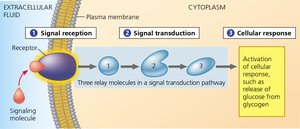
Reception: Binding of Signaling Molecules to Receptor Proteins
Reception depends on the presence of specific receptor proteins that bind signaling molecules (ligands), causing a change in shape and activation of the receptor.
Ligand: A molecule that specifically binds to another, usually larger, molecule (such as a receptor).
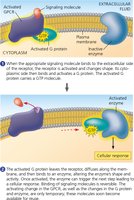
Transmembrane Receptors: Most water-soluble signaling molecules bind to receptors that span the plasma membrane, transmitting information from outside to inside the cell.
G Protein-Coupled Receptors (GPCRs): These receptors activate G proteins, which relay signals to other proteins inside the cell.
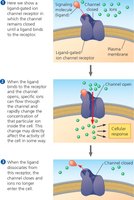
Ligand-Gated Ion Channels: Membrane receptors that open or close ion channels in response to ligand binding, allowing or blocking ion flow.
Receptors Inside the Cell
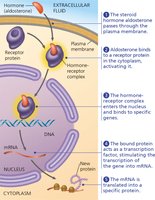
Some signaling molecules, such as steroid hormones, pass through the plasma membrane and bind to intracellular receptors, directly affecting gene expression.
Example: Aldosterone binds to a receptor protein inside the cell, activating genes that regulate sodium balance.
Key Vocabulary
Concentration Gradient: A region along which the density of a chemical substance increases or decreases.
Peripheral Proteins: Proteins loosely bound to the membrane surface or to integral proteins.
Membrane Potential: The voltage across a cell’s plasma membrane due to ion distribution.
Amphipathic: Having both hydrophilic and hydrophobic regions.
Phagocytosis: Endocytosis of large particles or organisms.
Facilitated Diffusion: Passive transport of molecules down their gradient via transport proteins.
Glycolipids: Lipids with covalently attached carbohydrates.
Phosphorylation Cascade: Series of reactions in cell signaling mediated by kinases.
Pinocytosis: Endocytosis of extracellular fluid and solutes.
Isotonic: Solution causing no net water movement in or out of a cell.
Protein Kinase: Enzyme transferring phosphate from ATP to a protein.
Integral Proteins: Transmembrane proteins with hydrophobic and hydrophilic regions.
Signal Transduction Pathway: Steps linking a stimulus to a cellular response.
Formulas and Equations
Membrane Potential:
Electrochemical Gradient: Where is the free energy change, is the gas constant, is temperature, and are internal and external concentrations, is ion charge, is Faraday's constant, and is membrane potential.
Summary Table: Types of Membrane Transport
Type | Energy Required? | Direction | Example |
|---|---|---|---|
Facilitated Diffusion | No | Down gradient | Glucose transport |
Active Transport | Yes (ATP) | Against gradient | Proton pump |
Bulk Transport | Yes | Variable | Exocytosis, Endocytosis |
Summary Table: Types of Cell Signaling
Type | Distance | Example |
|---|---|---|
Local | Adjacent cells | Gap junctions |
Long-Distance | Far cells | Hormones |
Summary Table: Types of Receptors
Type | Location | Ligand Type | Example |
|---|---|---|---|
GPCR | Plasma membrane | Water-soluble | Adrenaline receptor |
Ligand-Gated Ion Channel | Plasma membrane | Ion | Acetylcholine receptor |
Intracellular | Cytoplasm/Nucleus | Lipid-soluble | Steroid hormone receptor |
