 뒤로
Mendelian Genetics and Extensions: Principles of Heredity
스터디 가이드 - 스마트 노트
 자료에 맞춘 맞춤형 노트, 핵심 정의, 예시, 맥락을 확장해 제공합니다.
Chapter 14: Mendel and the Gene Idea
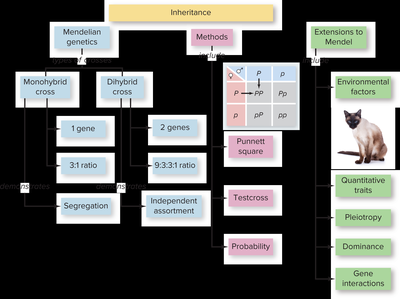
Introduction to Mendelian Genetics
Mendel's experiments with pea plants established the fundamental principles of heredity, which are the basis for modern genetics. His work revealed how traits are transmitted from parents to offspring and led to the formulation of two key laws: the law of segregation and the law of independent assortment.
Heredity: The transmission of traits from one generation to the next.
Character: A heritable feature that varies among individuals (e.g., flower color).
Trait: Each variant for a character (e.g., purple or white flowers).
Mendel’s Experimental Approach
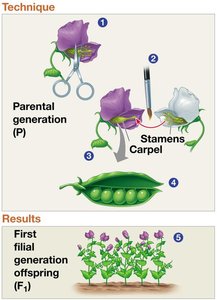
Mendel used garden peas for his experiments due to their short generation time, large number of offspring, and the ability to control mating. He started with true-breeding varieties and performed hybridization experiments.
True-breeding: Plants that produce offspring of the same variety when self-pollinated.
Hybridization: Mating two contrasting, true-breeding varieties.
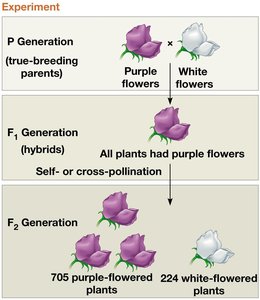
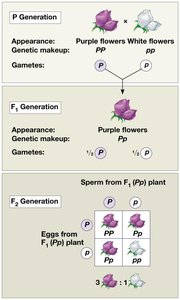
P generation: True-breeding parents.
F1 generation: Hybrid offspring of the P generation.
F2 generation: Offspring from self- or cross-pollination of F1 hybrids.
Mendel’s Laws of Inheritance
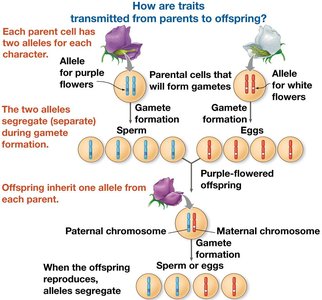
Mendel formulated two laws based on his experiments: the law of segregation and the law of independent assortment. These laws explain how alleles are distributed during gamete formation and how traits are inherited.
Law of Segregation: Two alleles for a gene segregate during gamete formation and reunite at random during fertilization.
Law of Independent Assortment: Genes for different traits can segregate independently during the formation of gametes.
Evidence for the Law of Segregation
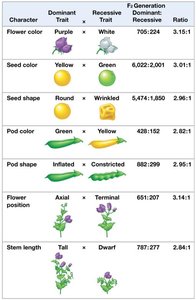
Mendel observed a 3:1 ratio of dominant to recessive traits in the F2 generation, which contradicted the blending theory of inheritance. This led him to deduce the law of segregation.
Dominant traits mask the expression of recessive traits in heterozygotes.
Recessive traits reappear in the F2 generation, indicating that they are not lost.
Genetic Vocabulary
Understanding key genetic terms is essential for interpreting Mendelian experiments.
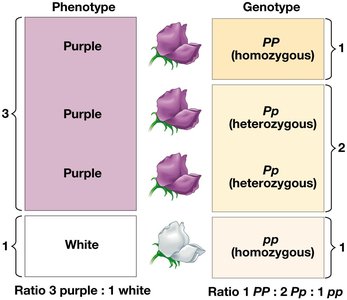
Homozygous: Two identical alleles for a gene (e.g., PP or pp).
Heterozygous: Two different alleles for a gene (e.g., Pp).
Genotype: Genetic makeup of an organism.
Phenotype: Physical appearance of an organism.
Punnett Squares and Testcrosses
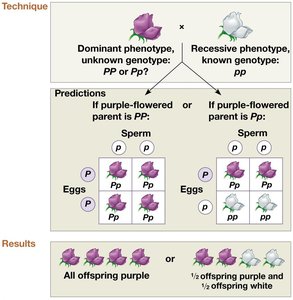
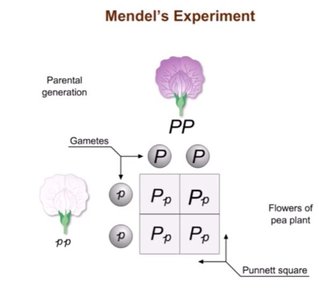
Punnett squares are used to predict the genotypic and phenotypic ratios of offspring from genetic crosses. Testcrosses help determine the genotype of an individual with a dominant phenotype.
Punnett squares show all possible combinations of alleles from parental gametes.
Testcross: Breeding a dominant phenotype individual with a homozygous recessive to reveal genotype.
Extensions to Mendelian Genetics
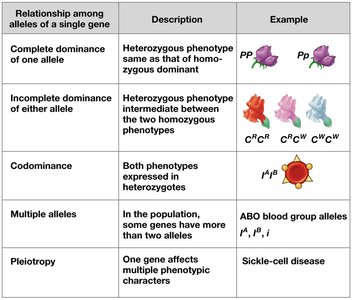
Inheritance patterns can be more complex than simple Mendelian genetics. These include complete dominance, incomplete dominance, codominance, multiple alleles, pleiotropy, epistasis, and polygenic inheritance.
Complete dominance: Heterozygote phenotype is identical to homozygous dominant.
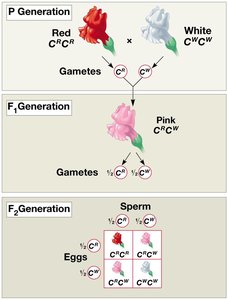
Incomplete dominance: Heterozygote phenotype is intermediate between two homozygotes.
Codominance: Both alleles are fully expressed in heterozygotes.
Multiple alleles: More than two alleles exist for a gene in a population.
Pleiotropy: One gene affects multiple phenotypic characters.
Epistasis: One gene affects the expression of another gene.
Polygenic inheritance: Multiple genes independently affect a single trait.
ABO Blood Groups: Codominance and Multiple Alleles
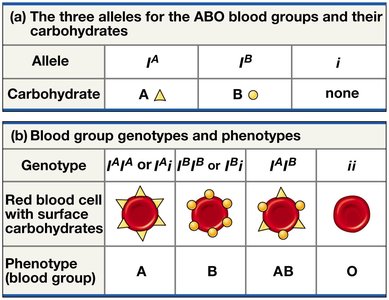
The ABO blood group system in humans is determined by three alleles and exhibits codominance. The IA and IB alleles are both expressed in individuals with AB blood type.
Genotypes: IAIA or IAi (type A), IBIB or IBi (type B), IAIB (type AB), ii (type O).
Phenotypes: A, B, AB, O.
Allele | Carbohydrate |
|---|---|
IA | A |
IB | B |
i | none |
Genotype | Phenotype |
|---|---|
IAIA, IAi | A |
IBIB, IBi | B |
IAIB | AB |
ii | O |
Pleiotropy and Human Genetic Disorders
Pleiotropy occurs when a single gene influences multiple phenotypic traits. Many genetic disorders, such as cystic fibrosis and sickle-cell disease, are examples of pleiotropy.
Cystic fibrosis: A recessive disorder affecting chloride transport, leading to multiple symptoms.
Sickle-cell disease: A recessive disorder affecting hemoglobin, causing various health issues and providing resistance to malaria in heterozygotes.
Pedigree Analysis and Human Inheritance
Pedigrees are family trees used to analyze the inheritance of traits across generations. They help predict the probability of inheriting specific traits and identify carriers of genetic disorders.
Pedigree: Diagram showing the inheritance of a trait in a family.
Carriers: Heterozygous individuals who carry a recessive allele but are phenotypically normal.
Pedigrees can reveal autosomal dominant, autosomal recessive, and sex-linked inheritance patterns.
Genetic Testing and Counseling
Genetic testing can identify carriers of genetic disorders and help prospective parents assess the risk of having affected children. Fetal testing methods include amniocentesis and chorionic villus sampling.
Amniocentesis: Testing fetal cells from amniotic fluid for genetic disorders.
Chorionic villus sampling (CVS): Testing placental cells for genetic disorders.
Ultrasound: Visual assessment of fetal health.
Summary Table: Mendelian and Extended Inheritance Patterns
Pattern | Description | Example |
|---|---|---|
Complete dominance | Heterozygote phenotype same as homozygous dominant | Purple flower color in peas |
Incomplete dominance | Heterozygote phenotype intermediate | Pink snapdragon flowers |
Codominance | Both phenotypes expressed in heterozygotes | ABO blood group |
Multiple alleles | More than two alleles in population | ABO blood group alleles |
Pleiotropy | One gene affects multiple traits | Sickle-cell disease |
Additional info: The notes include expanded explanations, definitions, and examples to ensure completeness and academic quality for exam preparation.
