 뒤로
Mendelian Genetics and Patterns of Inheritance: Study Guide
스터디 가이드 - 스마트 노트
 자료에 맞춘 맞춤형 노트, 핵심 정의, 예시, 맥락을 확장해 제공합니다.
Mendelian Genetics and Patterns of Inheritance
Introduction to Mendelian Genetics
Mendelian genetics forms the foundation of classical genetics, describing how traits are inherited from one generation to the next. Gregor Mendel's experiments with pea plants revealed the basic principles of heredity, including the concepts of genes, alleles, dominance, and segregation.
PART 1 · MENDEL’S APPROACH
Blending vs. Particulate Inheritance
Early theories of inheritance included the blending hypothesis, which suggested that parental traits mix in offspring, and the particulate hypothesis, which proposed that parents pass on discrete units (genes) that retain their identity across generations. Mendel's experiments supported the particulate model.
Blending hypothesis: Traits mix like paint; offspring are intermediate.
Particulate hypothesis: Traits are inherited as distinct units (genes).
Mendel’s experiments: Used garden peas for controlled crosses and observed inheritance patterns.
Mendel’s Experimental Approach
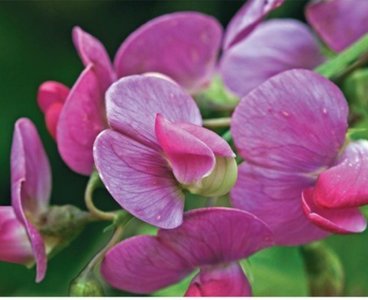
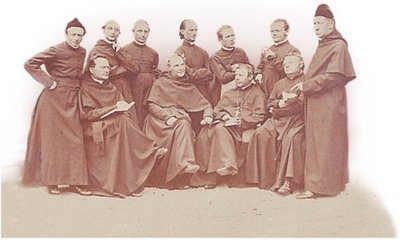
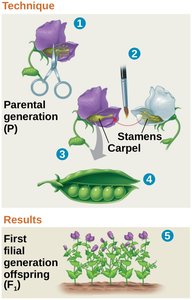
Mendel chose pea plants for their short generation time, many offspring, and ability to self- or cross-pollinate. He distinguished between characters (heritable features) and traits (variants of characters), and used true-breeding plants for his crosses.
Character: Heritable feature (e.g., flower color).
Trait: Variant of a character (e.g., purple or white flowers).
True-breeding: Plants that produce only their own variety when self-pollinated.
Hybridization: Crossing two contrasting true-breeding varieties.
P generation: True-breeding parents.
F1 generation: Hybrid offspring.
F2 generation: Offspring of F1 × F1.
The F2 Generation: 3:1 Ratio
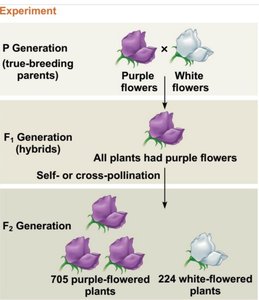
Mendel observed that crossing purple and white true-breeding pea plants produced all purple F1 offspring. Self-pollinating F1 plants yielded F2 offspring in a 3:1 ratio of purple to white, demonstrating dominance and recessiveness.
Dominant trait: Purple flowers.
Recessive trait: White flowers.
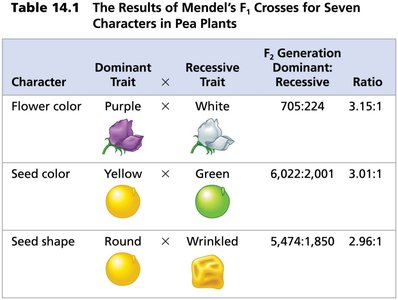
Ratio: 705 purple : 224 white (approx. 3:1).
Gene: Mendel’s “factor” is now called a gene.
Mendel’s Seven Characters
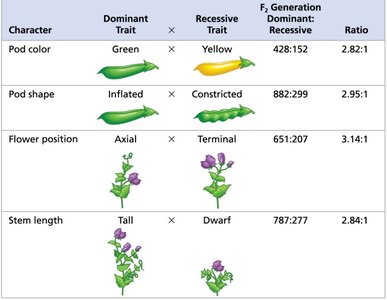
Mendel studied seven characters in pea plants, each showing a similar dominant:recessive ratio in the F2 generation.
Character | Dominant Trait | Recessive Trait | F2 Ratio |
|---|---|---|---|
Flower color | Purple | White | 3.15:1 |
Seed color | Yellow | Green | 3.01:1 |
Seed shape | Round | Wrinkled | 2.96:1 |
Pod color | Green | Yellow | 2.82:1 |
Pod shape | Inflated | Constricted | 2.95:1 |
Flower position | Axial | Terminal | 3.14:1 |
Stem length | Tall | Dwarf | 2.84:1 |
PART 2 · SEGREGATION AND VOCABULARY
Mendel’s Model: Four Concepts
Mendel’s model of inheritance is based on four key concepts:
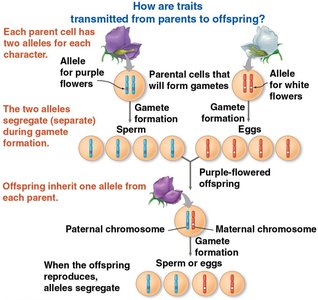
Alleles: Alternative versions of a gene account for variation in inherited characters.
Inheritance: Each organism inherits two alleles, one from each parent.
Dominance: If alleles differ, the dominant allele determines appearance.
Law of Segregation: The two alleles separate during gamete formation; each gamete gets one allele.
Alleles and Locus
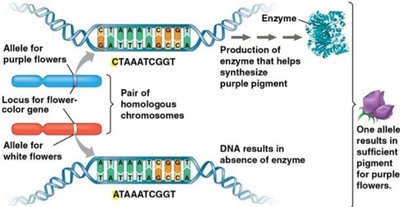
Each gene is located at a specific locus on a chromosome. Homologous chromosomes carry the same gene at the same locus, but may have different alleles.
Allele for purple flowers: Produces a functional pigment enzyme.
Allele for white flowers: DNA differs, no enzyme produced.
Genetic Vocabulary
Term | Meaning | Example |
|---|---|---|
Gene | Heritable unit at a specific locus | Flower-color gene |
Allele | Alternative version of a gene | P (purple), p (white) |
Dominant | Sets phenotype when present | P |
Recessive | No visible effect unless two copies | p |
Homozygous | Two identical alleles | PP or pp |
Heterozygous | Two different alleles | Pp |
Genotype | Genetic makeup | PP, Pp, or pp |
Phenotype | Observable traits | Purple or white |
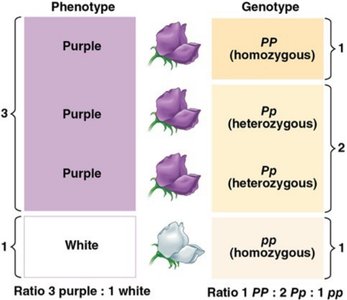
Phenotype vs. Genotype
Phenotype is the observable trait, while genotype is the genetic makeup. Different genotypes can produce the same phenotype.
Phenotype ratio: 3 purple : 1 white
Genotype ratio: 1 PP : 2 Pp : 1 pp
PART 3 · THE LAW OF SEGREGATION IN A PUNNETT SQUARE
Punnett Squares and Segregation
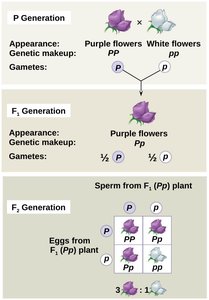
Punnett squares are used to predict the outcome of genetic crosses. The law of segregation explains the 3:1 ratio observed in the F2 generation.
P generation: PP × pp
F1 generation: All Pp
F2 generation: ¼ PP, ½ Pp, ¼ pp
Reading a Punnett Square
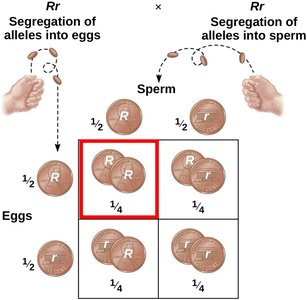
Each parent’s gametes are listed along the top and side. Offspring genotypes are calculated by combining alleles from each parent.
Gamete frequency: Heterozygote (Pp) makes P and p equally (½ each).
Genotype ratio: ¼ PP : ½ Pp : ¼ pp
Phenotype ratio: ¾ purple : ¼ white
Probability Rules
Multiplication rule: Probability of two independent events occurring together: multiply probabilities.
Addition rule: Probability of one outcome reached in different ways: add probabilities.
Testcross
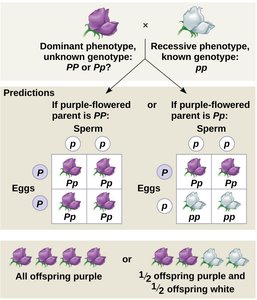
A testcross determines whether an individual with a dominant phenotype is homozygous or heterozygous by crossing it with a homozygous recessive individual.
All offspring purple: Parent is PP.
Half purple, half white: Parent is Pp.
PART 4 · DIHYBRID AND MULTIHYBRID CROSSES
Dihybrid Crosses and Independent Assortment
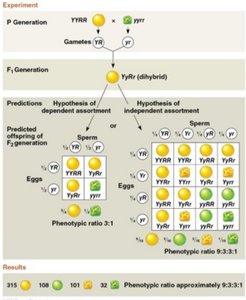
Dihybrid crosses involve two genes and test whether they are inherited together or independently. Mendel’s law of independent assortment states that alleles of different genes segregate independently during gamete formation.
Example: YYRR × yyrr → F1: YyRr
F2 ratio: 9:3:3:1 (independent assortment)
FOIL Method for Gametes
The FOIL (First, Outer, Inner, Last) method is used to determine all possible gamete combinations for individuals heterozygous for multiple genes.
Number of gamete types: where n = number of heterozygous genes.
Multihybrid Crosses
For crosses involving three or more genes, calculate each gene separately and multiply probabilities.
Example: AaBbCc × AaBbCc
Probability of aabbcc:
Probability of AaBbCc:
PART 5 · EXTENSIONS OF MENDELIAN GENETICS
Patterns of Inheritance
Pattern | Description | Example |
|---|---|---|
Complete dominance | Heterozygote looks like dominant homozygote | Pea flowers: PP, Pp purple |
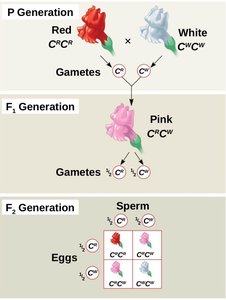
Incomplete dominance | Heterozygote is intermediate | Red × white → pink |
Codominance | Heterozygote shows both alleles separately | Blood type AB |
Multiple alleles | More than two alleles exist | ABO blood types |
Pleiotropy | One gene affects several traits | Sickle-cell disease |
Epistasis | One gene changes how another is expressed | Lab coat color |
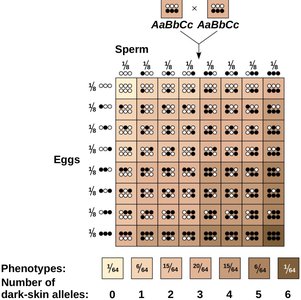
Polygenic | Several genes add up to affect one trait | Height, skin color |
Incomplete Dominance
In incomplete dominance, the heterozygote phenotype is intermediate between the two homozygotes. For example, crossing red and white snapdragons produces pink flowers.
Codominance and Multiple Alleles: ABO Blood Types
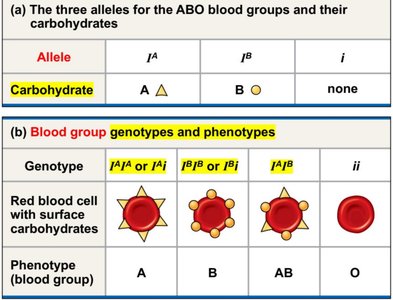
Codominance occurs when both alleles are fully expressed in the heterozygote. The ABO blood group system is an example, with three alleles (IA, IB, i) and codominant expression of IA and IB.
Allele | Carbohydrate |
|---|---|
IA | A |
IB | B |
i | None |
Genotype | Phenotype |
IAIA or IAi | A |
IBIB or IBi | B |
IAIB | AB |
ii | O |
Pleiotropy
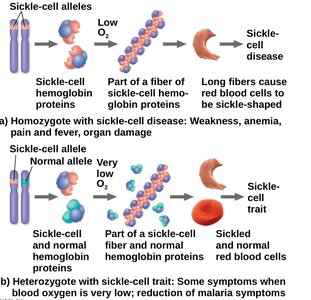
Pleiotropy occurs when one gene affects multiple traits. Sickle-cell disease is an example, where a single amino acid change in hemoglobin leads to multiple symptoms.
Epistasis
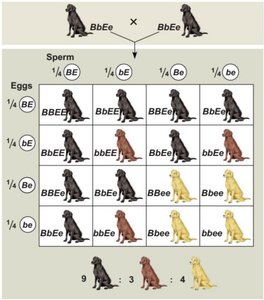
Epistasis is when the expression of one gene alters the expression of another gene. Labrador retriever coat color is determined by two genes: one for pigment color and one for pigment deposition.
Polygenic Inheritance
Polygenic inheritance involves multiple genes contributing additively to a single trait, such as human height or skin color. The result is a continuous variation in phenotype.
PART 6 · PEDIGREE ANALYSIS AND HUMAN GENETIC DISORDERS
Pedigree Analysis
Pedigrees are family trees used to study inheritance patterns in humans. They help determine whether traits are dominant or recessive and predict the probability of future offspring inheriting a trait.
Square: Male
Circle: Female
Filled: Affected
Open: Unaffected
Horizontal line: Mating
Vertical line: Offspring
Roman numerals: Generations
Recessively Inherited Disorders
Recessive disorders appear only in individuals homozygous for the allele. Carriers are heterozygous and phenotypically normal. Examples include albinism, cystic fibrosis, and sickle-cell disease.
Cystic fibrosis: Defective chloride channels, mucus buildup.
Sickle-cell disease: Hemoglobin mutation, heterozygote advantage against malaria.
Dominantly Inherited Disorders
Dominant disorders require only one copy of the allele to be expressed. Examples include achondroplasia (dwarfism).
Achondroplasia: Dd × dd → ½ dwarf : ½ normal
Summary
Mendelian genetics explains inheritance patterns using genes, alleles, dominance, and segregation.
Punnett squares and probability rules predict genotype and phenotype ratios.
Extensions include incomplete dominance, codominance, multiple alleles, pleiotropy, epistasis, and polygenic inheritance.
Pedigree analysis is used to study human inheritance and genetic disorders.
