 뒤로
Patterns in the Distribution of Organisms: Biomes, Biogeography, and Island Theory
스터디 가이드 - 스마트 노트
 자료에 맞춘 맞춤형 노트, 핵심 정의, 예시, 맥락을 확장해 제공합니다.
Patterns in the Distribution of Organisms Across Space
Climate Patterns and Their Influence
Climate patterns, including seasonality, precipitation, temperature, ocean currents, and geological features, are fundamental in determining the distribution of organisms globally. These abiotic factors interact to create distinct environments that support specific communities of plants and animals.
Seasonality: Refers to the regular changes in climate throughout the year, affecting temperature and precipitation.
Precipitation: The amount and timing of rainfall influence water availability and ecosystem productivity.
Temperature: Determines metabolic rates and survival limits for organisms.
Ocean Currents: Affect coastal climates and nutrient distribution.
Geological Features: Mountains, valleys, and other landforms create barriers and microclimates.
Abiotic and Biotic Factors in Species Distribution
The occurrence of species is shaped by both abiotic (non-living) and biotic (living) factors, past and present. Analytical approaches use current data to predict future distributions, considering these interactions.
Abiotic Factors: Sunlight, temperature, soil, water, and disturbance events.
Biotic Factors: Competition, predation, mutualism, and historical interactions.
Biomes: Major Terrestrial Ecosystems
Definition and Classification
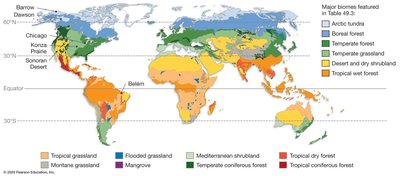
Biomes are major groupings of plant and animal communities, defined by dominant vegetation and distinctive abiotic conditions. The average annual temperature and precipitation, along with their variation, determine biome types.
Dominant Vegetation: Determines the structure and function of the biome.
Abiotic Conditions: Average and variation in temperature and precipitation.
Tropical Wet Forests (Rain Forests)
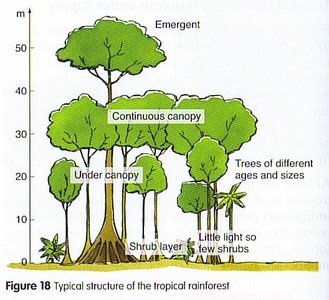
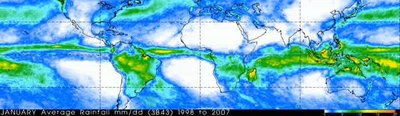
Tropical wet forests occur globally around the equator. They are characterized by consistently warm temperatures and high, but seasonally variable, precipitation due to shifting wind patterns in the Intertropical Convergence Zone (ITCZ).
Temperature: Always warm, not highly seasonal.
Precipitation: Always wet, but with wet and dry-ish seasons.
Structure: Emergent trees, continuous canopy, under canopy, shrub layer.
Temperate Grasslands and Boreal Forests
Temperate grasslands are found in continental interiors with moderate seasonality, temperature, and precipitation. Boreal forests are located at higher latitudes (~60 degrees) where it is cold and wet.
Temperate Grasslands: Moderate climate, found between 30-60 degrees latitude.
Boreal Forests: Cold, wet environments, typically at higher latitudes.

Featured Terrestrial Biomes
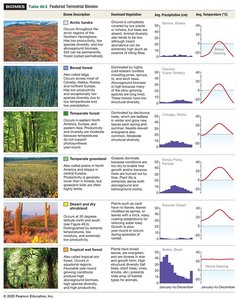
Biomes can be compared based on dominant vegetation, average precipitation, and average temperature.
Biome | Dominant Vegetation | Avg Precipitation | Avg Temperature |
|---|---|---|---|
Arctic Tundra | Low shrubs, mosses | Low | Very cold |
Boreal Forest | Coniferous trees | Moderate | Cold |
Temperate Forest | Deciduous trees | Moderate-high | Moderate |
Temperate Grassland | Grasses | Moderate | Moderate |
Desert | Sparse vegetation | Very low | Hot |
Tropical Wet Forest | Broadleaf trees | High | Warm |
Biogeographic Regions
Definition and Barriers
Biogeographic regions are areas within which organisms have evolved in relative isolation, separated by geographic features such as oceans, deserts, and mountain ranges. These barriers limit migration and lead to unique assemblages of species.
Barriers: Oceans, deserts, mountain ranges.
Isolation: Promotes speciation and distinct regional biotas.
Island Biogeography
Theory of Island Biogeography (MacArthur and Wilson)
The Theory of Island Biogeography explains species richness on islands as a balance between immigration and extinction rates. The equilibrium number of species is where these rates intersect, and is influenced by island size and distance from the source population.
Immigration: Arrival of new species decreases as the number of species increases.
Extinction: Loss of species increases as the number of species increases.
Equilibrium: Predicted number of species where immigration and extinction rates are equal.
Island Size: Larger islands support more species due to more habitats and lower extinction rates.
Distance from Source: Islands closer to the mainland have higher immigration rates and lower extinction.
Factor | Effect on Species Number |
|---|---|
Large Island | More species, lower extinction |
Small Island | Fewer species, higher extinction |
Nearshore Island | More species, higher immigration |
Remote Island | Fewer species, lower immigration |
Applications and Generalization
The theory is generalizable to any defined habitat area, not just islands, and helps explain patterns of species richness in fragmented landscapes.
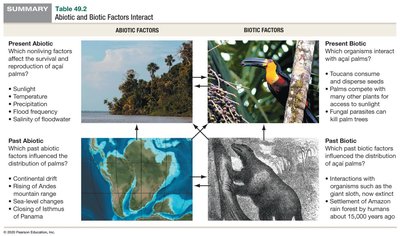
Abiotic and Biotic Factors: Case Study of Acai Palm Trees
Interactions Influencing Distribution
The distribution of acai palm trees is determined by both present and past abiotic and biotic factors. Abiotic factors include sunlight, temperature, flood frequency, and soil recovery. Biotic factors include interactions with animals (e.g., toucans dispersing seeds) and historical events (e.g., extinction of large mammals).
Factor | Present | Past |
|---|---|---|
Abiotic | Sunlight, temperature, flood frequency, soil recovery | Rising and falling continents, sea level changes, closing of Panama |
Biotic | Toucans, competition for sunlight, fungal parasites | Extinction of large mammals, historical dispersal |
Biogeography: The Study of Species Distribution
Geographic Patterns in Species Richness
Biogeography examines how species and populations are distributed geographically and through geologic time. It considers both historical and current interactions between biology and geography, including habitat area, latitude, and connections.
Species Richness: Varies with latitude, habitat size, and connectivity.
Historical Interactions: Past events shape current distributions.
Summary
Understanding the distribution and abundance of species requires integrating knowledge of climate patterns, biomes, biogeographic regions, and the principles of island biogeography. Both abiotic and biotic factors, past and present, play critical roles in shaping ecological communities.
