 뒤로
Photosynthesis and Cellular Respiration: Structure, Function, and Mechanisms
스터디 가이드 - 스마트 노트
 자료에 맞춘 맞춤형 노트, 핵심 정의, 예시, 맥락을 확장해 제공합니다.
Photosynthesis
Overview and Importance
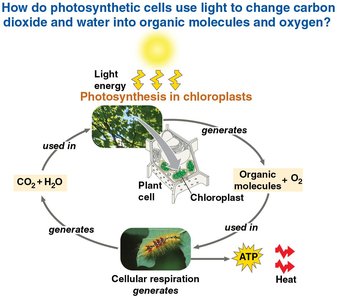
Photosynthesis is the fundamental process by which autotrophic organisms, such as plants, algae, and some bacteria, convert solar energy into chemical energy. This process sustains nearly all life on Earth by providing organic molecules and oxygen. - Autotrophs are organisms that produce their own food from inorganic substances. - Photoautotrophs use sunlight to synthesize organic compounds. - Heterotrophs rely on consuming other organisms for energy. 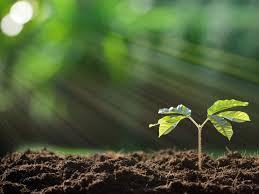
Structure of Chloroplasts
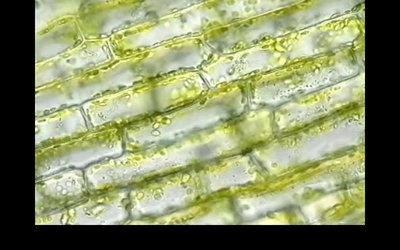
Chloroplasts are the organelles where photosynthesis occurs in plants. Their structure is specialized to facilitate the conversion of light energy into chemical energy. - Chloroplasts are mainly found in the mesophyll cells of leaves. - They have a double membrane and contain a dense fluid called the stroma. - Thylakoids are membrane-bound sacs arranged in stacks called grana. - Chlorophyll is the pigment responsible for capturing light energy. 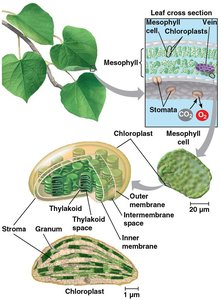
Photosynthesis Equation and Redox Process
The overall chemical reaction for photosynthesis is: - Photosynthesis is a redox process: water is oxidized, and carbon dioxide is reduced. - The direction of electron flow is reversed compared to cellular respiration. 
Stages of Photosynthesis
Photosynthesis consists of two main stages: Light Reactions and the Calvin Cycle. Light Reactions (occur in thylakoids): - Split water, releasing O2 - Reduce NADP+ to NADPH - Generate ATP by photophosphorylation Calvin Cycle (occurs in stroma): - Fixes CO2 into organic molecules - Uses ATP and NADPH to produce sugars 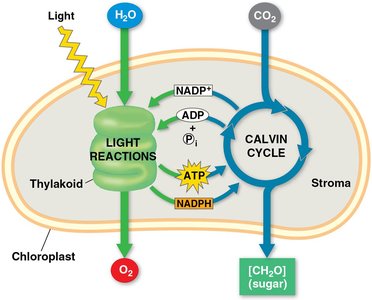
The Light Reactions
Nature of Sunlight and Pigments
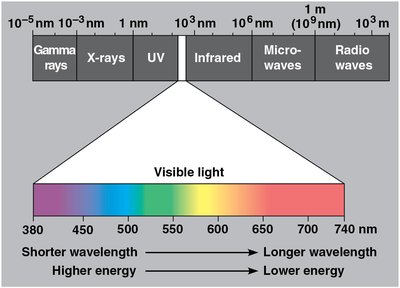
Light is electromagnetic radiation, and its energy is determined by wavelength. - Visible light (380–740 nm) is used in photosynthesis. - Pigments absorb specific wavelengths; chlorophyll absorbs violet-blue and red, reflecting green. 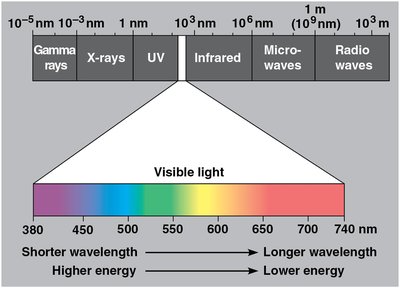
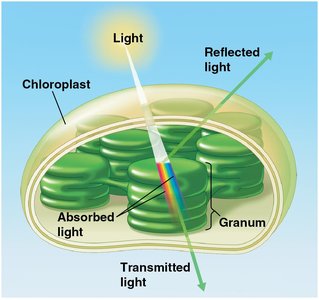
Photosynthetic Pigments
- Chlorophyll a: main pigment for light reactions - Chlorophyll b: accessory pigment, broadens absorption spectrum - Carotenoids: accessory pigments, absorb violet and blue-green light, provide photoprotection
Photosystems and Electron Flow
Photosystems are complexes that capture light energy and initiate electron transfer. - Photosystem II (PS II): absorbs 680 nm, splits water, initiates electron flow - Photosystem I (PS I): absorbs 700 nm, produces NADPH - Linear electron flow: produces ATP and NADPH - Cyclic electron flow: produces ATP only
Chemiosmosis and ATP Synthesis
- Both chloroplasts and mitochondria use chemiosmosis to generate ATP. - Electron transport chains create a proton gradient, driving ATP synthase. - In chloroplasts, protons are pumped into the thylakoid space; ATP and NADPH are produced in the stroma.
The Calvin Cycle
Phases of the Calvin Cycle
The Calvin cycle uses ATP and NADPH to convert CO2 into sugar. It has three phases: 1. Carbon Fixation: CO2 binds to RuBP, catalyzed by rubisco, forming 3-phosphoglycerate. 2. Reduction: 3-phosphoglycerate is converted to G3P using ATP and NADPH. 3. Regeneration: RuBP is regenerated from G3P, using ATP. - For one G3P molecule, the cycle consumes 9 ATP and 6 NADPH.
Alternative Mechanisms of Carbon Fixation
C3, C4, and CAM Plants
- C3 plants: Use rubisco for CO2 fixation; susceptible to photorespiration. - C4 plants: Minimize photorespiration by fixing CO2 into a four-carbon compound; spatial separation of steps. - CAM plants: Fix CO2 at night into organic acids; temporal separation of steps.
Photosynthesis and Cellular Respiration: Relationship
Overview of Cellular Respiration
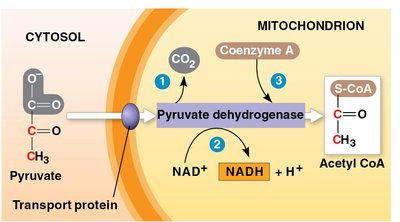
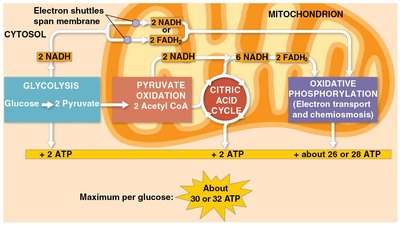
Cellular respiration is the process by which cells extract energy from organic molecules, primarily glucose, to produce ATP. - Equation: - Involves glycolysis, pyruvate oxidation, citric acid cycle, and oxidative phosphorylation. 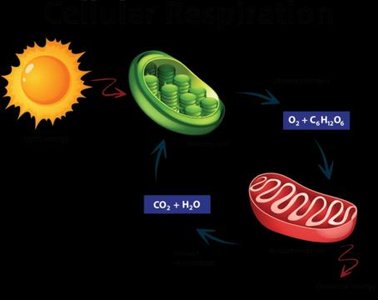
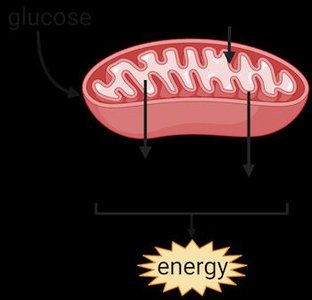

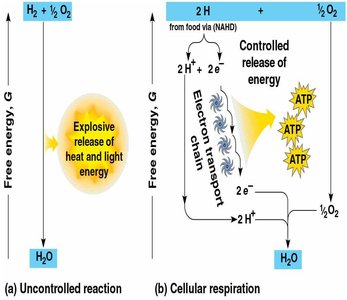


Relationship Between Photosynthesis and Respiration
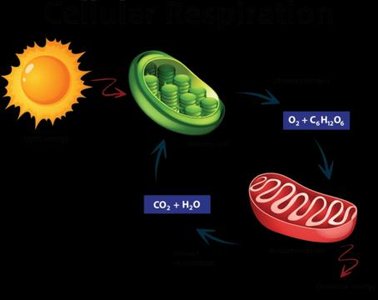
- Photosynthesis stores energy in organic molecules; respiration releases it. - The products of photosynthesis (O2 and glucose) are reactants in respiration; the products of respiration (CO2 and H2O) are reactants in photosynthesis.
Summary Table: Photosynthesis vs. Cellular Respiration
Process | Location | Reactants | Products | Energy Conversion |
|---|---|---|---|---|
Photosynthesis | Chloroplast | CO2, H2O, Light | Glucose, O2 | Light to Chemical |
Cellular Respiration | Mitochondria | Glucose, O2 | CO2, H2O, ATP | Chemical to ATP |
Key Terms and Concepts
- Autotroph: Organism that produces its own food - Heterotroph: Organism that consumes others for food - Chloroplast: Organelle for photosynthesis - Thylakoid: Membrane sac in chloroplast - Stroma: Fluid inside chloroplast - Photosystem: Complex for light capture - ATP: Cellular energy currency - NADPH: Electron carrier in photosynthesis - Rubisco: Enzyme for carbon fixation - Photorespiration: Process reducing photosynthetic efficiency - C3, C4, CAM plants: Types of carbon fixation mechanisms Example: Corn is a C4 plant, while rice is a C3 plant. Succulents often use CAM photosynthesis. Additional info: The notes include expanded explanations, definitions, and context to ensure completeness and academic quality for exam preparation.
