 뒤로
Photosynthesis: Carbon Fixation and Sugar Production (Chapter 10, Part 2)
스터디 가이드 - 스마트 노트
 자료에 맞춘 맞춤형 노트, 핵심 정의, 예시, 맥락을 확장해 제공합니다.
Photosynthesis: Carbon Fixation and Sugar Production
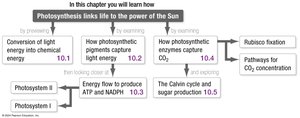
Overview of Chapter 10
This section focuses on the mechanisms by which plants fix carbon dioxide and convert it into sugars, emphasizing the Calvin cycle and adaptations for efficient carbon fixation. Understanding these processes is essential for grasping how photosynthesis sustains life on Earth.
The Calvin Cycle: Fixing Carbon
The Calvin cycle is the primary pathway by which plants convert inorganic carbon dioxide (CO2) into organic molecules. This process is fundamental to the biosphere, as it provides the basis for the synthesis of sugars and other organic compounds.
Carbon fixation: The incorporation of CO2 into organic molecules, beginning with the five-carbon compound ribulose bisphosphate (RuBP).
Key enzyme: Rubisco (ribulose-1,5-bisphosphate carboxylase/oxygenase) catalyzes the initial step, but is inefficient due to its ability to bind both CO2 and O2.
Product: CO2 is incorporated into glyceraldehyde 3-phosphate (G3P), a three-carbon sugar.
Example: The Calvin cycle is responsible for the majority of carbon fixation on Earth, making it ecologically vital.
Phases of the Calvin Cycle
The Calvin cycle consists of three distinct phases, each with specific biochemical steps:
Fixation: CO2 reacts with RuBP, producing two molecules of 3-phosphoglycerate (3PG).
Reduction: 3PG is phosphorylated by ATP and reduced by NADPH, forming G3P.
Regeneration: Some G3P is used to regenerate RuBP, allowing the cycle to continue.
Equation:
Rubisco: The Key Enzyme
Rubisco is the most abundant enzyme in leaf tissue and is found in all photosynthetic organisms using the Calvin cycle. However, it is slow and inefficient, as it can catalyze reactions with both CO2 and O2.
Photorespiration: When O2 reacts with RuBP, photorespiration occurs, consuming O2 and releasing CO2, which reduces photosynthetic efficiency.
Competition: High CO2 concentrations favor carbon fixation, while high O2 concentrations favor photorespiration.
Stomata: Gas Exchange Structures
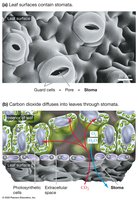
Plants regulate gas exchange through specialized structures called stomata, which consist of two guard cells forming a pore. Stomata allow CO2 to enter and O2 to exit the leaf, but also permit water vapor loss.
Cuticle: A waxy layer prevents water loss but also restricts gas movement.
Stomatal function: Stomata are typically open during the day and closed at night. On hot, dry days, they may close to conserve water, limiting CO2 uptake and increasing photorespiration.
Photorespiration and Environmental Challenges
Photorespiration is more likely in hot, dry environments where stomata close and O2 builds up. This process is wasteful, as it consumes O2 and releases CO2, reducing photosynthetic output.
Adaptations: Plants have evolved mechanisms to maintain a high CO2/O2 ratio, minimizing photorespiration.
Mechanisms for Increasing CO2 Concentration
To overcome photorespiration, some plants use alternative pathways to concentrate CO2:
C4 pathway: CO2 is initially fixed by PEP carboxylase in mesophyll cells, forming a four-carbon compound. This compound is transported to bundle sheath cells, where CO2 is released for the Calvin cycle.
Spatial separation: C4 plants separate initial carbon fixation and the Calvin cycle into different cell types.
CAM pathway: Crassulacean acid metabolism plants fix CO2 at night, storing it as organic acids. During the day, CO2 is released for the Calvin cycle. This is a temporal separation.
Example: Cacti and succulents use the CAM pathway to survive in arid environments.
Regulation of Photosynthesis
Photosynthesis is regulated by environmental and cellular factors:
Light: Triggers production of photosynthetic proteins.
Sugar levels: High sugar concentrations inhibit photosynthetic protein production and stimulate storage protein synthesis.
Rubisco activation: Rubisco is activated by regulatory molecules when light is available and inhibited when CO2 is low.
Fate of Sugar Produced by Photosynthesis
The G3P molecules produced by the Calvin cycle are used to synthesize glucose and fructose via gluconeogenesis. These sugars can be combined to form sucrose or polymerized into starch for storage.
Starch: Produced inside chloroplasts for long-term storage.
Sucrose: Synthesized in the cytosol for transport throughout the plant.
Carbon origin: Virtually all organic carbon in living organisms can be traced back to photosynthesis.
Summary Table: C3, C4, and CAM Pathways
Pathway | Initial Carbon Fixation | Location of Calvin Cycle | Adaptation |
|---|---|---|---|
C3 | Rubisco (RuBP) | Mesophyll cells | Most plants; efficient in cool, moist environments |
C4 | PEP carboxylase (3C compound) | Bundle sheath cells | Hot, dry environments; spatial separation |
CAM | PEP carboxylase (4C organic acid) | Mesophyll cells (temporal separation) | Arid environments; stomata open at night |
Additional info: The Calvin cycle is sometimes referred to as the C3 pathway, while C4 and CAM pathways are adaptations to reduce photorespiration and increase photosynthetic efficiency in challenging environments.
