 뒤로
뒤로Photosynthesis: Mechanisms, Adaptations, and Importance
스터디 가이드 - 스마트 노트
 자료에 맞춘 맞춤형 노트, 핵심 정의, 예시, 맥락을 확장해 제공합니다.
Photosynthesis: Feeding the Biosphere
Overview of Photosynthesis
Photosynthesis is the fundamental process by which plants, algae, and some bacteria convert solar energy into chemical energy, sustaining nearly all life on Earth. This process occurs within specialized organelles called chloroplasts and provides both food and oxygen for the biosphere.
Definition: Photosynthesis is the conversion of light energy into chemical energy stored in glucose and other organic molecules.
Importance: Directly or indirectly nourishes almost all living organisms.
General Equation:
Redox Process: CO2 is reduced to sugar, H2O is oxidized to O2.

Location and Structure of Photosynthesis
Chloroplast Structure
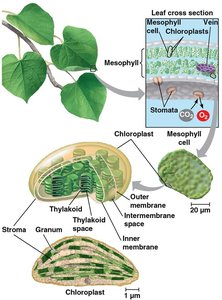
Photosynthesis takes place in the chloroplasts, primarily within the mesophyll cells of plant leaves. Chloroplasts contain internal membranes called thylakoids, which are organized into stacks known as grana. The surrounding fluid is the stroma.
Thylakoid: Site of light reactions.
Stroma: Site of the Calvin cycle.
Membranes: Outer and inner membranes surround the chloroplast.
The Two Stages of Photosynthesis
Light Reactions and Calvin Cycle
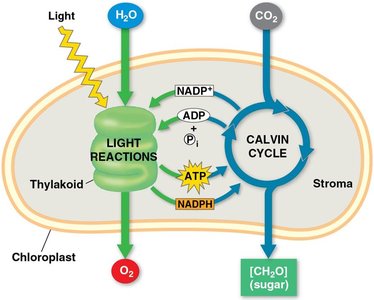
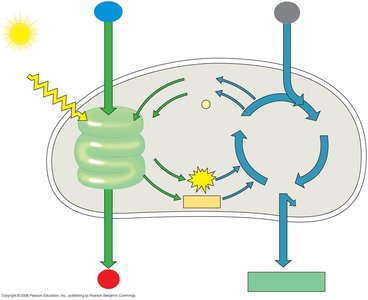
Photosynthesis consists of two main stages: the light reactions and the Calvin cycle. These stages cooperate to transform light energy into chemical energy and synthesize sugars.
Light Reactions: Occur in the thylakoid membranes; split water, release O2, reduce NADP+ to NADPH, and generate ATP by photophosphorylation.
Calvin Cycle: Occurs in the stroma; uses ATP and NADPH to convert CO2 into sugar (G3P).
The Nature of Sunlight
Electromagnetic Spectrum and Light Energy
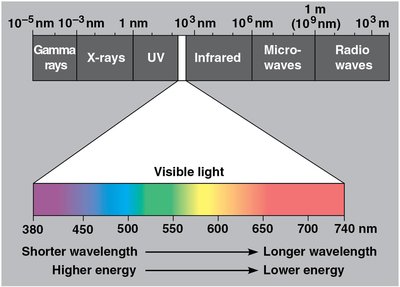
Light is a form of electromagnetic energy, traveling in waves. The wavelength determines the energy of light, with shorter wavelengths carrying more energy.
Electromagnetic Spectrum: Includes gamma rays, X-rays, UV, visible light, infrared, microwaves, and radio waves.
Visible Light: The range used in photosynthesis (about 380–740 nm).
Photons: Discrete particles of light, each with a fixed energy inversely related to wavelength.
Photosynthetic Pigments: Light Receptors
Pigments and Light Absorption
Pigments are molecules that absorb specific wavelengths of light. Chlorophyll is the primary pigment in plants, absorbing violet-blue and red light while reflecting green.
Chlorophyll: Main pigment; gives plants their green color.
Absorption Spectrum: Shows which wavelengths are absorbed by pigments.
Action Spectrum: Shows the effectiveness of different wavelengths in driving photosynthesis.
Mechanisms of ATP and NADPH Production
Chemiosmosis in Chloroplasts and Mitochondria
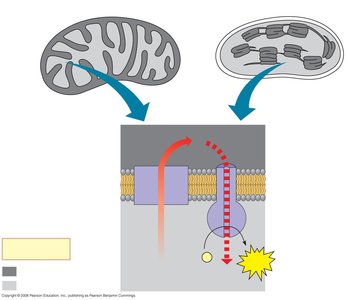
Both chloroplasts and mitochondria generate ATP by chemiosmosis, but they use different energy sources and spatial arrangements.
Mitochondria: Transfer chemical energy from food to ATP; protons pumped to intermembrane space.
Chloroplasts: Transform light energy into ATP; protons pumped into thylakoid space.
ATP Synthase: Enzyme that synthesizes ATP as protons diffuse back across the membrane.
Photosystems and Electron Flow
Photosystem II and Photosystem I
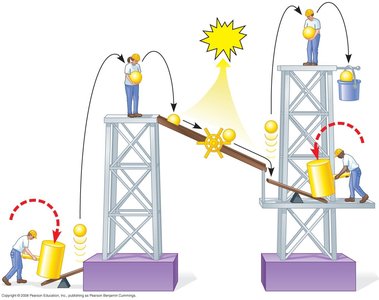
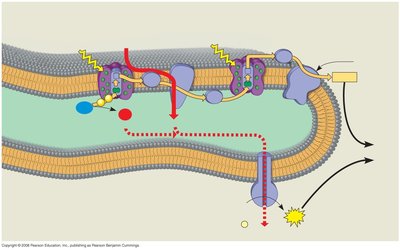
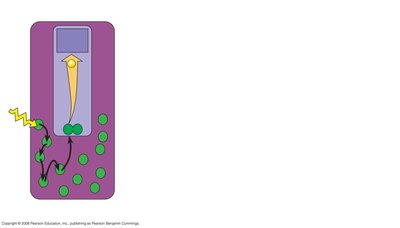
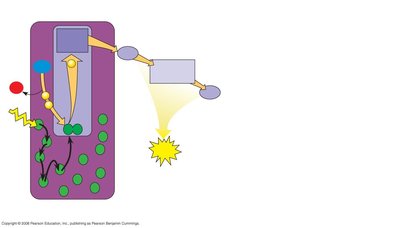
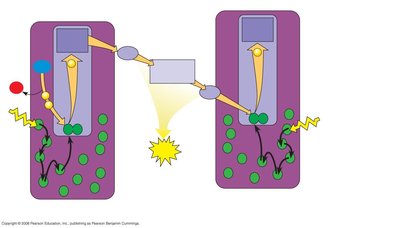
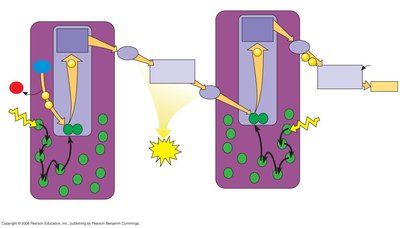
Photosystems are complexes in the thylakoid membrane that absorb light and transfer electrons. Photosystem II (PS II) absorbs at 680 nm, while Photosystem I (PS I) absorbs at 700 nm.
PS II: Functions first; reaction center is P680.
PS I: Functions second; reaction center is P700.
Linear Electron Flow: Electrons move from water through PS II and PS I to NADP+, forming NADPH.
Cyclic Electron Flow: Uses only PS I; produces ATP but not NADPH.
The Calvin Cycle
Phases and Function
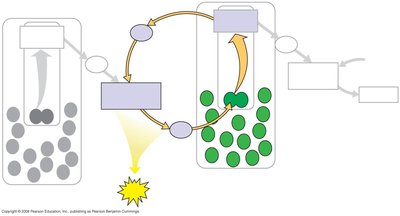
The Calvin cycle is a series of biochemical reactions that convert CO2 into sugar using ATP and NADPH. It consists of three phases: carbon fixation, reduction, and regeneration of the CO2 acceptor (RuBP).
Carbon Fixation: CO2 is attached to RuBP by the enzyme rubisco.
Reduction: ATP and NADPH are used to convert 3-phosphoglycerate into G3P.
Regeneration: RuBP is regenerated to continue the cycle.
Output: For every three turns, one G3P (a sugar) is produced.

Photorespiration and Adaptations
Photorespiration
Photorespiration is a process that occurs when rubisco adds O2 instead of CO2 to RuBP, leading to the consumption of O2 and release of CO2 without producing ATP or sugar. This is wasteful and problematic in hot, dry climates.
Evolutionary Relic: Rubisco evolved when atmospheric O2 was low.
Consequences: Can drain up to 50% of carbon fixed by the Calvin cycle.
C4 and CAM Plants: Adaptations to Minimize Photorespiration
C4 and CAM plants have evolved mechanisms to minimize photorespiration and maximize carbon fixation in hot, arid environments.
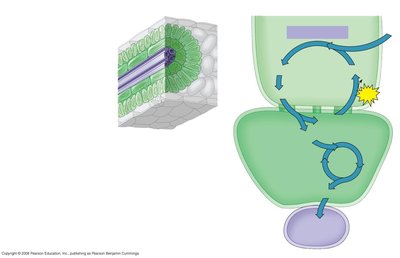
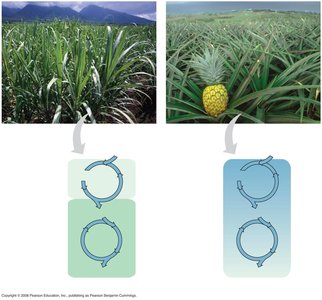
C4 Plants: Use PEP carboxylase to fix CO2 into four-carbon compounds in mesophyll cells, which are then transported to bundle-sheath cells for the Calvin cycle.
CAM Plants: Open stomata at night to fix CO2 into organic acids; during the day, CO2 is released for the Calvin cycle.
The Importance of Photosynthesis
Ecological and Biological Significance
Photosynthesis is essential for life, providing food, oxygen, and the basis for most ecosystems. Plants store excess sugar as starch and produce the O2 necessary for aerobic respiration.
Food Production: Sugar made in chloroplasts supplies energy and carbon skeletons for cells.
Oxygen Production: Photosynthesis produces the O2 in our atmosphere.
Storage: Excess sugar is stored as starch in roots, tubers, seeds, and fruits.
Summary Table: Comparison of C3, C4, and CAM Plants
Plant Type | CO2 Fixation | Adaptation | Example |
|---|---|---|---|
C3 | Directly via rubisco | Efficient in cool, moist climates | Wheat, rice |
C4 | PEP carboxylase in mesophyll cells | Spatial separation of steps | Sugarcane, maize |
CAM | CO2 fixed at night | Temporal separation of steps | Pineapple, succulents |
Key Concepts for Exam Preparation
Describe the structure of a chloroplast.
Explain the relationship between action spectrum and absorption spectrum.
Trace the movement of electrons in linear and cyclic electron flow.
Compare oxidative phosphorylation in mitochondria and photophosphorylation in chloroplasts.
Describe the role of ATP and NADPH in the Calvin cycle.
Discuss the consequences of photorespiration and adaptations in C4 and CAM plants.
