 뒤로
Photosynthesis: Mechanisms, Adaptations, and Importance in Biology
스터디 가이드 - 스마트 노트
 자료에 맞춘 맞춤형 노트, 핵심 정의, 예시, 맥락을 확장해 제공합니다.
Photosynthesis
Overview and Energetic Foundation
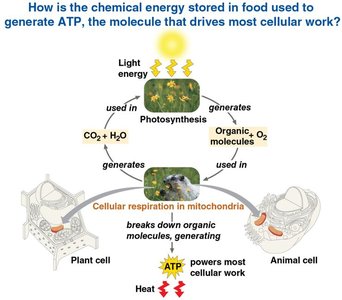
Photosynthesis is the process by which photoautotrophs convert light energy into chemical energy, providing the energetic foundation for nearly all life on Earth. It is a reciprocal process with cellular respiration, where the inputs of one are the outputs of the other.
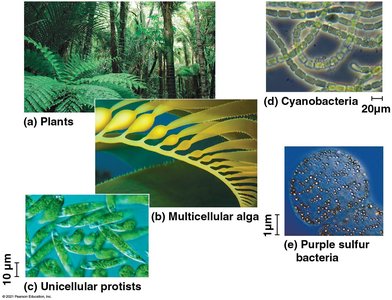
Photoautotrophs include plants, cyanobacteria, and aquatic protists.
Chemoheterotrophs rely on organic molecules produced by photoautotrophs.
Photosynthesis produces oxygen and organic molecules, which are used in cellular respiration.
Photoautotroph Diversity
While plants are the most familiar photoautotrophs, cyanobacteria and aquatic protists are major contributors to atmospheric oxygen.
Cyanobacteria and unicellular protists are responsible for much of Earth's oxygen production.
Photosynthetic organisms are found in diverse environments.
Plant Anatomy and Photosynthesis
Leaf Structure and Chloroplasts
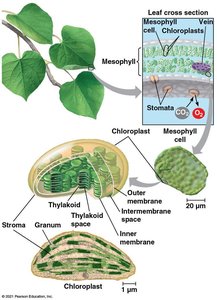
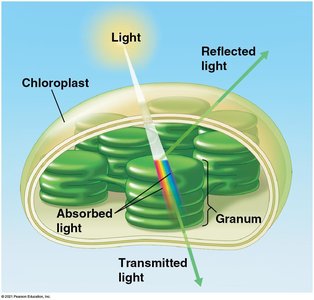
Photosynthesis occurs primarily in the leaves of plants, specifically within mesophyll cells packed with chloroplasts.
Chloroplasts have a double membrane and contain a dense fluid called the stroma.
Thylakoids are membrane sacs stacked into grana, where light reactions occur.
Chlorophyll is the main pigment, located in thylakoid membranes.
Light and Pigments
Electromagnetic Spectrum and Visible Light
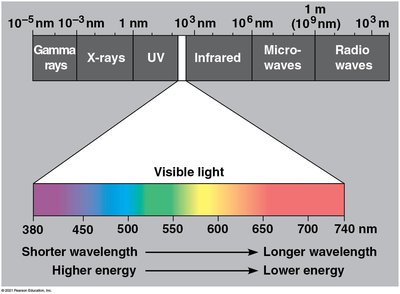
Light is a form of electromagnetic radiation, and only a small portion (visible light) is used in photosynthesis.
Visible light ranges from about 380 nm (violet) to 740 nm (red).
Shorter wavelengths have higher energy; longer wavelengths have lower energy.
Chlorophyll and Accessory Pigments
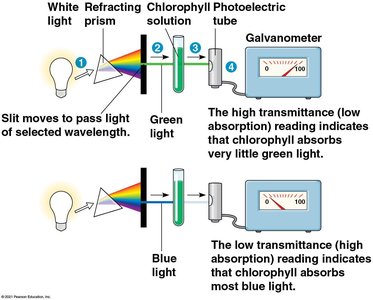
Chlorophyll absorbs light most efficiently in the blue and red regions, making plants appear green due to poor absorption of green light.
Chlorophyll a and chlorophyll b are the main photosynthetic pigments.
Accessory pigments (carotenoids, xanthophylls) expand the range of light absorption and protect against damage.
Absorption and Action Spectra
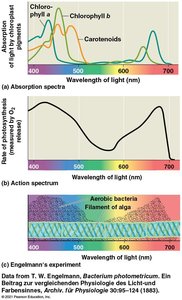
The absorption spectrum shows which wavelengths are absorbed by pigments, while the action spectrum shows which wavelengths drive photosynthesis.
Engelmann's experiment demonstrated that blue and red light are most effective for photosynthesis.
Mechanisms of Photosynthesis
Photosynthesis Equation and Redox Reactions
Photosynthesis is an anabolic and endergonic process, involving oxidation and reduction reactions.
Water is oxidized (loses electrons), providing electrons for the process.
Carbon dioxide is reduced (gains electrons), forming sugars.
Photosynthesis Equation:
Two-Part Process: Light Reactions and Calvin Cycle
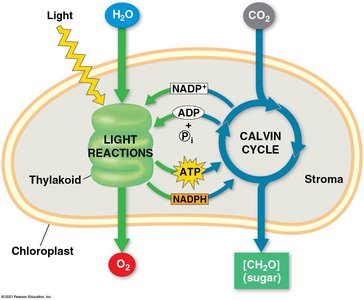
Light Reactions: Occur in thylakoid membranes. Light energy is used to produce ATP and NADPH; water is split, releasing O2.
Calvin Cycle: Occurs in the stroma. ATP and NADPH are used to fix carbon dioxide into a 3-carbon sugar (G3P).
Light-Dependent Reactions
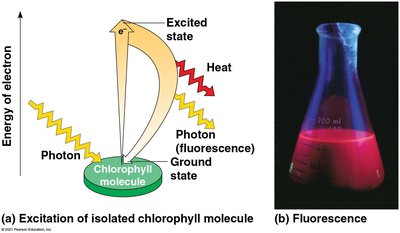
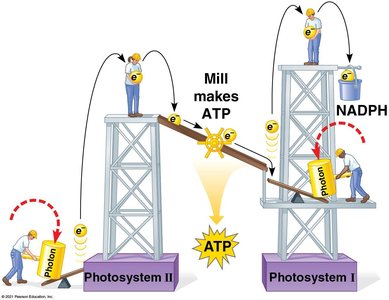
When photons interact with chlorophyll, electrons become excited and are transferred to the electron transport chain.
Isolated chlorophyll fluoresces as excited electrons return to the ground state.
Photosystems and Electron Transport
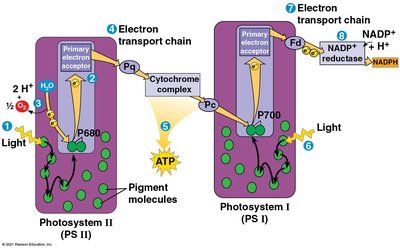
Photosystems are complexes of proteins and pigments that direct photons to the reaction center.
Photosystem II (PSII): Central chlorophyll absorbs at 680 nm (P680).
Photosystem I (PSI): Central chlorophyll absorbs at 700 nm (P700).
Water provides replacement electrons via photolysis, releasing O2.
Chemiosmosis and ATP Synthesis
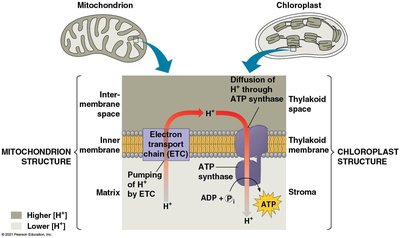
As electrons move through the ETC, protons are pumped into the thylakoid space, and their diffusion back through ATP synthase drives ATP production.
In photosynthesis, energy comes from photons (photophosphorylation).
In respiration, energy comes from glucose oxidation (oxidative phosphorylation).
Non-Cyclic and Cyclic Electron Flow
Non-cyclic electron flow: Electrons move from PSII to PSI, producing both ATP and NADPH; requires water.
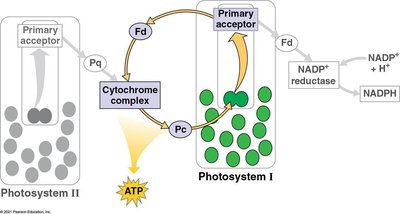
Cyclic electron flow: Electrons cycle within PSI, producing only ATP; does not require water.
The Calvin Cycle
Phases of the Calvin Cycle
The Calvin Cycle is the set of reactions that fix carbon dioxide into organic molecules.
Carbon fixation: RuBisCo attaches CO2 to RuBP (5C).
Reduction: ATP and NADPH convert RuBP into G3P (3C sugar).
Regeneration: ATP regenerates RuBP from G3P.
Products and Regulation
For every 3 CO2 molecules, 6 G3P are produced; 1 is a net product, 5 regenerate RuBP.
G3P is a precursor for glucose, sucrose, and other carbohydrates.
Each step is enzyme-controlled.
Photorespiration and Adaptations
Photorespiration
Rubisco can bind O2 instead of CO2, leading to photorespiration—a wasteful process that consumes ATP but produces no sugar.
Photorespiration is minimized when stomata are open and gas exchange is optimal.
In some environments, closed stomata increase O2 and decrease CO2, increasing photorespiration.
C3, C4, and CAM Plant Adaptations
C3 plants: No adaptations; both stages occur in the same cell.
C4 plants: Spatial separation; CO2 is fixed in mesophyll cells and released in bundle sheath cells, minimizing O2 exposure.
CAM plants: Temporal separation; CO2 is fixed at night and used during the day, reducing water loss.
Plant Type | Adaptation | Photorespiration |
|---|---|---|
C3 | None | High |
C4 | Spatial separation | Low |
CAM | Temporal separation | Low |
Importance of Photosynthesis
Ecological and Industrial Significance
Photosynthesis is essential for life, providing food and oxygen for all aerobic organisms. It is also increasingly important in industry, such as biofuel production.
All animals, including humans, depend on photoautotrophs for energy and oxygen.
Modern industry explores plant-based solutions for sustainable energy.
Summary Table: Photosynthesis vs. Cellular Respiration
Process | Location | Inputs | Outputs |
|---|---|---|---|
Photosynthesis | Chloroplast | CO2, H2O, Light | O2, Glucose |
Cellular Respiration | Mitochondria | O2, Glucose | CO2, H2O, ATP |
Key Concepts to Master
Photoautotrophic energy processing and its control
Reduction and oxidation reactions in photosynthesis
Inputs and outputs of all steps of photosynthesis
Cellular location of photosynthesis steps
Adaptations to reduce photorespiration
Comparison of photosynthesis and cellular respiration
Photosynthesis as the energetic foundation for life
