 뒤로
Photosynthesis: Mechanisms, Structures, and Adaptations
스터디 가이드 - 스마트 노트
 자료에 맞춘 맞춤형 노트, 핵심 정의, 예시, 맥락을 확장해 제공합니다.
Photosynthesis: Overview and Importance
Introduction to Photosynthesis
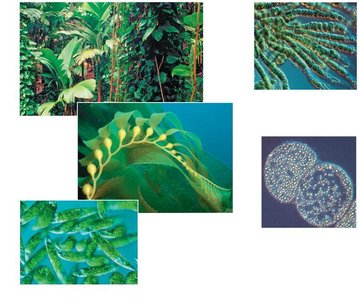
Photosynthesis is the process by which plants, algae, and certain prokaryotes convert solar energy into chemical energy, producing organic compounds from inorganic molecules. This process is fundamental to life on Earth, as it provides the oxygen we breathe and the food we consume.
Photosynthetic Organisms: Includes plants, multicellular algae, unicellular eukaryotes, cyanobacteria, and some other prokaryotes.
General Equation: The overall chemical reaction for photosynthesis is:
Key Functions: Converts solar energy to chemical energy, inorganic to organic compounds, and low-energy molecules to high-energy molecules.
Chloroplast Structure and Function
Chloroplast Anatomy
Chloroplasts are the organelles where photosynthesis occurs in eukaryotic cells. They have a complex structure that facilitates the light-dependent and light-independent reactions of photosynthesis.
Double Membrane: Chloroplasts are surrounded by an outer and inner membrane.
Stroma: The dense fluid inside the chloroplast where the Calvin cycle takes place.
Thylakoids: Flattened sacs that contain chlorophyll and are the site of the light reactions. Thylakoids are often stacked into structures called grana.
Chlorophyll: The green pigment responsible for capturing light energy.
The Light Reactions
Overview of Light Reactions
The light reactions occur in the thylakoid membranes and are responsible for converting light energy into chemical energy in the form of ATP and NADPH. Oxygen is produced as a by-product.
Inputs: Light, water (H2O), NADP+, ADP + Pi
Outputs: Oxygen (O2), ATP, NADPH
Photosystems: Complexes of proteins and pigments (chlorophyll a, chlorophyll b, carotenoids) that absorb light and transfer energy.
Electron Flow: Linear electron flow is the main pathway, involving both Photosystem II (PSII) and Photosystem I (PSI).
Steps of Linear Electron Flow
Light excites electrons in PSII, which are transferred to a primary electron acceptor.
Water is split, providing electrons to PSII and releasing O2.
Electrons move through an electron transport chain, creating a proton gradient used to synthesize ATP (photophosphorylation).
Electrons reach PSI, are re-excited by light, and transferred to NADP+ to form NADPH.
Chemiosmosis: The proton gradient across the thylakoid membrane drives ATP synthesis via ATP synthase, similar to the process in mitochondria.
Cyclic Electron Flow
Involves only PSI and produces ATP but not NADPH or O2.
Helps balance the ATP/NADPH ratio required for the Calvin cycle.
The Calvin Cycle (Light-Independent Reactions)
Overview of the Calvin Cycle
The Calvin cycle occurs in the stroma and uses ATP and NADPH from the light reactions to fix carbon dioxide into organic molecules, ultimately producing glyceraldehyde-3-phosphate (G3P), a precursor to glucose and other carbohydrates.
Three Phases:
Carbon Fixation: CO2 is attached to ribulose bisphosphate (RuBP) by the enzyme rubisco, forming 3-phosphoglycerate.
Reduction: ATP and NADPH are used to convert 3-phosphoglycerate into G3P.
Regeneration: Some G3P is used to regenerate RuBP, enabling the cycle to continue.
Inputs per 1 G3P: 3 CO2, 9 ATP, 6 NADPH
Outputs: 1 G3P (used to make glucose and other organic molecules)
Adaptations in Photosynthetic Pathways
Photorespiration and Its Alternatives
Photorespiration is a process that occurs when rubisco binds O2 instead of CO2, leading to a wasteful pathway that consumes energy without producing sugar. This is more likely under hot, dry conditions when plants close their stomata to conserve water.
C3 Plants: Use the standard Calvin cycle; susceptible to photorespiration.
C4 Plants: Spatially separate carbon fixation and the Calvin cycle. CO2 is initially fixed into a four-carbon compound in mesophyll cells, then transported to bundle-sheath cells where the Calvin cycle occurs. Examples: maize, sugarcane.
CAM Plants: Temporally separate carbon fixation and the Calvin cycle. CO2 is fixed at night into organic acids and released during the day for use in the Calvin cycle. Examples: succulents, cacti.
Key Terms and Concepts
Chlorophyll: Main pigment for capturing light energy.
Rubisco: Ribulose bisphosphate carboxylase/oxygenase, the enzyme that fixes CO2 in the Calvin cycle.
ATP & NADPH: Energy carriers produced in the light reactions and consumed in the Calvin cycle.
Stroma: Fluid inside the chloroplast where the Calvin cycle occurs.
Thylakoid: Membranous sacs where the light reactions take place.
Summary Table: Comparison of Photosynthetic Pathways
Pathway | Initial CO2 Fixation | Adaptation | Examples |
|---|---|---|---|
C3 | 3-phosphoglycerate (Calvin cycle) | Standard; susceptible to photorespiration | Wheat, rice, most plants |
C4 | Oxaloacetate (4-carbon compound) | Spatial separation; reduces photorespiration | Corn, sugarcane |
CAM | Organic acids at night | Temporal separation; conserves water | Cacti, succulents |
Essential Study Points
Follow the flow of energy and matter in photosynthesis.
Know the inputs and outputs of the light reactions (PSII, PSI) and the Calvin cycle.
Understand the differences between linear and cyclic electron flow.
Recognize the importance of rubisco and the adaptations of C4 and CAM plants.
Be able to identify where each process occurs within the chloroplast (thylakoid, stroma).
