 뒤로
뒤로Photosynthesis: Mechanisms, Structures, and Ecological Importance
스터디 가이드 - 스마트 노트
 자료에 맞춘 맞춤형 노트, 핵심 정의, 예시, 맥락을 확장해 제공합니다.
Photosynthesis: The Foundation of Life
Introduction to Photosynthesis
Photosynthesis is the process by which autotrophic organisms, such as plants, algae, and some bacteria, convert light energy into chemical energy stored in glucose. This process is fundamental to life on Earth, as it provides the organic molecules and oxygen required by most living organisms.
Autotrophs: Organisms that synthesize their own food from inorganic substances using light or chemical energy. Examples include plants, algae, and cyanobacteria.
Heterotrophs: Organisms that obtain energy by consuming other organisms or organic matter. Examples include animals, fungi, and many bacteria.
Photosynthetic autotrophs are the primary producers in most ecosystems, forming the base of food webs.
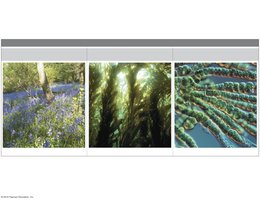
Autotrophs vs. Heterotrophs
Obtaining Food: Producers and Consumers
Organisms are classified based on how they obtain energy and carbon:
Autotrophs (Producers): Use inorganic sources (CO2, H2O) and energy (usually sunlight) to produce organic molecules.
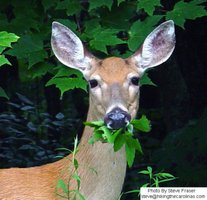
Heterotrophs (Consumers): Rely on consuming organic molecules produced by other organisms.
Examples of heterotrophs include animals eating plants or other animals.

Chloroplasts: The Site of Photosynthesis
Structure and Function
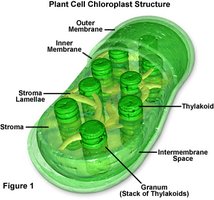
Photosynthesis occurs in chloroplasts, specialized organelles found in plant and algal cells. Chloroplasts have a double membrane and contain internal structures called thylakoids, which are stacked into grana. The stroma is the fluid-filled space surrounding the thylakoids, containing enzymes for the Calvin cycle.
Thylakoids: Membranous sacs containing photosynthetic pigments (chlorophylls and carotenoids).
Stroma: Site of the Calvin cycle (light-independent reactions).
The Overall Equation of Photosynthesis
Summary Equation
The process of photosynthesis can be summarized by the following equation:
Inputs: Carbon dioxide, water, and light energy
Outputs: Glucose and oxygen
Stages of Photosynthesis
Light-Dependent Reactions
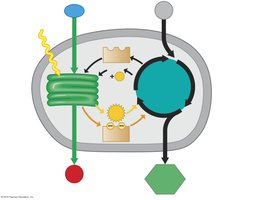
These reactions occur in the thylakoid membranes and require light. Their main functions are to capture solar energy and convert it into chemical energy in the form of ATP and NADPH, while splitting water to release oxygen.
Photosystem II and I: Protein complexes that absorb light and drive electron transport.
Electron Transport Chain (ETC): Transfers electrons, creating a proton gradient used to synthesize ATP (photophosphorylation).
Oxygen Evolution: Water is split, releasing O2 as a byproduct.
Light-Independent Reactions (Calvin Cycle)
These reactions occur in the stroma and do not require light directly. They use ATP and NADPH from the light-dependent reactions to fix carbon dioxide and synthesize glucose.
Carbon Fixation: CO2 is attached to RuBP by the enzyme Rubisco, forming 3-phosphoglycerate (3-PGA).
Reduction: 3-PGA is converted to G3P using ATP and NADPH.
Regeneration: RuBP is regenerated from G3P, allowing the cycle to continue.
The net equation for the Calvin cycle is:
The Nature of Light and Photosynthetic Pigments
Electromagnetic Spectrum and Absorption
Light is a form of electromagnetic radiation. The visible spectrum (about 380–750 nm) is used in photosynthesis. The energy of light is inversely proportional to its wavelength.
Chlorophyll a: Main pigment, absorbs blue and red light, reflects green.
Chlorophyll b and Carotenoids: Accessory pigments, broaden the spectrum of absorbed light and protect against excess light.
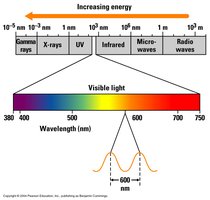
Why Are Plants Green?
Plants appear green because chlorophyll pigments absorb red and blue wavelengths but reflect green light, which is not efficiently absorbed.
Photosystems and Energy Transfer
Photosystem Structure and Function
Photosystems are complexes of pigments and proteins that capture light energy and transfer it to a reaction center, where electrons are excited and transferred through an electron transport chain.
Resonance Energy Transfer: Energy is transferred between pigment molecules until it reaches the reaction center.
Electron Transport: Excited electrons are passed to electron acceptors, driving the synthesis of ATP and NADPH.
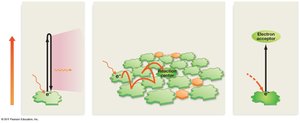
Comparing Photosynthesis and Cellular Respiration
Similarities and Differences
Both processes involve electron transport chains and chemiosmosis to generate ATP. However, photosynthesis stores energy in glucose, while respiration releases energy from glucose.
Process | Location | Inputs | Outputs |
|---|---|---|---|
Photosynthesis | Chloroplasts | CO2, H2O, light | Glucose, O2 |
Respiration | Mitochondria | Glucose, O2 | CO2, H2O, ATP |
Key Terms and Concepts
Photosynthesis: Conversion of light energy to chemical energy in plants, algae, and some bacteria.
Autotroph: Organism that produces its own food.
Heterotroph: Organism that consumes other organisms for food.
Chloroplast: Organelle where photosynthesis occurs.
Thylakoid: Membranous structure within chloroplasts containing pigments.
Stroma: Fluid inside chloroplasts where the Calvin cycle occurs.
Chlorophyll: Main pigment involved in photosynthesis.
Calvin Cycle: Series of reactions that synthesize glucose from CO2.
Rubisco: Enzyme that catalyzes carbon fixation.
ATP/NADPH: Energy carriers produced in the light-dependent reactions.
Summary
Photosynthesis is a complex, multi-step process that sustains life on Earth by converting solar energy into chemical energy. It involves the coordinated action of light-dependent and light-independent reactions, specialized organelles (chloroplasts), and a variety of pigments and enzymes. Understanding photosynthesis is essential for appreciating the flow of energy and matter in ecosystems.
