 뒤로
Photosynthesis: Mechanisms, Structures, and Energy Transformations
스터디 가이드 - 스마트 노트
 자료에 맞춘 맞춤형 노트, 핵심 정의, 예시, 맥락을 확장해 제공합니다.
Photosynthesis
Overview and Importance
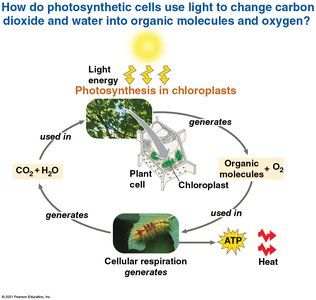
Photosynthesis is a fundamental biological process by which photoautotrophic organisms convert light energy into chemical energy, producing organic molecules and oxygen from carbon dioxide and water. This process is essential for sustaining life on Earth, as it forms the basis of most food chains and provides atmospheric oxygen.
Key Equation:
Reverse of Cellular Respiration: Photosynthesis stores energy, while respiration releases it.
Redox Reactions: Water is oxidized to O2, and CO2 is reduced to glucose.
Modes of Nutrition
Autotrophs vs. Heterotrophs
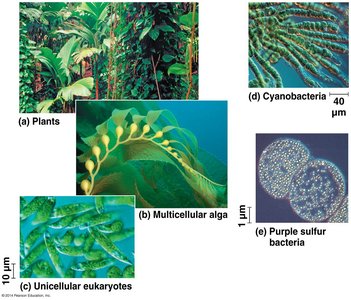
Organisms are classified based on how they obtain their food. Autotrophs synthesize their own food from inorganic sources, while heterotrophs rely on consuming other organisms.
Autotrophs: "Self-feeders"; produce food from inorganic carbon. Includes photoautotrophs (plants, algae, some prokaryotes).
Heterotrophs: Consume autotrophs or other heterotrophs. Includes herbivores, carnivores, and decomposers.
Chloroplast Structure and Function
Site of Photosynthesis
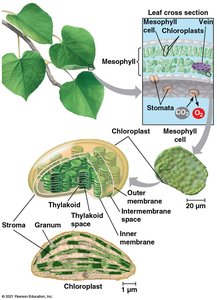
Chloroplasts are specialized organelles found in the green parts of plants, primarily in the mesophyll cells of leaves. They contain the pigment chlorophyll, which absorbs light energy.
Mesophyll: Tissue layer with high chloroplast concentration.
Stomata: Openings for gas exchange (CO2 in, O2 out).
Stroma: Dense fluid surrounding thylakoids.
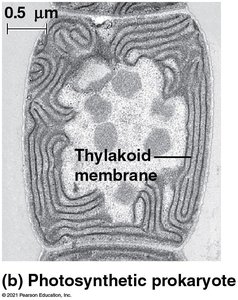
Thylakoids: Membrane sacs containing chlorophyll; site of light reactions.
Photosynthesis: Chemical Overview
Reactants and Products
The process of photosynthesis involves the transformation of carbon dioxide and water into glucose and oxygen, driven by light energy.
Reactants: CO2 and H2O
Products: C6H12O6 (glucose), O2, and H2O
Redox: CO2 is reduced, H2O is oxidized


Phases of Photosynthesis
Light Reactions and Calvin Cycle
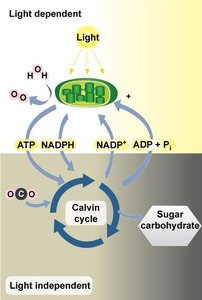
Photosynthesis occurs in two main phases: the light-dependent reactions and the Calvin cycle (light-independent reactions).
Light Reactions: Occur in thylakoid membranes; convert light energy to ATP and NADPH; split water to release O2.
Calvin Cycle: Occurs in stroma; uses ATP and NADPH to fix CO2 into organic molecules (G3P).

Light and Photosynthetic Pigments
Nature of Light
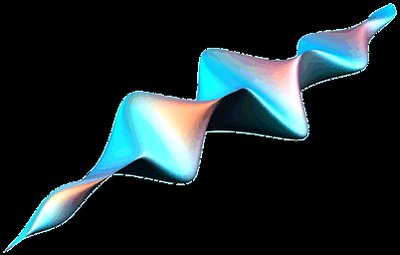
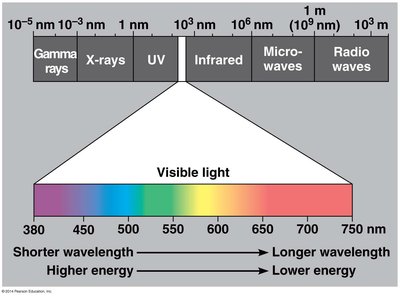
Light is electromagnetic radiation, with energy inversely proportional to wavelength. Plants absorb light in the visible spectrum (380–750 nm).
Photon: Quantum of light energy.
Visible Spectrum: ROYGBIV; shorter wavelengths have higher energy.
Pigments and Light Absorption
Photosynthetic pigments absorb specific wavelengths of light. Chlorophyll a is the primary pigment, while chlorophyll b and carotenoids are accessory pigments.
Chlorophyll a: Main pigment; absorbs blue-violet and red light.
Chlorophyll b: Accessory pigment; broadens absorption spectrum.
Carotenoids: Accessory pigments; photoprotective.
Absorption vs. Reflection: Colors seen are those not absorbed.


Excitation of Chlorophyll
Photon Absorption and Electron Excitation
When chlorophyll absorbs a photon, an electron is elevated to a higher energy (excited) state. The electron returns to the ground state, releasing energy as heat or fluorescence.
Ground State: Lowest energy state of electron.
Excited State: Higher energy, unstable; returns to ground state by releasing energy.
Fluorescence: Emission of light as electron returns to ground state.
Photosystems and Light Harvesting
Photosystem II and Photosystem I
Photosystems are complexes in the thylakoid membrane that capture light energy and initiate electron transport. Each contains a light-harvesting complex and a reaction-center complex.
Photosystem II (PSII): Contains P680 chlorophyll a; absorbs at 680 nm; strongest oxidizing agent.
Photosystem I (PSI): Contains P700 chlorophyll a; absorbs at 700 nm.
Energy Transfer: Energy is passed from pigment to pigment, not electrons, until it reaches the reaction center.
Electron Transport Chain and Chemiosmosis
Mechanism of ATP and NADPH Formation
The electron transport chain (ETC) in the thylakoid membrane harnesses energy from electrons to create a proton gradient, driving ATP synthesis via chemiosmosis.
Water Splitting: Provides electrons to PSII; releases O2 and H+.
ETC: Transfers electrons from PSII to PSI; energy released pumps protons into thylakoid space.
ATP Synthase: Uses proton motive force to synthesize ATP.
NADPH Formation: Electrons from PSI reduce NADP+ to NADPH.
Linear vs. Cyclic Electron Flow
Linear electron flow involves both photosystems and produces ATP, NADPH, and O2. Cyclic electron flow involves only PSI and produces ATP but not NADPH or O2.
Linear Flow: PSII → ETC → PSI → ETC → NADPH
Cyclic Flow: PSI → ETC → PSI; compensates for extra ATP needed in Calvin cycle.
The Calvin Cycle
Stages and Key Steps
The Calvin cycle is the light-independent phase of photosynthesis, where CO2 is fixed and reduced to form G3P, using ATP and NADPH from the light reactions.
Carbon Fixation: CO2 combines with RuBP via Rubisco; forms 3C molecules.
Reduction: NADPH reduces 3C molecules to G3P.
Regeneration: ATP is used to regenerate RuBP from G3P.
Inputs: 6 CO2, 18 ATP, 12 NADPH
Outputs: 2 G3P, 12 NADP+, 18 ADP, 6 H2O
Summary Table: Photosynthesis Phases
Phase | Location | Inputs | Outputs |
|---|---|---|---|
Light Reactions | Thylakoid Membrane | Light, H2O, NADP+, ADP | O2, NADPH, ATP |
Calvin Cycle | Stroma | CO2, NADPH, ATP | G3P, NADP+, ADP, H2O |
Vocabulary and Key Concepts
Autotroph vs. Heterotroph
Chlorophyll
Stroma
Thylakoids
Pigments
Photons
Ground state → excited state
Fluorescence
Light reactions vs. Dark reactions
Photosystem
Exergonic fall
Chemiosmosis
Proton motive force
Linear vs. Cyclic flow
Carbon fixation
Rubisco and RuBP
Study Questions
What are the starting materials of photosynthesis and where do they come from?
What are the products of photosynthesis and where do they go?
What are the reactants and products of the light reactions and the Calvin cycle?
Plant/leaf structure vocab and location
How does absorption of light kick start the light reactions? Where does it occur? What molecules are involved?
What is the initial source of electrons in PS? And where do these electrons ultimately end up?
Difference between linear and cyclic flow of electrons
How do photosystems operate?
Compare/contrast chemiosmosis/ATP generation via ETC in mitochondria vs chloroplast
Be able to give brief overviews of what events occur during the light reactions (PSII, ETC, PSI, ETC) and the 3 phases of the Calvin cycle
