 뒤로
Photosynthesis: The Process That Powers Life on Earth
스터디 가이드 - 스마트 노트
 자료에 맞춘 맞춤형 노트, 핵심 정의, 예시, 맥락을 확장해 제공합니다.
Photosynthesis: The Process That Feeds the Biosphere
Introduction to Photosynthesis
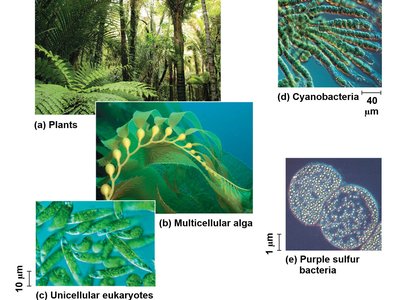
Photosynthesis is the process by which plants, algae, and certain prokaryotes convert solar energy into chemical energy, sustaining nearly all life on Earth. This process occurs in specialized organelles called chloroplasts and is fundamental to the energy flow in the biosphere.
Autotrophs are organisms that produce their own food from inorganic substances. They are the primary producers in ecosystems.
Heterotrophs obtain organic molecules by consuming other organisms and are considered consumers or decomposers.
Almost all heterotrophs depend on photoautotrophs for food and oxygen.
Chloroplast Structure and Function
Organization of the Chloroplast
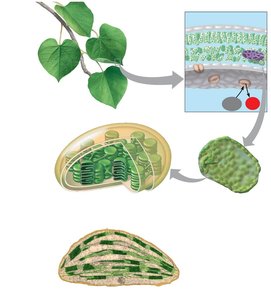
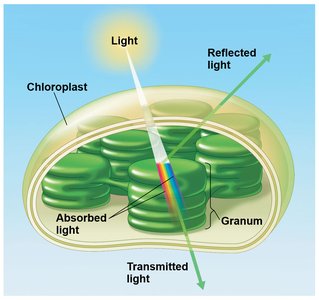
Chloroplasts are the sites of photosynthesis in plants, mainly located in the mesophyll cells of leaves. Their structure is highly adapted for capturing light and facilitating the chemical reactions of photosynthesis.
Stomata: Microscopic pores that allow gas exchange (CO2 in, O2 out).
Stroma: The dense fluid inside the chloroplast, surrounding the thylakoids.
Thylakoids: Flattened sacs that contain chlorophyll and are organized into stacks called grana.
The Overall Equation of Photosynthesis
Chemical Summary
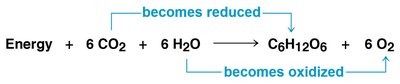
Photosynthesis is a complex series of redox reactions that can be summarized by the following equation:
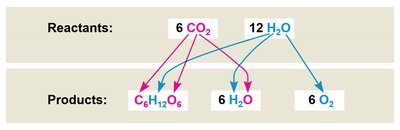
This process is the reverse of cellular respiration.
Water is split, providing electrons and releasing oxygen as a by-product.
Stages of Photosynthesis
Light Reactions and the Calvin Cycle
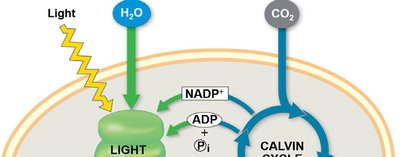
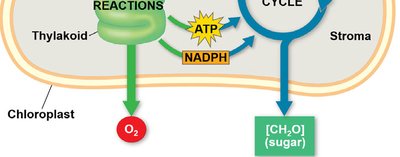
Photosynthesis consists of two main stages: the light reactions and the Calvin cycle.
Light reactions (in the thylakoids): Split water, release O2, produce ATP and NADPH.
Calvin cycle (in the stroma): Uses ATP and NADPH to convert CO2 into sugar (G3P).
The Nature of Sunlight
Electromagnetic Spectrum and Visible Light
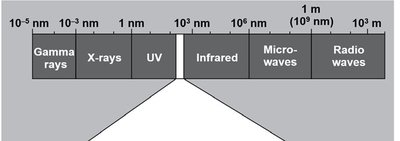
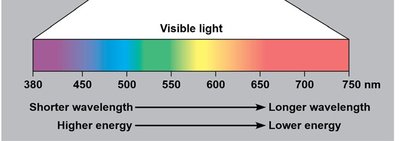
Light is a form of electromagnetic energy. The electromagnetic spectrum encompasses all wavelengths of electromagnetic radiation, but only a small portion (380–750 nm) is visible to the human eye and is used in photosynthesis.
Wavelength determines the energy and color of light.
Light behaves as both a wave and as particles called photons.
Photosynthetic Pigments
Types and Functions of Pigments
Pigments are molecules that absorb specific wavelengths of light. The main pigments in chloroplasts are:
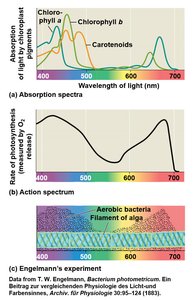
Chlorophyll a: The primary pigment involved in light reactions.
Chlorophyll b: An accessory pigment that broadens the spectrum of light used.
Carotenoids: Accessory pigments that absorb additional wavelengths and provide photoprotection.
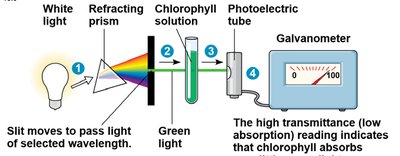
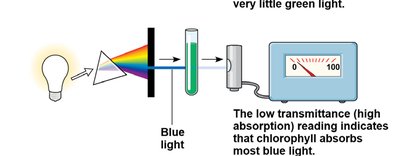
A spectrophotometer measures the absorption of light by pigments, producing an absorption spectrum.
The action spectrum shows the effectiveness of different wavelengths in driving photosynthesis, as demonstrated by Engelmann's experiment.
The structural difference between chlorophyll a and b accounts for their different absorption properties.
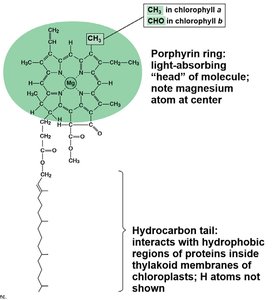
Excitation of Chlorophyll and Photosystems
Light Absorption and Electron Excitation
When pigments absorb light, electrons are excited to a higher energy state. In isolation, this energy is released as heat or fluorescence.
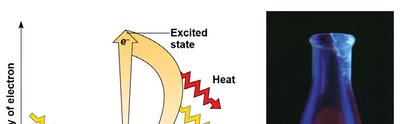
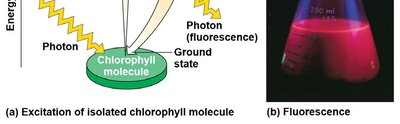
Photosystems
A photosystem consists of a reaction-center complex surrounded by light-harvesting complexes. There are two types:
Photosystem II (PS II): Contains P680 chlorophyll a, absorbs 680 nm light.
Photosystem I (PS I): Contains P700 chlorophyll a, absorbs 700 nm light.
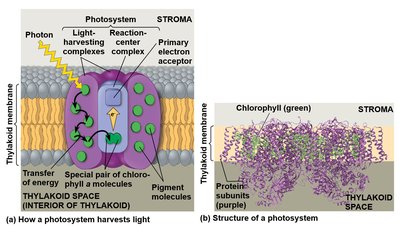
Electron Flow in the Light Reactions
Linear Electron Flow
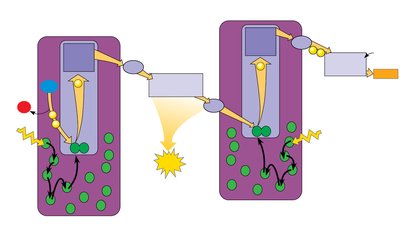
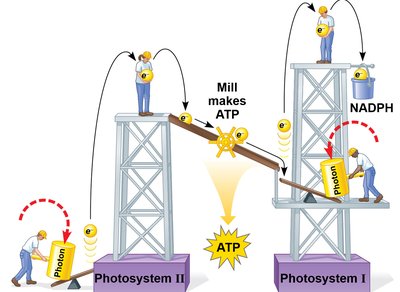
Linear electron flow is the primary pathway, involving both photosystems and resulting in the production of ATP and NADPH. The process includes:
Photon excites pigment in PS II; energy is transferred to P680.
Excited electron from P680 is transferred to the primary electron acceptor.
Water is split, electrons reduce P680+, O2 is released.
Electrons move down the electron transport chain to PS I, creating a proton gradient.
ATP is produced by chemiosmosis.
Light excites P700 in PS I; electron is transferred to its primary acceptor.
Electrons move to ferredoxin (Fd), then to NADP+ reductase.
NADP+ is reduced to NADPH.
Cyclic Electron Flow
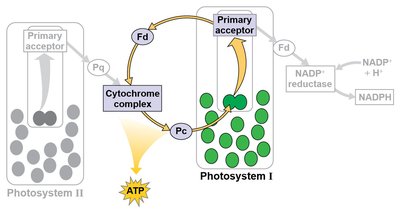
In cyclic electron flow, electrons cycle back to PS I, producing ATP but not NADPH or O2. This process helps balance the ATP/NADPH ratio.
Chemiosmosis and ATP Synthesis
Comparison with Mitochondria
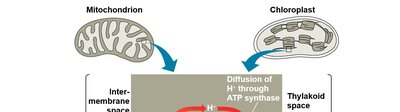
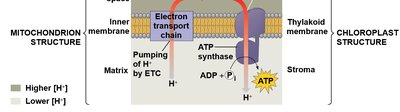
Both chloroplasts and mitochondria use chemiosmosis to generate ATP, but the energy sources differ: mitochondria use chemical energy from food, while chloroplasts use light energy.
Protons are pumped into the thylakoid space in chloroplasts and into the intermembrane space in mitochondria.
ATP synthesis occurs as protons diffuse back into the stroma (chloroplast) or matrix (mitochondria).
The Calvin Cycle
Carbon Fixation and Sugar Production
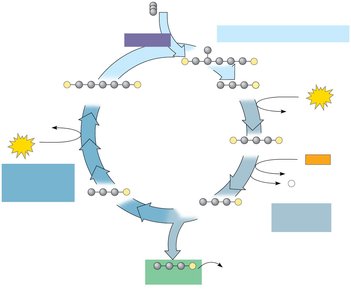
The Calvin cycle uses ATP and NADPH to convert CO2 into sugar. It is an anabolic pathway that regenerates its starting molecule, ribulose bisphosphate (RuBP).
Occurs in the stroma of the chloroplast.
Produces glyceraldehyde 3-phosphate (G3P) as the main output.
Three phases: Carbon fixation (catalyzed by rubisco), reduction, and regeneration of RuBP.
Alternative Mechanisms of Carbon Fixation
Photorespiration
Photorespiration occurs when rubisco adds O2 instead of CO2 to RuBP, leading to a loss of fixed carbon and energy. This process is considered wasteful but may protect plants under certain conditions.
C4 and CAM Pathways
Plants in hot, arid climates have evolved alternative mechanisms to minimize photorespiration and conserve water:
C4 plants: Spatially separate carbon fixation and the Calvin cycle using bundle-sheath and mesophyll cells. PEP carboxylase fixes CO2 efficiently even at low concentrations.
CAM plants: Temporally separate carbon fixation (at night) and the Calvin cycle (during the day) to reduce water loss.
The Importance of Photosynthesis
Ecological and Biological Significance
Photosynthesis is essential for life on Earth, providing the oxygen we breathe and the organic molecules that form the basis of food webs. Plants store excess sugar as starch, supporting growth and reproduction.
