 뒤로
뒤로Plant Diversity II: The Evolution of Seed Plants
스터디 가이드 - 스마트 노트
 자료에 맞춘 맞춤형 노트, 핵심 정의, 예시, 맥락을 확장해 제공합니다.
Plant Diversity II: The Evolution of Seed Plants
Seed Plant Adaptations
Seed plants dominate terrestrial ecosystems due to several key adaptations that enhance survival and reproduction in diverse environments.
Seeds consist of an embryo, a nutrient supply, and a protective coat, allowing for long-distance dispersal and survival in harsh conditions.
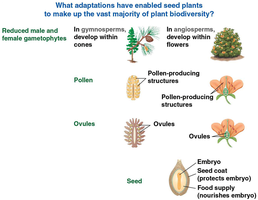
Seed plants possess reduced gametophytes, heterospory, ovules, and pollen, which collectively reduce dependence on water for fertilization and increase protection from environmental stress.
Water is not required for fertilization in seed plants, unlike in seedless plants.
Reduced Gametophytes
Seed plant life cycles are dominated by the sporophyte generation, with microscopic gametophytes that are nutritionally dependent on the sporophyte.
Gametophytes develop from spores retained within the sporangia of the parent sporophyte, providing protection and nutrients.
This adaptation shields gametophytes from drought and UV radiation.
Heterospory
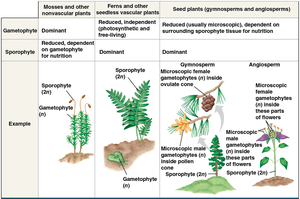
Seed plants are heterosporous, producing two distinct types of spores:
Megaspores develop into female gametophytes.
Microspores develop into male gametophytes.
Heterospory contrasts with homospory in ferns and their relatives, which produce one spore type.
Ovules and Egg Production
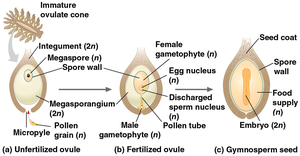
An ovule consists of a megaspore within a megasporangium, surrounded by protective integuments.
Gymnosperms typically have one integument; angiosperms have two.
The ovule develops into a seed after fertilization.
Pollen and Sperm Production
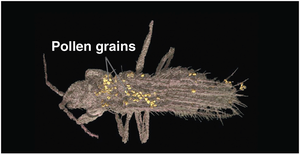
Pollen grains are male gametophytes enclosed within a protective wall, enabling fertilization without water.
Pollination is the transfer of pollen to the ovule-containing part of the plant, often by wind or animals.
Pollen grains germinate on the female structure, producing a pollen tube that delivers sperm to the egg.
Evolutionary Advantages of Seeds
Seeds provide several advantages over spores:
Seeds are multicellular and contain stored food, supporting the embryo during germination.
Seeds can remain dormant for extended periods, germinating when conditions are favorable.
Seeds facilitate long-distance dispersal by wind or animals.
Gymnosperms: "Naked Seed" Plants
Gymnosperms bear seeds exposed on sporophylls, usually in cones. Most gymnosperms are conifers (e.g., pines, firs, redwoods).
The Life Cycle of a Pine
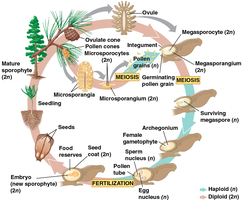
Pine trees exhibit key reproductive adaptations: miniaturized gametophytes, seeds, and pollen.
Male cones produce pollen grains (male gametophytes) via meiosis.
Female (ovulate) cones produce megaspores that develop into female gametophytes.
Fertilization and seed development can take up to three years.
Early Seed Plants and the Rise of Gymnosperms
Seed plant characteristics date back to the late Devonian period (~380 million years ago). Gymnosperms replaced seedless vascular plants as the climate became drier, aided by seeds and pollen.
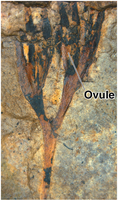
Gymnosperm Diversity
There are four phyla of gymnosperms:
Cycadophyta: Large cones, palm-like leaves, flagellated sperm; most endangered plant group.
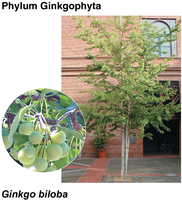
Ginkgophyta: Only one living species, Ginkgo biloba, tolerant of pollution, with flagellated sperm.
Gnetophyta: Includes Gnetum, Ephedra, and Welwitschia; diverse habitats.
Coniferophyta: Largest group, mostly evergreens with needle- or scale-like leaves.
Angiosperms: Flowering Plants
Angiosperms are seed plants with reproductive structures called flowers and fruits. They comprise over 90% of all plant species and dominate most terrestrial ecosystems.
Flowers
Flowers are specialized shoots with four types of modified leaves (floral organs):
Sepals: Enclose the flower bud.
Petals: Often brightly colored to attract pollinators.
Stamens: Male organs (microsporophylls) producing pollen.
Carpels: Female organs (megasporophylls) producing ovules.
Flowers may have radial or bilateral symmetry, influencing pollinator interactions.
Fruits
Fruits develop from the ovary after fertilization and aid in seed protection and dispersal.
Fruits can be fleshy (e.g., tomatoes, grapes) or dry (e.g., beans, nuts).
Dispersal adaptations include wind, water, animal ingestion, or attachment to fur.
The Angiosperm Life Cycle
Angiosperms exhibit a unique process called double fertilization:
One sperm fertilizes the egg, forming a diploid zygote.
The other sperm fuses with two nuclei to form a triploid endosperm, which nourishes the embryo.
The seed contains the embryo, endosperm, and seed coat.
Fossil Angiosperms and Phylogeny
Angiosperms originated in the early Cretaceous (~140 mya) and diversified rapidly. Early angiosperms were likely small-flowered, woody shrubs.
Evolutionary Links with Animals
Plants and animals have co-evolved, especially in pollination and herbivory. Bilaterally symmetrical flowers can increase speciation rates by promoting specialized pollinator interactions.
Angiosperm Diversity
Angiosperms are divided into several groups:
Monocots: One cotyledon; includes grasses, orchids, and palms.
Eudicots: Two cotyledons; includes most familiar flowering trees and crops.
Basal angiosperms: Oldest lineages, such as Amborella and water lilies.
Magnoliids: Woody and herbaceous plants with spiral floral organs.
Human Welfare and Seed Plants
Seed plants are essential for human survival, providing food, fuel, wood, and medicines. Most of our calories come from a few angiosperm crops, and many medicines are derived from seed plants.
Threats to Plant Diversity
Habitat destruction, especially in the tropics, threatens plant diversity and the animals that depend on them. Loss of plant species can have practical and ethical consequences, including the loss of potential medicinal resources.
