 뒤로
Plant Sensory Systems: Signals and Responses
스터디 가이드 - 스마트 노트
 자료에 맞춘 맞춤형 노트, 핵심 정의, 예시, 맥락을 확장해 제공합니다.
Plant Sensory Systems, Signals, and Responses
Introduction to Plant Sensory Systems
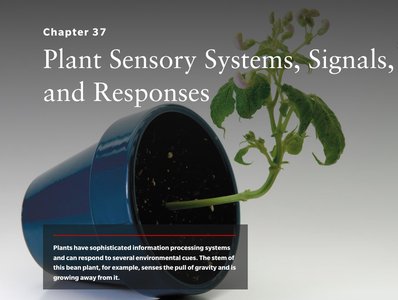
Plants possess sophisticated information processing systems that allow them to detect and respond to various environmental cues. These responses maximize their survival, growth, and reproduction. Unlike animals, plants do not have nervous systems, but they use chemical, electrical, and mechanical signals to communicate and adapt to their surroundings.
Information Processing in Plants
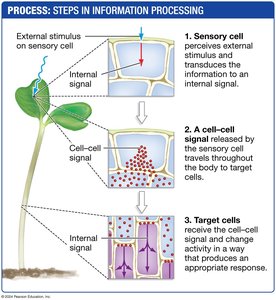
Plants gather, process, and respond to information through signal transduction pathways. This process involves three main steps:
Sensory cell: Detects external stimuli and converts them into internal signals.
Cell-to-cell signal: The sensory cell releases a signal (such as a hormone) that travels to target cells.
Target cell: Receives the signal and changes its activity to produce an appropriate response.
Signal Transduction Pathways
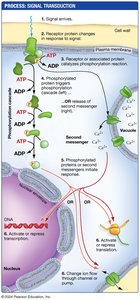
Signal transduction is the process by which a cell detects an external or internal signal and converts it into a cellular response. There are two main types of transduction pathways:
Phosphorylation cascades: Series of protein activations via phosphorylation.
Second messengers: Small molecules that amplify the signal and initiate responses.
These cascades can result in activation of membrane transport proteins, translation machinery, or changes in gene expression.
Plant Hormones (Phytohormones)
Hormones are chemical messengers produced in low concentrations that modulate cellular processes in distant cells. In plants, hormones such as auxin, gibberellins, cytokinins, ethylene, and abscisic acid play crucial roles in growth, development, and responses to stimuli.
Plant Responses to Light
Photoreceptors and Light Wavelengths
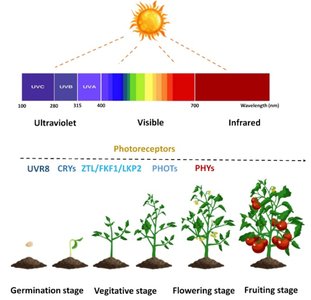
Sunlight consists of various wavelengths, and plants use photoreceptors to detect these wavelengths and regulate growth and development. Different photoreceptors are sensitive to ultraviolet, visible, and infrared light, affecting processes such as germination, flowering, and fruiting.
Phototropism: Plant Movement Toward Light
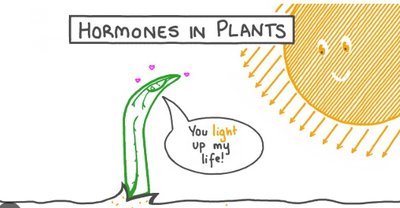
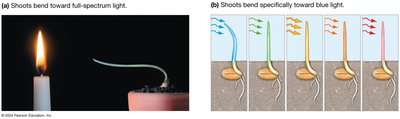
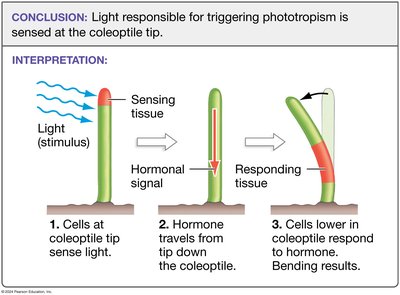
Phototropism is the directional growth of plants in response to light, primarily blue light. Phototropins are blue-light receptors that initiate signaling pathways, leading to hormone-induced cell elongation on the shaded side of the shoot, causing the plant to bend toward the light.
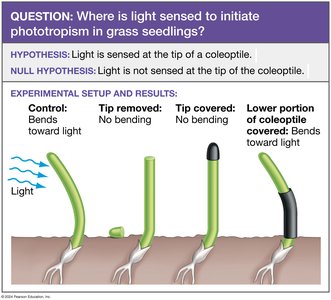
Charles and Francis Darwin demonstrated that the tip of the coleoptile senses light and produces a hormonal signal (auxin) that travels downward, causing cells to elongate and the shoot to bend.
Red and Far-Red Light Responses
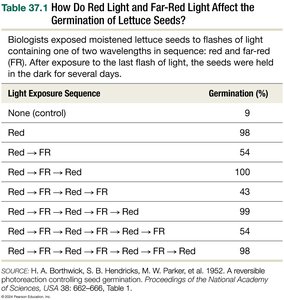
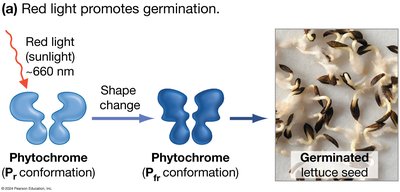
Plants respond differently to red and far-red light. Red light promotes germination, while far-red light inhibits it. The phytochrome receptor exists in two forms (Pr and Pfr) and can switch between them depending on the light wavelength, affecting processes like germination, stem elongation, and flowering.
Light Exposure Sequence | Germination (%) |
|---|---|
None (control) | 9 |
Red | 98 |
Red → FR | 54 |
Red → FR → Red | 100 |
Red → FR → Red → FR | 43 |
Red → FR → Red → FR → Red | 98 |
Red → FR → Red → FR → Red → FR | 54 |
Summary
Plants detect and respond to environmental stimuli using sensory cells, signal transduction pathways, and hormones.
Light, gravity, touch, and other cues trigger specific responses that optimize plant growth and survival.
Photoreceptors and phytohormones play key roles in mediating these responses.
Additional info: The notes above expand on the original lecture content by providing definitions, examples, and context for signal transduction, photoreceptors, and hormone action in plants, as well as including a recreated table for red/far-red light effects on seed germination.
