 뒤로
Lec26 Population Ecology: Structure, Dynamics, and Ecological Concepts
스터디 가이드 - 스마트 노트
 자료에 맞춘 맞춤형 노트, 핵심 정의, 예시, 맥락을 확장해 제공합니다.
Ecology: The Study of Interactions
Definition and Importance
Ecology is a branch of biology that examines how living organisms interact with each other and their environment. Understanding ecology is essential for conservation, resource management, and recognizing human impacts on nature.
Key Point 1: Ecology studies both macroorganisms (plants, animals) and microorganisms (bacteria, archaea, viruses).
Key Point 2: Ecological research provides the scientific basis for conservation and management efforts.
Example: Ecologists investigate how climate change affects species distribution and abundance.
Levels of Ecological Organization
Definitions and Hierarchy
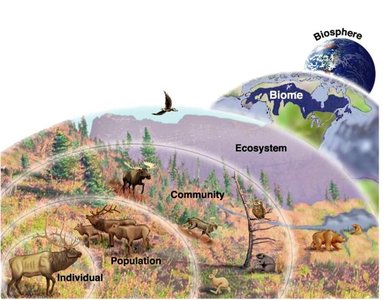
Ecological study is organized into hierarchical levels, each focusing on different aspects of biological interactions and environmental relationships.
Organism: An individual living thing belonging to a species.
Population: All individuals of the same species living in a specific area, interacting and potentially interbreeding.
Community: All populations of different species living and interacting in a particular area.
Ecosystem: A community of organisms and the abiotic factors they interact with, functioning as a unit.
Biome: Large geographic area characterized by climate and dominant vegetation.
Biosphere: The global sum of all ecosystems where life exists.
Types of Ecological Study
Questions and Focus Areas
Ecologists investigate different levels of biological organization, each with distinct research questions.
Organismal Ecology: How do individuals interact with each other and their environment?
Population Ecology: How and why does population size change over space and time?
Community Ecology: How do species interact, and what are the consequences?
Ecosystem Ecology: How does energy flow and how do nutrients cycle through the environment?
Global Ecology: How is the biosphere affected by global changes in nutrient cycling and climate?
Population Ecology
Introduction and Key Concepts
Population ecology focuses on groups of the same species, seeking to understand how environmental factors affect their abundance, distribution, and dynamics.
Abundance: The number of individuals present in a population.
Range: The geographic area where a population can live.
Distribution: How individuals are arranged within their range.
Dynamics: How abundance, range, and distribution change over time.
Abundance vs Density
Abundance: Total number of individuals in a population.
Density: Number of individuals per unit area or volume.
Range and Distribution
Range: The spatial extent where a population exists.
Distribution: The spatial arrangement of individuals within their range.
Estimating Population Size
Population size can be estimated using several methods, each with its own challenges.
Direct Counts: Counting all individuals in a population.
Quadrat Sampling: Counting individuals in randomly selected areas.
Transect Sampling: Counting individuals along a line.
Mark–Recapture Method: Marking individuals, releasing them, and recapturing to estimate population size.
Factors Affecting Population Growth
Biotic and Abiotic Factors
Population size, range, and distribution are influenced by both biotic (living) and abiotic (non-living) factors.
Biotic Factors: Competition, predation, disease, and interactions with other organisms.
Abiotic Factors: Climate, water availability, soil characteristics, temperature, and other physical conditions.
Ecological Niche
An ecological niche describes the role of a species in its environment, including how it obtains resources and interacts with other organisms.
Definition 1: The role or job of a species in an environment.
Definition 2: The range of environmental conditions a species can tolerate and the resources it can use.
Example: Different organisms occupy specific niches in aquatic environments based on salinity levels.
Population Growth Models
Carrying Capacity and Growth Types
Population growth is influenced by resource availability and environmental limits.
Carrying Capacity (K): The maximum population size an environment can support over time.
Exponential Growth: Occurs when resources are unlimited.
Logistic Growth: Occurs when resources become limited, and population growth slows as it approaches carrying capacity.
Population Growth Equation (Logistic Model): where: = population size = intrinsic rate of increase = carrying capacity
Density-Dependent and Density-Independent Factors
Density-Dependent Factors: Effects increase with population density (e.g., competition, disease, accumulation of toxic wastes).
Density-Independent Factors: Effects are unrelated to population density (e.g., natural disasters, pollution from external sources).
Ecological Community and Habitat
Community and Habitat Definitions
An ecological community consists of interacting populations of different species living in the same habitat. A habitat is the specific local environment providing the resources and conditions needed for survival.
Community: All populations of different species in a habitat.
Habitat: The physical environment or place with necessary resources and conditions.
