 뒤로
뒤로Preparation and Analysis of Molar Solutions: Copper Sulfate Pentahydrate and Spectrophotometry
스터디 가이드 - 스마트 노트
 자료에 맞춘 맞춤형 노트, 핵심 정의, 예시, 맥락을 확장해 제공합니다.
Preparation of Known Molar Solutions of Copper Sulfate Pentahydrate
Introduction
This lab focuses on the preparation of molar solutions, calculation of molecular mass, and the use of spectrophotometry to analyze solution concentration. The experiment uses copper sulfate pentahydrate (CuSO4·5H2O) as the solute and explores key concepts such as moles, molarity, and the Beer-Lambert Law.
Laboratory Safety
General Safety Precautions
Always wear safety glasses and gloves when handling chemicals.
Never pipet by mouth; use pipet pumps or bulbs.
Handle glassware with care to avoid injury from breakage.
Dispose of chemical waste in designated containers, not down the sink.
Clean all equipment thoroughly after use and return items to their proper place.

Key Concepts and Definitions
Molecular Formula
The molecular formula indicates the total number and types of atoms in a molecule. For copper sulfate pentahydrate, the formula is CuSO4·5H2O, which includes:
1 copper atom (Cu)
1 sulfur atom (S)
4 oxygen atoms (O) from sulfate
5 water molecules (10 hydrogen atoms and 5 oxygen atoms)
Molecular Mass and Molar Mass
Molecular mass is the sum of the atomic masses of all atoms in a molecule, measured in atomic mass units (amu) or daltons. Molar mass is the mass of one mole of a substance, measured in grams per mole (g/mol).
To calculate molecular mass, sum the atomic masses of each element multiplied by the number of atoms present.
For CuSO4·5H2O: Cu: 63.55 g/mol S: 32.065 g/mol O: 15.999 g/mol × 9 = 143.991 g/mol H: 1.0079 g/mol × 10 = 10.079 g/mol Total molar mass = 250 g/mol
Mole
A mole is a fundamental unit in chemistry representing Avogadro's number (6.022 × 10²³) of atoms or molecules. One mole of a substance has a mass equal to its molecular mass in grams.
Example: 18 g of H2O = 1 mole of water
Example: 180 g of C6H12O6 = 1 mole of glucose
Molarity
Molarity (M) is the concentration of a solution, defined as moles of solute per liter of solution:
To prepare a 1 M solution of CuSO4·5H2O in 1 L: 250 g is required.
For 20 mL (0.020 L):
Preparation of Standard Solutions
Stepwise Procedure
Weigh the calculated amount of CuSO4·5H2O.
Dissolve in less than the final volume of water, then bring to the final volume after complete dissolution.
Mix thoroughly using a stir plate and, if necessary, gentle heat (not exceeding 30°C).
Prepare a series of dilutions for standard curve construction using the equation:
Spectrophotometry and Beer-Lambert Law
Principle of Spectrophotometry
Spectrophotometry measures the amount of light absorbed by a solution. The relationship between absorbance (A), concentration (c), and path length (l) is described by the Beer-Lambert Law:
A = absorbance
\(\varepsilon\) = molar extinction coefficient
c = concentration of solute
l = path length (cm)
Calibration with a blank (solvent only) is essential to set a baseline for accurate measurements.
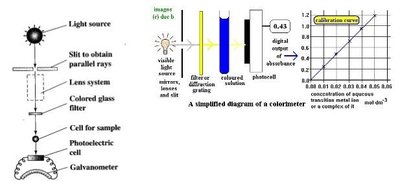
Standard Curve
A standard curve is a graph plotting known concentrations of a substance against their measured absorbance. This curve allows determination of unknown concentrations by interpolation.
Plot concentration (M) on the x-axis and absorbance at 635 nm on the y-axis.
Use a scatterplot for data visualization.
Key Laboratory Terms
Solvent: The substance (usually liquid) in which the solute is dissolved.
Solute: The substance dissolved in the solvent.
Solution: A homogeneous mixture of solute and solvent.
Colorimeter: An instrument that measures the absorbance of specific wavelengths of light by a solution.
Absorbance: A measure of the amount of light absorbed by a solution at a particular wavelength.
Data Collection and Analysis
Measuring Absorbance
Calibrate the colorimeter with a cuvette containing deionized water (blank).
Measure absorbance of each standard and unknown solution at 635 nm.
Record data and plot on the standard curve to determine unknown concentrations.
Sample Table: Standard Curve Volumes
Test Tube | 1 M CuSO4 (mL) | dH2O (mL) | Concentration (M) |
|---|---|---|---|
1 | 0 | 5 | 0.0 |
2 | 0.5 | 4.5 | 0.1 |
3 | 1.0 | 4.0 | 0.2 |
4 | 1.5 | 3.5 | 0.3 |
5 | 2.0 | 3.0 | 0.4 |
6 | 2.5 | 2.5 | 0.5 |
7 | 3.75 | 1.25 | 0.75 |
8 | 5 | 0 | 1.0 |
Conclusions and Applications
Spectrophotometry is not suitable for colorless solutes (e.g., salt, sugar) because they do not absorb visible light.
Standard curves are essential for quantifying unknown concentrations in spectrophotometric assays.
Calibration with a blank ensures accurate baseline measurements by accounting for solvent absorbance.
Additional Info
Proper lab technique and accurate calculations are critical for reproducible results.
Understanding solution preparation and spectrophotometric analysis is foundational for many biological and chemical experiments.
