 뒤로
Protists: Diversity, Classification, and Ecological Roles
스터디 가이드 - 스마트 노트
 자료에 맞춘 맞춤형 노트, 핵심 정의, 예시, 맥락을 확장해 제공합니다.
Protists: Classification and Overview
Definition and General Characteristics
Protists are a diverse group of eukaryotic microorganisms that are not classified as plants, animals, or fungi. They exhibit remarkable structural and functional diversity, ranging from unicellular to multicellular forms, and are found in a variety of aquatic and moist terrestrial environments.
Protists are eukaryotes, meaning they possess membrane-bound organelles and a nucleus.
They are classified within the Domain Eukarya.
Protists include photoautotrophs, heterotrophs, and mixotrophs.
Kingdom Protista is no longer valid; protists are now distributed across several supergroups.
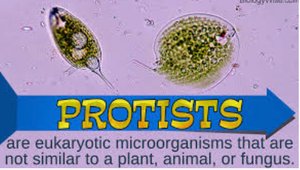
Biological Classification Hierarchy
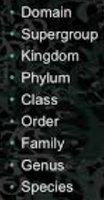
The classification of living organisms follows a hierarchical structure, which includes several taxonomic ranks.
Domain → Supergroup → Kingdom → Phylum → Class → Order → Family → Genus → Species
Three Domains of Life
All life is classified into three domains: Bacteria, Archaea, and Eukarya. Protists belong to the Eukarya domain.
Bacteria: Prokaryotic, no nucleus
Archaea: Prokaryotic, distinct biochemistry
Eukarya: Eukaryotic, includes protists, plants, fungi, and animals

Structural and Functional Diversity of Protists
Cellular Organization
Protists display a wide range of cellular organizations:
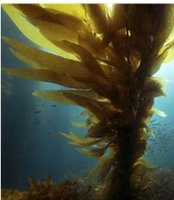
Most are unicellular, but some are colonial or multicellular (e.g., kelps).
Single-celled protists carry out all life functions within one cell.
Nutritional Diversity
Protists are the most nutritionally diverse eukaryotes:
Photoautotrophs: Use chloroplasts for photosynthesis.
Heterotrophs: Absorb organic molecules or ingest food particles.
Mixotrophs: Combine photosynthesis and heterotrophic nutrition (e.g., Euglena).
Endosymbiosis and Eukaryotic Evolution
Endosymbiotic Theory
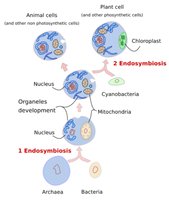
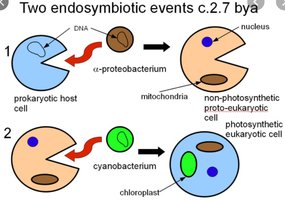
Endosymbiosis describes a relationship where one organism lives inside another. The origin of mitochondria and plastids (chloroplasts) in eukaryotes is explained by this theory.
Mitochondria originated from an engulfed alpha proteobacterium.
Plastids (chloroplasts) evolved from an engulfed cyanobacterium.
Primary endosymbiosis led to red and green algae; secondary endosymbiosis further diversified protists.
Classification: Four Supergroups of Eukaryota
Overview of Supergroups
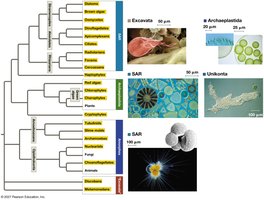
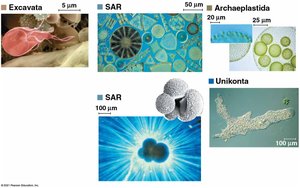
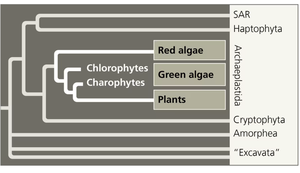
Protists are distributed across four major supergroups within Domain Eukarya:
SAR (Stramenopiles, Alveolates, Rhizarians)
Archaeplastida (includes red and green algae, land plants)
Amorphea (includes animals, fungi, and some protists)
Excavata (includes various flagellated protists)
The SAR Clade: Stramenopiles, Alveolates, Rhizarians
Stramenopiles
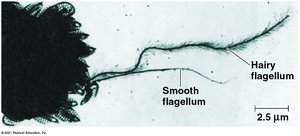
Stramenopiles are important photosynthetic organisms, characterized by a "hairy" flagellum paired with a "smooth" flagellum.
Includes diatoms, brown algae, and oomycetes.
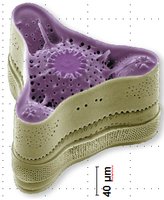
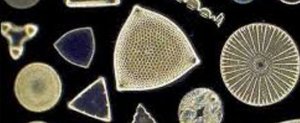
Diatoms
Diatoms are unicellular algae with unique, glass-like walls of silicon dioxide.
Major component of phytoplankton.
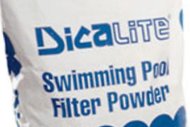
Dead diatom walls form diatomaceous earth.
Contribute to carbon fixation, removing CO2 from the atmosphere.

Brown Algae
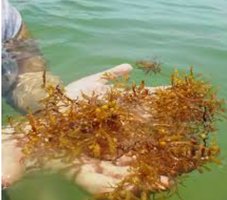
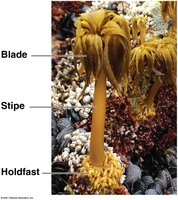
Brown algae are the largest and most complex protists, all multicellular and mostly marine.
Commonly called "seaweeds"; kelps are giant seaweeds.
Have plant-like bodies with holdfast, stipe, and blades (analogous to plant structures).
Used as food and in processed food thickening (algin).
Oomycetes
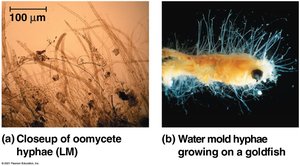
Oomycetes include water molds, white rusts, and downy mildews.
Cell walls composed of cellulose (not chitin like fungi).
Acquire nutrients through parasitism or decomposition.
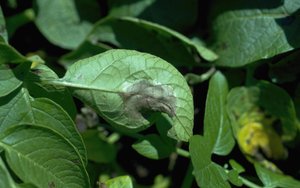
Phytophthora infestans causes potato late blight.
Alveolates
Alveolates possess membrane-enclosed sacs (alveoli) under the plasma membrane.
Includes dinoflagellates, apicomplexans, and ciliates.
Dinoflagellates
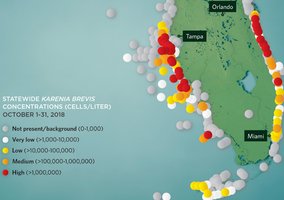
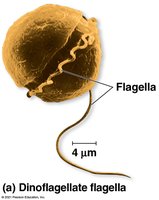
Dinoflagellates are abundant unicellular algae with two flagella and cellulose plates.
Components of marine and freshwater plankton.
Some cause toxic "red tides" (e.g., Karenia brevis).
Produce brevetoxins harmful to marine life.
Apicomplexans
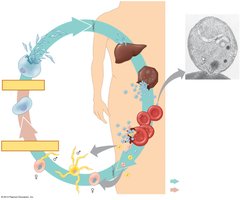
Apicomplexans are parasitic protists with a complex of organelles at one end for penetrating host cells.
Spread as infectious cells called sporozoites.
Plasmodium causes malaria, requiring two hosts (mosquito and human).
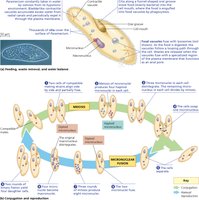
Ciliates
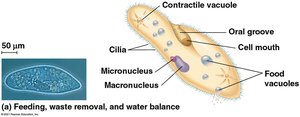
Ciliates use motile cilia for locomotion and feeding.
Contain two nuclei: macronucleus and micronucleus.
Contractile vacuole for osmoregulation.
Reproduce by conjugation (sexual) and transverse fission (asexual).
Example: Paramecium
Rhizarians
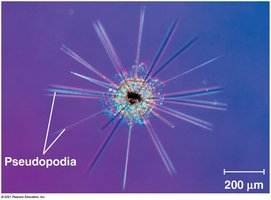
Rhizarians include many amoebas, some with thread-like pseudopodia.
Radiolarians have symmetrical internal skeletons made of silica.
Pseudopodia are used for movement and feeding by phagocytosis.
Archaeplastida: Red and Green Algae
Red Algae
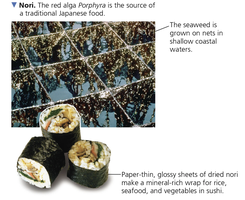
Red algae (rhodophytes) contain phycoerythrin, a red pigment.
Most are multicellular.
Used in agar, carrageenan, and sushi wraps.
Green Algae
Green algae are named for their green chloroplasts and are divided into chlorophytes and charophytes.
Charophytes are most closely related to land plants.
Large size and complexity evolved via colonies, multicellular bodies, and repeated nuclear division without cytoplasmic division.
Amorphea (Unikonta): Protists Related to Fungi and Animals
Amoebozoans
Amoebozoans are amoebas with lobe- or tube-shaped pseudopodia.
Includes tubulinids, slime molds, and archamoebas.
Dictyostelium discoideum is a model organism for multicellular evolution.
Entamoeba histolytica causes amebic dysentery.
Opisthokonts
Opisthokonts include animals, fungi, and closely related protists.
Choanoflagellates are the closest living relatives to animals.
Excavata: Flagellated Protists
Metamonada
Metamonada are anaerobic, heterotrophic, flagellated protists.
Trichomonas vaginalis is a sexually transmitted parasite.
Giardia intestinalis causes intestinal infections.
Discoba
Discoba includes Euglenids and Kinetoplastids.
Euglenids (e.g., Euglena) are mixotrophs with a spiral rod inside their flagella.
Kinetoplastids (e.g., Trypanosoma) cause African sleeping sickness and Chagas' disease.
Ecological Roles of Protists
Key Producers and Symbionts
Protists play essential roles in ecological communities:
Photosynthetic protists (e.g., diatoms, dinoflagellates) are major producers in aquatic environments.
Dinoflagellates form symbiotic relationships with coral polyps, supporting coral reefs.
Protists contribute to the global carbon cycle and are used in biodiesel production.
Summary Table: Major Protist Groups and Characteristics
Supergroup | Major Clades | Key Features | Examples |
|---|---|---|---|
SAR | Stramenopiles, Alveolates, Rhizarians | Photosynthetic, flagella, pseudopodia | Diatoms, Brown algae, Paramecium, Radiolarians |
Archaeplastida | Red algae, Green algae | Chloroplasts, multicellular | Nori, Volvox, Chara |
Amorphea | Amoebozoans, Opisthokonts | Lobe-shaped pseudopodia, multicellular evolution | Dictyostelium, Entamoeba, Choanoflagellates |
Excavata | Metamonada, Discoba | Flagellated, mixotrophic, parasitic | Euglena, Trypanosoma, Giardia |
