 뒤로
Regulation of Gene Expression: Mechanisms and Concepts
스터디 가이드 - 스마트 노트
 자료에 맞춘 맞춤형 노트, 핵심 정의, 예시, 맥락을 확장해 제공합니다.
Regulation of Gene Expression
Overview
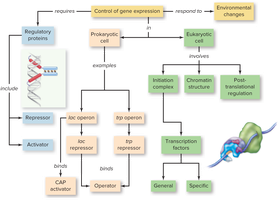
Gene expression regulation is a fundamental process that allows cells to respond to environmental changes and maintain specialized functions. Although all somatic cells share the same genetic content, differences in gene expression result in diverse cell types and functions.
Key Point: Regulation occurs at multiple levels, including transcription, RNA processing, translation, and protein degradation.
Key Point: Abnormal gene expression can lead to diseases such as cancer.
Concept 18.1: Regulation in Prokaryotes
Operon Model and Metabolic Control
Prokaryotic cells often regulate gene expression in response to environmental changes, primarily at the transcriptional level. Genes involved in the same metabolic pathway are organized into operons, allowing coordinated regulation.
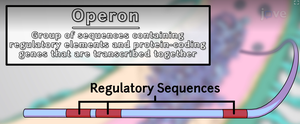
Operon: A group of sequences containing regulatory elements and protein-coding genes transcribed together.
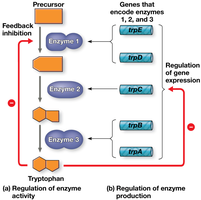
Feedback Inhibition: The end product of a metabolic pathway inhibits enzyme activity, preventing further synthesis.
Gene Regulation: Cells can adjust enzyme production by regulating gene expression.
The lac Operon
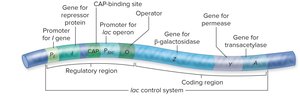
The lac operon in E. coli is a classic example of gene regulation in response to environmental signals. It is induced in the presence of lactose, allowing the cell to metabolize this sugar.
Inducer (Allolactose): Binds to the repressor, inactivating it and permitting transcription.
Regulatory Region: Includes promoter, operator, and CAP-binding site.
Coding Region: Contains genes for β-galactosidase, permease, and transacetylase.
Concept 18.2: Regulation in Eukaryotes
Differential Gene Expression
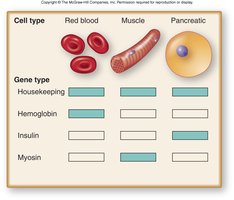
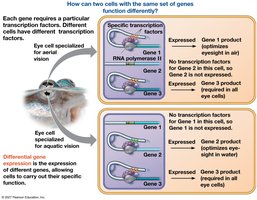
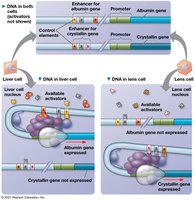
In multicellular organisms, regulation of gene expression is essential for cell specialization. Differential gene expression refers to the expression of different genes by cells with the same genome.
Key Point: Most regulation occurs at the transcriptional level.
Example: Red blood cells express hemoglobin genes, while pancreatic cells express insulin genes.
Stages of Eukaryotic Gene Expression
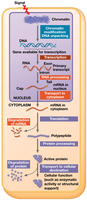
Gene expression in eukaryotes is regulated at multiple stages:
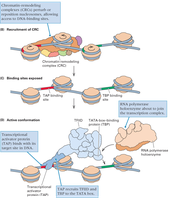
Chromatin Structure: Determines accessibility of DNA for transcription.
Transcription Initiation: Controlled by transcription factors and regulatory elements.
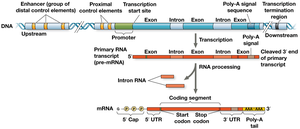
RNA Processing: Includes capping, splicing, and polyadenylation.
Translation: Regulation of mRNA translation into protein.
Protein Processing and Degradation: Modifications and selective degradation of proteins.
Regulation of Chromatin Structure
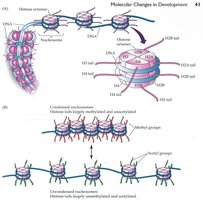
Chromatin structure plays a critical role in gene expression.
Heterochromatin: Highly packed, usually not expressed.
Euchromatin: Less packed, transcriptionally active.
Histone Acetylation: Opens chromatin, promotes transcription.
DNA Methylation: Condenses chromatin, reduces transcription.
Epigenetic Inheritance
Epigenetic inheritance involves the transmission of traits by mechanisms not directly involving the DNA sequence, such as chromatin modifications.
Key Point: Epigenetic changes can be passed to future generations of cells.
Transcription Initiation and Control Elements
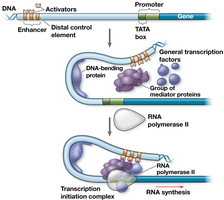
Promoters: DNA sequences where RNA polymerase binds to initiate transcription.
Enhancers: Distal control elements that increase transcription levels.
Activators: Proteins that bind enhancers and stimulate transcription.
Repressors: Proteins that inhibit transcription.
General Transcription Factors: Required for transcription of all protein-coding genes.
Specific Transcription Factors: Regulate expression of particular genes.
Alternative RNA Splicing
Alternative RNA splicing allows a single gene to code for multiple proteins by varying which segments are treated as exons or introns.
Key Point: More than 90% of human protein-coding genes undergo alternative splicing.
Post-Transcriptional Regulation
Regulation after transcription includes RNA processing, translation, and protein degradation.
Protein Processing: Polypeptides undergo cleavage and chemical modifications.
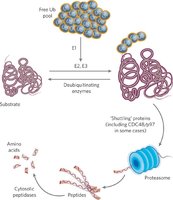
Protein Degradation: Proteins are marked for degradation by ubiquitin and broken down by proteasomes.
Summary Table: Comparison of Gene Regulation Mechanisms
Level | Prokaryotes | Eukaryotes |
|---|---|---|
Transcription | Operon model, repressors, activators | Chromatin structure, transcription factors, enhancers |
RNA Processing | Rare | Alternative splicing, capping, polyadenylation |
Translation | Regulatory proteins, riboswitches | Regulatory proteins, microRNAs |
Protein Processing | Limited | Cleavage, modification, degradation |
Key Terms and Definitions
Operon: Cluster of genes under control of a single promoter and operator.
Inducer: Molecule that inactivates a repressor and initiates transcription.
Epigenetic Inheritance: Transmission of traits not involving DNA sequence changes.
Enhancer: DNA element that increases transcription from a distance.
Alternative Splicing: Process by which different mRNAs are produced from the same gene.
Proteasome: Protein complex that degrades unneeded or damaged proteins.
Important Equations
Transcription:
Translation:
Feedback Inhibition:
Example Applications
Adaptive Advantage: Grouping genes into operons allows bacteria to efficiently respond to environmental changes.
Cell Specialization: Differential gene expression enables cells to perform unique functions, such as insulin production in pancreatic cells.
Additional info:
Epigenetic mechanisms may explain why identical twins can have different susceptibilities to genetic diseases.
Combinatorial control of gene activation allows for complex regulation with a limited number of control elements.
