 뒤로
The Cell Cycle: Mechanisms, Regulation, and Cancer
스터디 가이드 - 스마트 노트
 자료에 맞춘 맞춤형 노트, 핵심 정의, 예시, 맥락을 확장해 제공합니다.
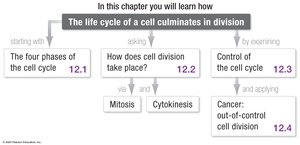
The Cell Cycle
Overview and Importance
The cell cycle is a fundamental process by which cells grow, replicate their DNA, and divide to produce new cells. This process is essential for growth, development, tissue repair, and reproduction in multicellular organisms.
Cell division is the process by which new cells are formed from pre-existing cells.
Organisms start life as single-celled embryos and grow through a series of cell divisions.
Meiosis produces reproductive cells (gametes), while mitosis produces somatic cells.
Phases of the Cell Cycle
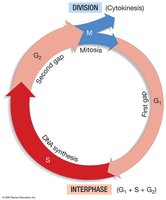
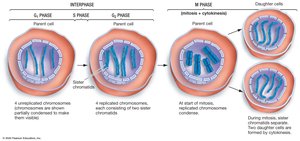
The cell cycle consists of four main phases: M phase (mitosis and cytokinesis), and three interphase stages (G1, S, G2). Cells alternate between division and non-dividing phases.
M phase: Chromosomes are separated and the cell divides.
Interphase: Chromosomes are uncoiled; cells grow, prepare for division, or fulfill specialized functions.
S phase: DNA synthesis and chromosome replication occur.
G1 and G2 phases: Gap phases where cells grow and prepare for DNA replication or mitosis.
Chromosome Structure and Replication
Chromosome Morphology
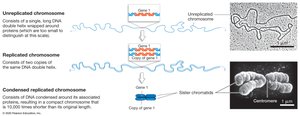
Chromosomes are composed of a single long double helix of DNA wrapped around histone proteins. Genes are regions of DNA that code for specific RNA and proteins.
Before mitosis, chromosomes are replicated and condense into compact structures.
Each double-stranded DNA copy is called a chromatid.
Chromatids are attached by proteins called cohesions and at the centromere.
Sister chromatids are two attached chromatids considered a single chromosome until they separate during mitosis.
Events in M Phase
Mitosis and Cytokinesis
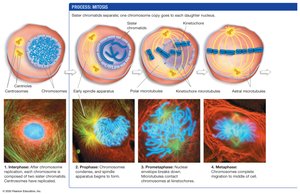
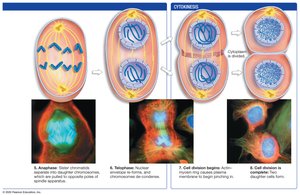
M phase consists of mitosis (division of replicated chromosomes) and cytokinesis (division of cytoplasm). Mitosis is a continuous process with five subphases.
Prophase: Chromatin condenses.
Prometaphase: Nuclear envelope breaks down; spindle fibers attach to chromosomes.
Metaphase: Chromosomes align at the cell's equator.
Anaphase: Sister chromatids separate and move to opposite poles.
Telophase: Nuclear envelope reforms around chromosomes.
Cytokinesis: Cytoplasm divides, forming two daughter cells.
Regulation of the Cell Cycle
Cell-Cycle Control Mechanisms
Cell-cycle length varies among cell types, mainly due to differences in G1 phase duration. Regulation ensures proper division and prevents uncontrolled growth.
Rapidly dividing cells may eliminate G1 phase.
Nondividing cells may enter a permanent arrested state called G0.
Cell-cycle regulation is crucial for organismal health.
M Phase-Promoting Factor (MPF)
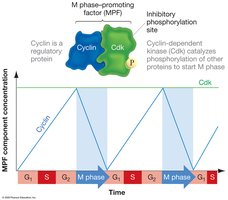
MPF is a key regulator of the cell cycle, composed of a cyclin and a cyclin-dependent kinase (Cdk). MPF activity is controlled by cyclin concentration and phosphorylation.
Cyclin: Regulatory protein whose concentration fluctuates during the cell cycle.
Cdk: Protein kinase active only when bound to cyclin.
MPF is activated by removal of an inhibitory phosphate in late G2 phase.
MPF is deactivated by negative feedback and destruction of cyclin during anaphase.
Cell-Cycle Checkpoints
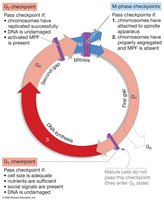
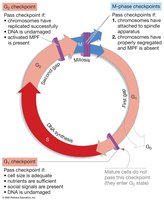
Checkpoints are critical points where the cell cycle can be arrested if conditions are not favorable. There are four main checkpoints: G1, G2, and two in M phase.
G1 checkpoint: Assesses cell size, nutrients, social signals, and DNA damage.
G2 checkpoint: Ensures proper chromosome replication and DNA integrity.
M-phase checkpoints: Ensure proper chromosome attachment and separation.
Defective checkpoints can lead to uncontrolled cell division and cancer.
Cancer and Loss of Cell-Cycle Control
Cancer: Out-of-Control Cell Division
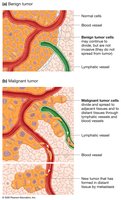
Cancer is a complex family of diseases caused by cells that divide uncontrollably, invade tissues, and spread (metastasize). It arises from failures in cell-cycle checkpoints.
Cancerous cells may activate growth proteins inappropriately or fail to suppress division.
Malignant tumors: Invasive, can spread and form secondary tumors.
Benign tumors: Noncancerous, noninvasive.
Social Control and Checkpoint Failure
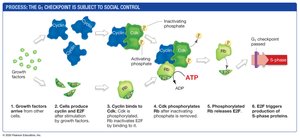
Normal cells respond to growth factors and social signals, dividing only when beneficial. Cancer cells often ignore these signals, leading to unchecked division.
Growth factors stimulate production of regulatory proteins (e.g., E2F).
Retinoblastoma (Rb) protein acts as a gatekeeper, inhibiting E2F and preventing S phase entry.
Cyclin-Cdk complexes phosphorylate Rb, releasing E2F and allowing cell cycle progression.
In cancer, cyclin may be overproduced or Rb may be defective, causing loss of control.
Summary Table: Cell Cycle Phases and Checkpoints
Phase | Main Events | Checkpoint Purpose |
|---|---|---|
G1 | Cell growth, preparation for DNA replication | Checks size, nutrients, signals, DNA damage |
S | DNA synthesis, chromosome replication | None |
G2 | Preparation for mitosis | Checks DNA replication and integrity |
M | Mitosis and cytokinesis | Checks chromosome attachment and separation |
Key Terms and Concepts
Chromatin: DNA-histone complex in relaxed state during interphase.
Centromere: Region where sister chromatids are attached.
Apoptosis: Programmed cell death, often triggered by DNA damage.
Metastasis: Spread of cancer cells to new locations in the body.
Growth factors: Proteins that stimulate cell division.
Equations and Formulas
Cell cycle regulation involves phosphorylation reactions:
Protein kinase reaction:
MPF activation:
Additional info: The notes expand on brief points with academic context, including definitions, examples, and regulatory mechanisms. Images are included only when directly relevant to the explanation of the paragraph.
