 뒤로
The Cell Cycle: Structure, Function, and Regulation
스터디 가이드 - 스마트 노트
 자료에 맞춘 맞춤형 노트, 핵심 정의, 예시, 맥락을 확장해 제공합니다.
The Cell Cycle
Overview and Biological Importance
The cell cycle is a fundamental process by which cells grow, replicate their DNA, and divide to produce new cells. This process is essential for asexual reproduction, growth, development, and tissue renewal in multicellular organisms. - Asexual reproduction: Single-celled organisms reproduce by dividing into two genetically identical cells. - Growth and development: Multicellular organisms increase in size and complexity through repeated cell divisions. - Tissue renewal: Damaged or old cells are replaced by new cells through the cell cycle. 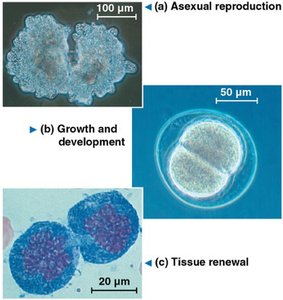
Phases of the Cell Cycle
The cell cycle consists of two main phases: Interphase and the Mitotic (M) phase. Interphase is subdivided into G1, S, and G2 phases, during which the cell grows, replicates its DNA, and prepares for division. The M phase includes mitosis (nuclear division) and cytokinesis (cytoplasmic division). 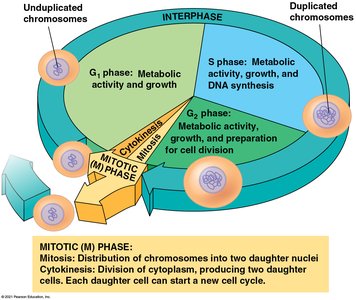
G1 phase: Metabolic activity and cell growth.
S phase: DNA synthesis and chromosome duplication.
G2 phase: Further growth and preparation for mitosis.
Mitotic (M) phase: Distribution of chromosomes and division of cytoplasm.
Chromosomes and Chromatin
Structure and Function
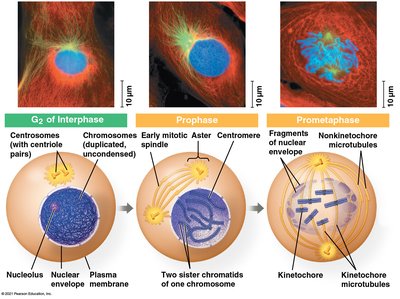
Chromosomes are structures composed of DNA and proteins (chromatin) that carry genetic information. During cell division, chromatin condenses to form visible chromosomes. Each duplicated chromosome consists of two sister chromatids joined at a centromere. 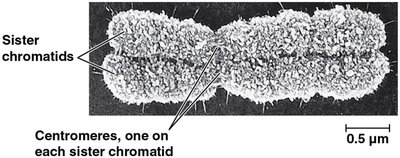
Somatic cells: Body cells with two sets of chromosomes (diploid).
Gametes: Reproductive cells with one set of chromosomes (haploid).
Chromatin: Complex of DNA and protein that condenses during cell division.
Chromosome Duplication and Distribution
Before cell division, chromosomes are duplicated, resulting in two sister chromatids. These chromatids are separated during mitosis, ensuring each daughter cell receives an identical set of chromosomes. 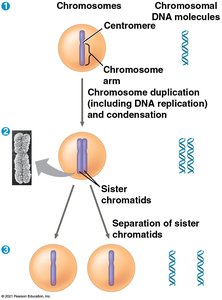
Mitosis and Cytokinesis
Stages of Mitosis
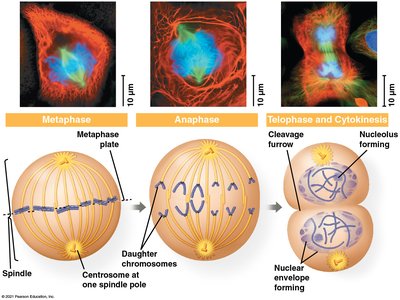
Mitosis is conventionally divided into five stages: prophase, prometaphase, metaphase, anaphase, and telophase. Each stage is characterized by specific events that ensure accurate chromosome segregation.
Prophase: Chromosomes condense, spindle apparatus forms.
Prometaphase: Nuclear envelope fragments, spindle fibers attach to chromosomes.
Metaphase: Chromosomes align at the metaphase plate.
Anaphase: Sister chromatids separate and move to opposite poles.
Telophase: Nuclear envelopes reform, chromosomes decondense.
Cytokinesis
Cytokinesis is the division of the cytoplasm, resulting in two daughter cells. In animal cells, this occurs via a process called cleavage, forming a cleavage furrow that pinches the cell in two. 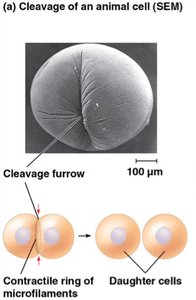
Mitotic Spindle and Chromosome Movement
Mitotic Spindle Structure
The mitotic spindle is a structure made of microtubules that controls chromosome movement during mitosis. It originates from centrosomes and attaches to chromosomes via kinetochores. 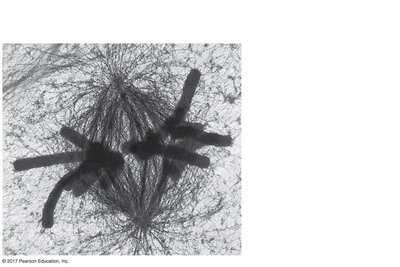
Binary Fission in Prokaryotes
Mechanism of Binary Fission
Prokaryotes, such as bacteria, divide by binary fission, a simpler process than mitosis. The chromosome is replicated, and the cell splits into two genetically identical daughter cells. 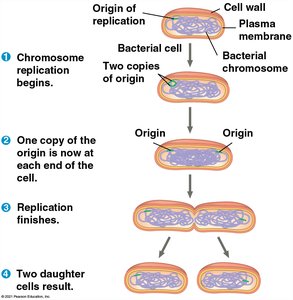
Regulation of the Cell Cycle
Cell Cycle Control System
The cell cycle is regulated by a molecular control system with specific checkpoints (G1, G2, and M) that ensure proper progression. Cells only proceed to the next phase if conditions are favorable and all processes are complete. 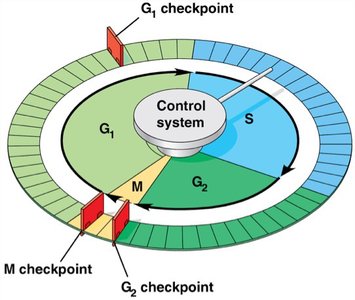
G1 checkpoint: Determines if the cell will proceed to DNA synthesis.
G2 checkpoint: Ensures DNA replication is complete and the cell is ready for mitosis.
M checkpoint: Ensures chromosomes are properly attached to the spindle before anaphase.
Cyclins and Cyclin-Dependent Kinases (Cdks)
Two types of regulatory proteins, cyclins and cyclin-dependent kinases (Cdks), control the cell cycle. Cdks must be bound to cyclins to be active. The activity of Cdks fluctuates with cyclin concentration, forming complexes such as MPF (maturation-promoting factor). 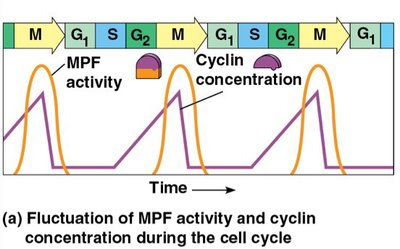
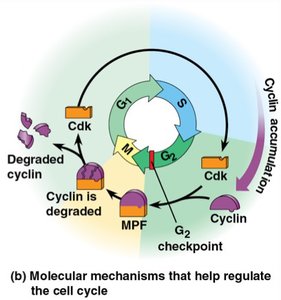
MPF: Cyclin-Cdk complex that triggers the cell's entry into mitosis.
Cyclin accumulation: Cyclin levels rise and fall during the cell cycle, regulating Cdk activity.
Internal and External Signals
Cell cycle checkpoints are influenced by internal signals (e.g., proper chromosome attachment) and external signals (e.g., growth factors). Cancer cells can evade these controls, leading to uncontrolled division.
Summary Table: Cell Cycle Phases and Key Events
Phase | Main Events |
|---|---|
G1 | Cell growth, metabolic activity |
S | DNA synthesis, chromosome duplication |
G2 | Further growth, preparation for mitosis |
Mitosis | Chromosome segregation, nuclear division |
Cytokinesis | Division of cytoplasm, formation of two daughter cells |
Key Equations and Concepts
Chromosome Number Conservation
During mitosis, the chromosome number is maintained:
Cell Cycle Regulation
The activity of cyclin-dependent kinases (Cdks) is regulated by cyclin concentration:
Conclusion
The cell cycle is a highly regulated process essential for growth, development, and maintenance of all living organisms. Understanding its phases, regulation, and mechanisms is fundamental to biology and medicine. Additional info: Expanded explanations and context were added to clarify the molecular control system, the role of cyclins and Cdks, and the biological significance of cell division.
