 뒤로
The Chromosomal Basis of Inheritance
스터디 가이드 - 스마트 노트
 자료에 맞춘 맞춤형 노트, 핵심 정의, 예시, 맥락을 확장해 제공합니다.
Chapter 15: The Chromosomal Basis of Inheritance
Introduction
This chapter explores how chromosomes carry genes and how their behavior during meiosis forms the physical basis for Mendelian inheritance. It also examines the experimental evidence that established the chromosome theory of inheritance and discusses the consequences of chromosomal alterations.
Concept 15.1: Mendelian Inheritance and Chromosome Behavior
The Chromosome Theory of Inheritance
Mendel’s hereditary units were theoretical until parallels were drawn between their behavior and that of chromosomes during meiosis.
In the early 1900s, Sutton, Boveri, and others developed the chromosome theory of inheritance, which states that genes are located on chromosomes and that the behavior of chromosomes during meiosis accounts for inheritance patterns.
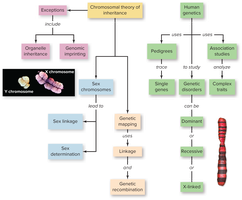
Genes and Chromosomes
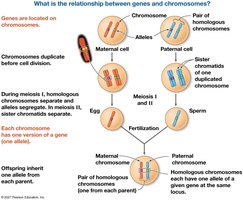
Genes are segments of DNA located on chromosomes.
Chromosomes duplicate before cell division, and homologous chromosomes separate during meiosis, distributing genes to gametes.
Each chromosome carries one version (allele) of a gene from each parent.
Experimental Evidence: Thomas Hunt Morgan’s Work
Morgan used Drosophila melanogaster (fruit flies) for genetic studies due to their short generation time, high offspring number, and only four pairs of chromosomes.
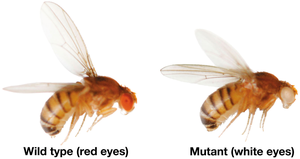
He distinguished between wild type (normal) and mutant phenotypes (e.g., white-eyed vs. red-eyed flies).
Correlating Gene Behavior with Chromosome Behavior
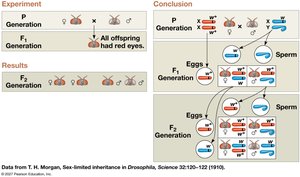
Morgan crossed white-eyed males with red-eyed females. All F1 offspring had red eyes, but in the F2 generation, only males had white eyes, suggesting the gene for eye color is on the X chromosome.
This provided strong evidence for the chromosome theory of inheritance.
The Chromosomal Basis of Mendel’s Laws
The law of segregation and law of independent assortment are explained by the behavior of chromosomes during meiosis.
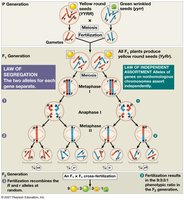
Concept 15.2: Sex-Linked Genes and Sex Determination
Sex Chromosomes and Sex Determination
Humans and other mammals have two types of sex chromosomes: X (large) and Y (small).
Females are XX; males are XY. The presence of the SRY gene on the Y chromosome triggers male development.
Other sex determination systems exist, such as X-0, Z-W, and haplo-diploid systems in different organisms.
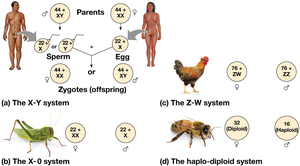
Sex-Linked Genes
Genes located on sex chromosomes are called sex-linked genes.
Y-linked genes are found only on the Y chromosome; X-linked genes are found on the X chromosome.
The human X chromosome contains about 900 genes, while the Y chromosome contains about 70-200 genes.
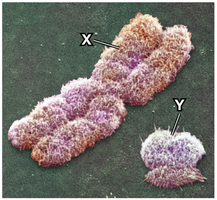
Inheritance of X-Linked Genes
X-linked recessive traits are more common in males (who have only one X chromosome) than in females (who need two copies of the allele).
Examples include color blindness and hemophilia.
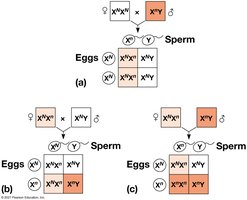
X Inactivation in Female Mammals
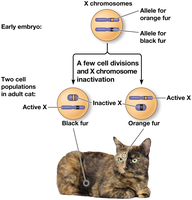
In females, one X chromosome in each cell is randomly inactivated during embryonic development, forming a Barr body.
Females heterozygous for X-linked genes are mosaics, with different cells expressing different alleles (e.g., tortoiseshell cats).
Concept 15.3: Linked Genes and Genetic Recombination
Linked Genes
Genes located near each other on the same chromosome tend to be inherited together and are called linked genes.
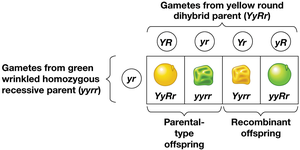
However, nonparental (recombinant) phenotypes can still occur due to genetic recombination.
Genetic Recombination
Genetic recombination is the production of offspring with combinations of traits differing from either parent.
For genes on different chromosomes, recombination frequency is 50% due to independent assortment.
Recombination of Linked Genes: Crossing Over
Linked genes can be separated by crossing over during meiosis, which exchanges segments between homologous chromosomes.
This process increases genetic diversity.
Concept 15.4: Alterations of Chromosome Number or Structure
Abnormal Chromosome Number
Nondisjunction is the failure of homologous chromosomes or sister chromatids to separate properly during meiosis.
This results in aneuploidy—an abnormal number of chromosomes (e.g., monosomy, trisomy).
Alterations of Chromosome Structure
Chromosome breakage can cause:
Deletion: loss of a chromosomal segment
Duplication: repetition of a segment
Inversion: reversal of a segment
Translocation: movement of a segment to a nonhomologous chromosome
Human Conditions Due to Chromosomal Alterations
Some chromosomal alterations cause syndromes with characteristic symptoms.
Down syndrome (trisomy 21) results from three copies of chromosome 21 and is associated with developmental and physical changes.
Sex chromosome aneuploidies include Klinefelter syndrome (XXY), Turner syndrome (XO), and others.
Summary Table: Types of Chromosomal Alterations
Alteration Type | Description | Example |
|---|---|---|
Deletion | Loss of a chromosomal segment | Cri du chat syndrome |
Duplication | Repetition of a segment | Charcot-Marie-Tooth disease |
Inversion | Reversal of a segment within a chromosome | Some forms of hemophilia |
Translocation | Segment moves to a nonhomologous chromosome | Chronic myelogenous leukemia |
Key Terms
Chromosome theory of inheritance: Genes are located on chromosomes, and their behavior during meiosis explains inheritance patterns.
Sex-linked gene: A gene located on a sex chromosome (X or Y).
Linked genes: Genes located close together on the same chromosome, usually inherited together.
Nondisjunction: Failure of chromosomes to separate properly during meiosis.
Aneuploidy: Abnormal number of chromosomes in a cell.
