 뒤로
The Chromosomal Basis of Inheritance: Study Guide
스터디 가이드 - 스마트 노트
 자료에 맞춘 맞춤형 노트, 핵심 정의, 예시, 맥락을 확장해 제공합니다.
Chapter 15: The Chromosomal Basis of Inheritance
Big Idea: Chromosomes are made of genes that determine heredity
Chromosomes are the physical structures that carry genes, the units of heredity. Understanding the relationship between chromosomes and genes is fundamental to genetics.
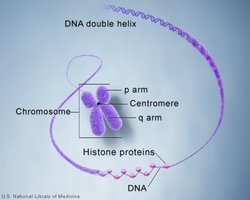
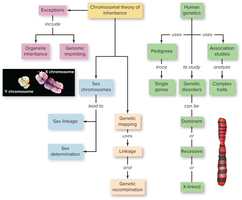
Concept 15.1: Mendelian Inheritance and Chromosome Behavior
Mendel's "hereditary units" were theoretical until parallels between chromosome behavior and inheritance were observed. The chromosome theory of inheritance was developed in the early 1900s, providing a physical basis for Mendel's laws.
Chromosome Theory of Inheritance: Genes are located on chromosomes, and the behavior of chromosomes during meiosis accounts for inheritance patterns.
Historical Evidence: Thomas Hunt Morgan's experiments with fruit flies (Drosophila melanogaster) provided the first solid evidence linking genes to chromosomes.
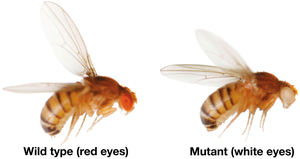
Morgan’s Choice of Experimental Organism
Morgan used Drosophila melanogaster for genetic studies due to its short generation time, high offspring number, and simple chromosome structure.
Wild Type: The normal phenotype common in the population (e.g., red eyes).
Mutant Phenotype: Traits alternative to the wild type (e.g., white eyes).
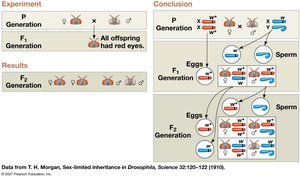
Correlating Gene Alleles with Chromosome Behavior
Morgan's experiments demonstrated that the white-eyed allele in fruit flies is located on the X chromosome, supporting the chromosome theory of inheritance.
Experimental Cross: Mating wild-type females with mutant males produced all red-eyed offspring in the F1 generation. The F2 generation showed a 3:1 ratio, but only males had white eyes.
Conclusion: The white-eyed allele is X-linked.
The Chromosomal Basis of Mendel’s Laws
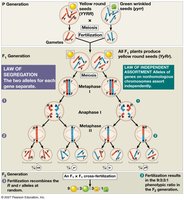
Mendel’s laws of segregation and independent assortment are explained by the behavior of chromosomes during meiosis.
Law of Segregation: The two alleles for each gene separate during gamete formation.
Law of Independent Assortment: Alleles of different genes assort independently during gamete formation.
Concept 15.2: Sex-Linked Genes and Patterns of Inheritance
Sex-linked genes are located on sex chromosomes and exhibit unique inheritance patterns. Morgan’s discovery of sex-linked traits was pivotal for the chromosome theory.
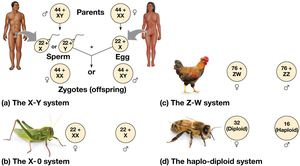
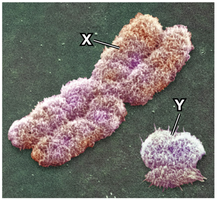
Sex Chromosomes: X and Y chromosomes determine sex in mammals. Other systems exist in different organisms.
Sex-Linked Genes: Genes located on either sex chromosome. X-linked genes are more numerous than Y-linked genes.
Inheritance of X-Linked Genes
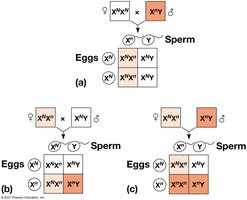
X-linked genes follow specific inheritance patterns. Recessive X-linked traits are more common in males because they have only one X chromosome.
Female Expression: Requires two copies of the allele (homozygous).
Male Expression: Requires only one copy (hemizygous).
Examples: Color blindness, hemophilia.
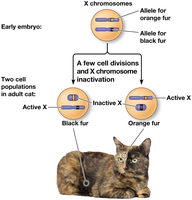
X Inactivation in Female Mammals
In female mammals, one X chromosome in each cell is randomly inactivated, forming a Barr body. Heterozygous females are mosaics for X-linked traits.
Barr Body: The condensed, inactive X chromosome.
Mosaicism: Different cell populations express different alleles.
Concept 15.3: Linked Genes and Genetic Recombination
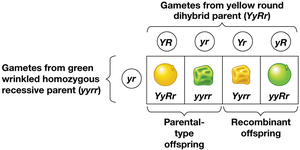
Genes located near each other on the same chromosome tend to be inherited together (linked genes). Genetic recombination can produce new combinations of traits.
Linked Genes: Genes on the same chromosome that are inherited together.
Genetic Recombination: Offspring with combinations of traits different from either parent.
Crossing Over: The mechanism that breaks the physical connection between linked genes during meiosis.
Abnormal Chromosome Number and Structure
Errors in meiosis can lead to abnormal chromosome numbers (aneuploidy) or structural changes. These alterations are associated with various human conditions.
Nondisjunction: Failure of homologous chromosomes to separate properly.
Aneuploidy: Presence of an abnormal number of chromosomes (e.g., trisomy, monosomy).
Alterations of Structure: Deletion, duplication, inversion, and translocation.
Type | Description |
|---|---|
Deletion | Removes a chromosomal fragment |
Duplication | Repeats a segment |
Inversion | Reverses orientation of a segment |
Translocation | Moves a segment to another chromosome |
Human Conditions Due to Chromosomal Alterations
Some chromosomal alterations result in syndromes with characteristic symptoms. Down syndrome (trisomy 21) is a common example of aneuploidy.
Down Syndrome: Caused by three copies of chromosome 21.
Klinefelter Syndrome: Extra X chromosome in males (XXY).
Turner Syndrome: Monosomy X in females (X0).
Summary Table: Chromosomal Alterations and Associated Syndromes
Condition | Chromosomal Alteration | Symptoms |
|---|---|---|
Down Syndrome | Trisomy 21 | Intellectual disability, characteristic facial features |
Klinefelter Syndrome | XXY | Male with extra X, often sterile |
Turner Syndrome | X0 | Female with single X, sterile |
Key Equations:
Probability of inheritance (Mendelian ratio):
(for a monohybrid cross)
(for a monohybrid cross)
Frequency of recombination:
Additional info: The study notes expand on the original content by providing definitions, examples, and tables for clarity. All included images directly reinforce the adjacent explanations and are strictly relevant to the described concepts.
