 뒤로
The Molecular Basis of Inheritance: DNA Structure and Replication
스터디 가이드 - 스마트 노트
 자료에 맞춘 맞춤형 노트, 핵심 정의, 예시, 맥락을 확장해 제공합니다.
The Molecular Basis of Inheritance
Introduction
The molecular basis of inheritance explores how genetic information is stored, transmitted, and replicated within living organisms. Early experiments established that DNA, not protein, is the hereditary material responsible for inheritance.
Historical Experiments Demonstrating DNA as Genetic Material
Mendel, Morgan, and the Chromosomal Theory of Inheritance
Mendel demonstrated that traits are inherited through discrete units called genes.
Morgan showed that genes are located on chromosomes, which contain both DNA and proteins.
The question arose: Which molecule—DNA or protein—carries genetic information?
Griffith’s Transformation Experiment
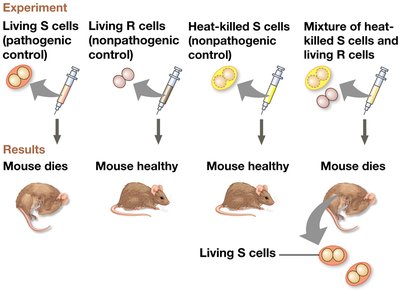
Frederick Griffith’s work with Streptococcus pneumoniae revealed that a substance from dead pathogenic bacteria could transform harmless bacteria into a pathogenic form, suggesting the presence of a heritable material.
Live S (smooth, pathogenic) bacteria killed mice.
Live R (rough, nonpathogenic) and heat-killed S bacteria did not kill mice.
A mixture of live R and heat-killed S bacteria killed mice, and live S bacteria were recovered.
Conclusion: A transforming principle from dead S bacteria changed R bacteria heritably.
Avery, MacLeod, and McCarty’s Experiment
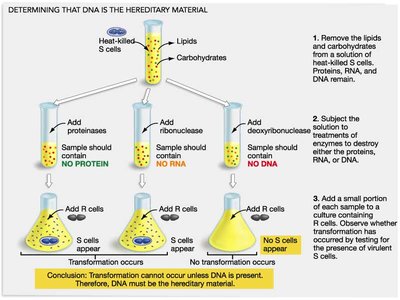
These researchers identified DNA as the transforming material by systematically destroying proteins, RNA, or DNA in bacterial extracts and observing transformation.
Transformation occurred when protein or RNA was destroyed, but not when DNA was destroyed.
Conclusion: DNA is the hereditary material.
Hershey and Chase Experiment
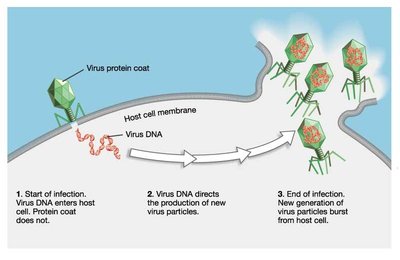
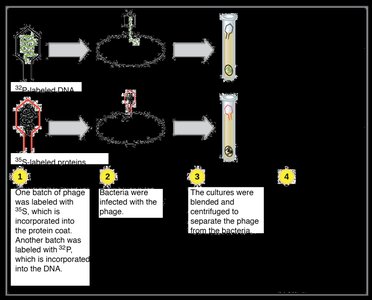
Using bacteriophages (viruses that infect bacteria), Hershey and Chase labeled DNA with radioactive phosphorus and protein with radioactive sulfur to determine which entered bacterial cells during infection.
Only DNA entered the bacteria and directed the production of new viruses.
Conclusion: DNA, not protein, is the genetic material.
Discovering the Structure of DNA
Chargaff’s Rules
DNA base composition varies between species.
In double-stranded DNA, the amount of adenine (A) equals thymine (T), and guanine (G) equals cytosine (C).
Watson, Crick, and the Double Helix
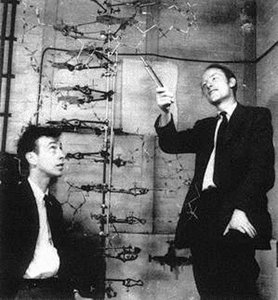
Watson and Crick, using X-ray diffraction data and chemical knowledge, proposed the double helix model of DNA: two antiparallel strands twisted around each other, with specific base pairing (A with T, G with C).
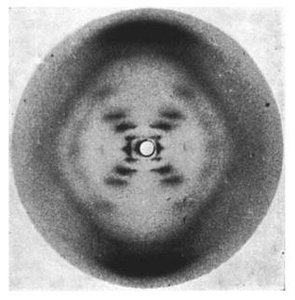
Rosalind Franklin’s X-ray Diffraction
Franklin’s X-ray images provided critical evidence for the helical structure of DNA.
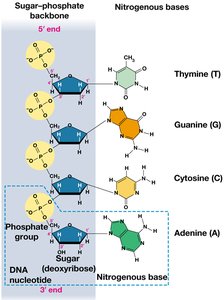
DNA Structure
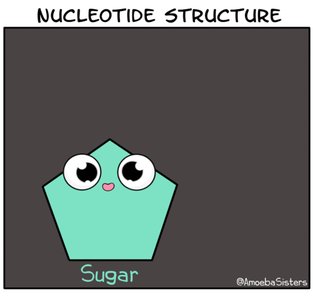
DNA is a polymer of nucleotides, each consisting of a phosphate group, deoxyribose sugar, and a nitrogenous base (A, T, G, or C).
The sugar-phosphate backbone forms the outer sides of the helix; bases pair in the center via hydrogen bonds.
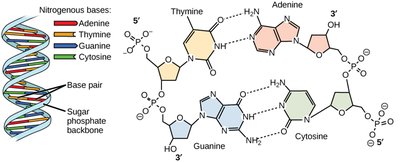
Antiparallel Strands
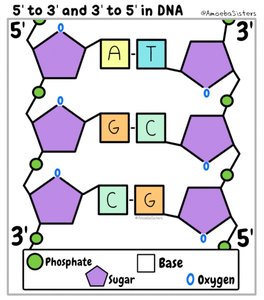
Each DNA strand has directionality: a 5′ end (phosphate group) and a 3′ end (hydroxyl group).
The two strands run in opposite directions (antiparallel), which is essential for replication and enzyme function.
Additional Features of DNA Structure
Strands are complementary: each base on one strand determines its partner on the other.
DNA is negatively charged due to its phosphate backbone.
Major and minor grooves allow protein binding for gene regulation.
DNA Replication
Overview of DNA Replication
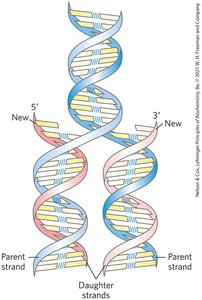
DNA replication is the process by which cells make an exact copy of their DNA before division. It is semi-conservative: each new DNA molecule contains one old strand and one new strand.
Key Proteins in DNA Replication
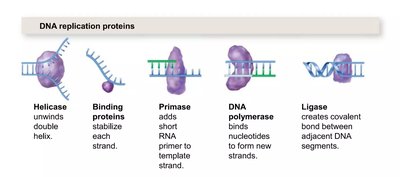
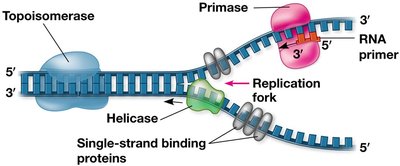
Helicase: Unwinds the double helix.
Single-strand binding proteins: Stabilize unwound strands.
Primase: Synthesizes short RNA primers.
DNA polymerase: Adds nucleotides to the growing DNA strand.
Ligase: Joins DNA fragments together.
Initiation: Origins of Replication and Replication Forks
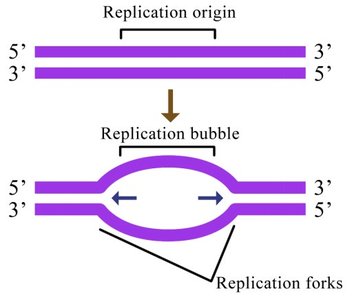
Replication begins at origins of replication (Ori), forming replication bubbles.
Each bubble has two replication forks moving in opposite directions.
Unwinding and Preparing the DNA
Helicase unwinds DNA at the replication fork.
Single-strand binding proteins keep strands apart.
Topoisomerase relieves tension ahead of the fork.
Priming: RNA Primers
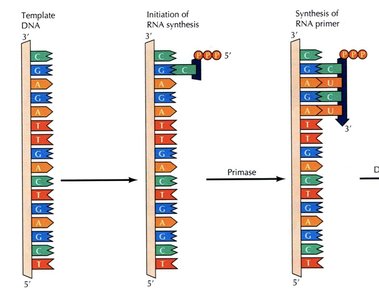
DNA polymerase can only add nucleotides to an existing 3′ end.
Primase synthesizes a short RNA primer to provide a starting point.
Elongation: Leading and Lagging Strands
The leading strand is synthesized continuously toward the replication fork.
The lagging strand is synthesized discontinuously in short segments called Okazaki fragments, away from the fork.
RNA primers are replaced with DNA, and fragments are joined by DNA ligase.
Directionality of DNA Synthesis
DNA polymerase adds nucleotides only in the 5′ to 3′ direction.
Each incoming nucleotide is a nucleoside triphosphate; two phosphates are released as pyrophosphate, driving the reaction:
Replicating the Ends of DNA: Telomeres and Telomerase
Linear chromosomes face the end-replication problem: the lagging strand cannot be fully replicated at the ends, leading to gradual shortening.
Telomeres are repetitive sequences that protect chromosome ends.
Telomerase extends telomeres in germ cells, some stem cells, and many cancer cells.
Proofreading and DNA Repair
DNA polymerase proofreads and removes mismatched bases during replication.
Mismatch repair enzymes correct errors missed by polymerase.
Base excision repair and other systems fix damage from environmental factors.
Replication in Prokaryotes
Bacteria typically have a single circular chromosome with one origin of replication.
Replication proceeds bidirectionally until the entire chromosome is copied.
Key enzymes: helicase, primase, DNA polymerase, DNA ligase.
Summary Table: Key Experiments Identifying DNA as Genetic Material
Experiment | Organism/System | Key Finding |
|---|---|---|
Griffith | Streptococcus pneumoniae (mice) | Transformation of nonpathogenic to pathogenic bacteria |
Avery, MacLeod, McCarty | Bacterial extracts | DNA is the transforming material |
Hershey & Chase | Bacteriophage and E. coli | DNA, not protein, enters cells and directs viral replication |
Additional info: This summary integrates foundational experiments, DNA structure, and the mechanisms of replication, providing a comprehensive overview for General Biology students.
