 뒤로
The Origin and Evolution of Vertebrates: Study Notes
스터디 가이드 - 스마트 노트
 자료에 맞춘 맞춤형 노트, 핵심 정의, 예시, 맥락을 확장해 제공합니다.
Chapter 34: The Origin and Evolution of Vertebrates
Overview: Half a Billion Years of Backbones
Vertebrates are a diverse and successful group of animals characterized by the presence of a backbone. Their evolutionary history spans over 500 million years, beginning in the Cambrian period. The earliest vertebrates were aquatic, but the evolution of limbs allowed some to colonize land, leading to the rise of amphibians, reptiles, birds, and mammals.
Vertebrates derive their name from the vertebrae, the series of bones forming the backbone.
There are about 52,000 species of vertebrates, much fewer than insects, but vertebrates display remarkable diversity in form and function.
Examples of vertebrate disparity include plant-eating dinosaurs (up to 40,000 kg), blue whales (up to 100,000 kg), and tiny fish (as small as 8.4 mm).
Concept 34.1: Chordates Have a Notochord and a Dorsal, Hollow Nerve Cord
Vertebrates belong to the phylum Chordata, which is defined by four key characteristics present at some stage in their life cycle:
Notochord: A flexible, rod-like structure providing skeletal support. In humans, remnants form the gelatinous material in intervertebral discs.
Dorsal, Hollow Nerve Cord: Develops into the central nervous system (brain and spinal cord). Unique to chordates, as other phyla have solid, ventral nerve cords.
Pharyngeal Slits or Clefts: Openings in the pharynx used for suspension feeding, gas exchange (gills), or development of head structures in tetrapods.
Muscular, Post-Anal Tail: Extends beyond the anus, containing muscles and skeletal elements for locomotion.
Two groups of invertebrate chordates, lancelets (Cephalochordata) and tunicates (Urochordata), provide clues to vertebrate origins. Lancelets retain all chordate features as adults and are suspension feeders. Tunicates display chordate traits only in their larval stage and undergo metamorphosis to a sessile adult form.
Lancelets: Simple brain structure, swimming mechanism similar to fishes, and serial muscle blocks (somites).
Tunicates: Loss of Hox genes compared to other chordates, suspension feeding, and unique genetic controls for body plan development.
Concept 34.2: Vertebrates Are Chordates That Have a Backbone
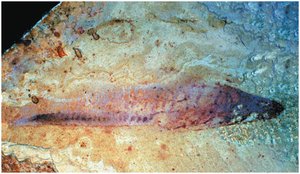
The evolution of a head and backbone marked a major transition in chordate history. Early Cambrian fossils, such as Haikouella and Myllokunmingia, provide evidence for the origin of vertebrates.
Hagfishes (Myxini): Most basal vertebrates, possessing a skull but lacking jaws and vertebrae. Marine scavengers with a flexible notochord.
Lampreys: Jawless vertebrates, some parasitic, with a notochord and cartilaginous skeleton.
Conodonts: Extinct, soft-bodied vertebrates with mineralized dental elements, representing early vertebrate innovations.
Mineralization of the vertebrate skeleton began with dental elements and later extended to protective armor and the endoskeleton.
Concept 34.3: Gnathostomes Are Vertebrates That Have Jaws
Gnathostomes are jawed vertebrates, including sharks, ray-finned and lobe-finned fishes, amphibians, reptiles, birds, and mammals. Jaws evolved from skeletal rods supporting pharyngeal slits, enabling new feeding strategies.
Derived Characters: Genome duplication (Hox genes), enlarged forebrain, lateral line system for detecting vibrations.
Evolutionary Breakthroughs: Jaws and paired fins allowed efficient predation and locomotion.
Placoderms and Acanthodians: Extinct armored jawed vertebrates, precursors to modern gnathostomes.
Concept 34.4: Tetrapods Are Gnathostomes That Have Limbs
Tetrapods evolved from lobe-finned fishes, developing limbs and feet for terrestrial locomotion. Key adaptations include a neck, fused pelvic girdle, and loss of gills in most adults.
Tiktaalik: Transitional fossil with both fish and tetrapod features, illustrating the evolution of limbs.
Amphibians: Salamanders, frogs, and caecilians. Exhibit metamorphosis and diverse reproductive strategies.
Concept 34.5: Amniotes Are Tetrapods That Have a Terrestrially Adapted Egg
Amniotes (mammals and reptiles, including birds) possess amniotic eggs with extraembryonic membranes, enabling reproduction on land. Adaptations include less permeable skin and rib-based lung ventilation.
Reptiles: Scales, internal fertilization, ectothermy (except birds), and diverse lineages (lepidosaurs, archosaurs).
Birds: Adaptations for flight, endothermy, complex behaviors, and evolutionary origins from feathered dinosaurs.
Concept 34.6: Mammals Are Amniotes That Have Hair and Produce Milk
Mammals are characterized by mammary glands, hair, endothermy, and specialized teeth. They belong to the synapsid lineage and have evolved diverse reproductive strategies (monotremes, marsupials, eutherians).
Monotremes: Egg-laying mammals (platypus, echidna).
Marsupials: Pouched mammals (kangaroos, opossums).
Eutherians: Placental mammals with complex placentas and extended parental care.
Concept 34.7: Humans Are Mammals That Have a Large Brain and Bipedal Locomotion
Humans (Homo sapiens) are distinguished by upright posture, large brains, language, and tool use. Fossil evidence reveals a complex, branching evolutionary history with multiple hominin species.
Derived Characters: Bipedalism, reduced jawbones, shorter digestive tract, and advanced cognitive abilities.
Hominin Evolution: Australopiths, Homo habilis, Homo ergaster, Homo erectus, Neanderthals, Denisovans, and Homo sapiens.
Migration and Diversity: Out-of-Africa migration, adaptive radiation, and evidence of symbolic thought and complex tools.
Additional info: These notes expand on the original content with definitions, examples, and context for each major evolutionary transition in vertebrate history.
