뒤로
뒤로The Structure and Function of Large Biological Molecules
스터디 가이드 - 스마트 노트
 자료에 맞춘 맞춤형 노트, 핵심 정의, 예시, 맥락을 확장해 제공합니다.
Chapter 5: The Structure and Function of Large Biological Molecules
Introduction
Large biological molecules, also known as macromolecules, are essential for life. They include carbohydrates, lipids, proteins, and nucleic acids. Each class of macromolecule has unique structures and functions that are fundamental to cellular processes.
Macromolecules: Polymers and Monomers
Concept 5.1: Macromolecules are polymers, built from monomers
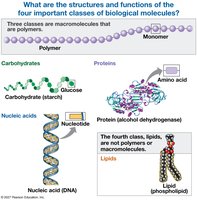
Most macromolecules are polymers, which are long molecules made up of repeating units called monomers. Carbohydrates, proteins, and nucleic acids are true polymers, while lipids are not.
Polymer: A long molecule consisting of many similar or identical building blocks linked by covalent bonds.
Monomer: The repeating unit that serves as the building block of a polymer.
Enzymes: Specialized macromolecules that speed up chemical reactions, including those that build or break down polymers.
The Synthesis and Breakdown of Polymers
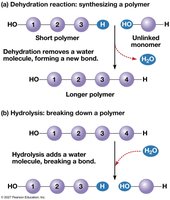
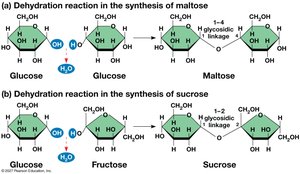
Dehydration Reaction: Two monomers bond together through the loss of a water molecule, forming a polymer.
Hydrolysis: Polymers are disassembled to monomers by the addition of a water molecule, breaking the bond.
Diversity of Polymers: Cells contain thousands of different macromolecules, which vary among cells, species, and individuals. A vast variety of polymers can be built from a small set of monomers.
Carbohydrates
Concept 5.2: Carbohydrates serve as fuel and building material
Carbohydrates include sugars and polymers of sugars. They are classified as monosaccharides (simple sugars), disaccharides, and polysaccharides (complex carbohydrates).
Monosaccharides
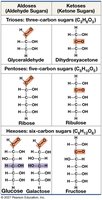
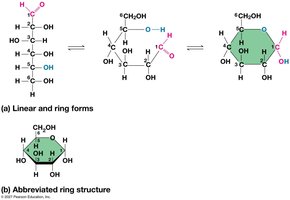
Monosaccharides: The simplest carbohydrates, usually with molecular formulas that are multiples of CH2O. Glucose is the most common monosaccharide.
Classified by the location of the carbonyl group (aldose or ketose) and the number of carbons in the skeleton.
Ring Structures
In aqueous solutions, many sugars form rings rather than linear structures.
Monosaccharides are major fuels for cells and serve as raw materials for building other molecules.
Disaccharides
Disaccharide: Formed when a dehydration reaction joins two monosaccharides via a covalent bond called a glycosidic linkage.
Polysaccharides
Polysaccharides: Polymers of sugars with storage and structural roles. Their function is determined by their sugar monomers and the positions of glycosidic linkages.
Storage Polysaccharides
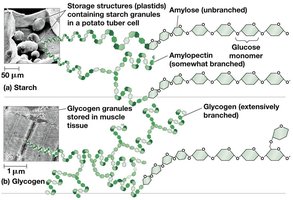
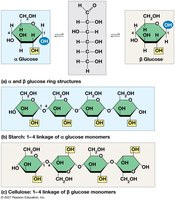
Starch: Storage polysaccharide in plants, composed of glucose monomers. Stored as granules in chloroplasts and plastids. Amylose is the simplest form.
Glycogen: Storage polysaccharide in animals, mainly in liver and muscle cells. Hydrolysis releases glucose when needed.
Structural Polysaccharides
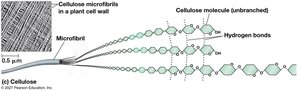
Cellulose: Major component of plant cell walls. Like starch, it is a polymer of glucose, but with different glycosidic linkages (β instead of α).
Starch is helical (α configuration); cellulose is straight and unbranched (β configuration). Hydrogen bonds form between parallel cellulose molecules.
Enzymes that digest starch cannot hydrolyze cellulose. Cellulose in human food is "insoluble fiber." Some microbes can digest cellulose, aiding herbivores.
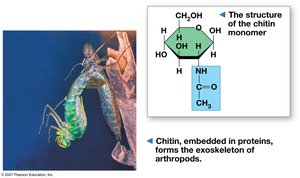
Chitin: Structural polysaccharide in arthropod exoskeletons and fungal cell walls.
Lipids
Concept 5.3: Lipids are a diverse group of hydrophobic molecules
Lipids are not true polymers but are grouped together because they are hydrophobic. The most important lipids are fats, phospholipids, and steroids.
Fats
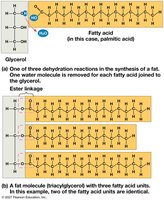
Constructed from glycerol (a three-carbon alcohol) and fatty acids (carboxyl group attached to a long carbon skeleton).
Three fatty acids are joined to glycerol by ester linkages, forming a triacylglycerol (triglyceride).
Fatty acids vary in length and in the number and location of double bonds.
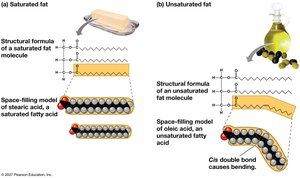
Saturated fatty acids: No double bonds; solid at room temperature (animal fats).
Unsaturated fatty acids: One or more double bonds; liquid at room temperature (plant and fish fats).
Hydrogenation converts unsaturated fats to saturated fats and can create trans fats, which are linked to cardiovascular disease.
Main function: energy storage, insulation, and cushioning of organs.
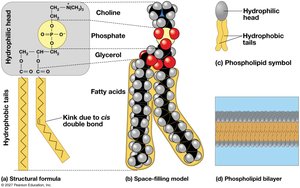
Phospholipids
Composed of two fatty acids and a phosphate group attached to glycerol.
Fatty acid tails are hydrophobic; phosphate group is hydrophilic, forming a bilayer in water (basis of cell membranes).
Steroids
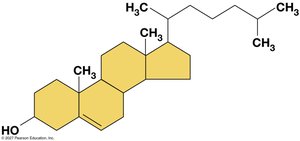
Lipids with a carbon skeleton of four fused rings.
Cholesterol: Important component of animal cell membranes and precursor for other steroids. High levels may contribute to cardiovascular disease.
Proteins
Concept 5.4: Proteins include a diversity of structures, resulting in a wide range of functions
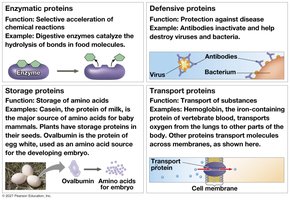
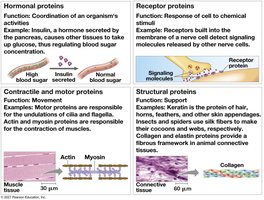
Proteins are the most structurally sophisticated molecules, accounting for more than 50% of the dry mass of most cells. They perform a vast array of functions, including catalysis, defense, storage, transport, communication, movement, and support.
Amino Acids and Polypeptides
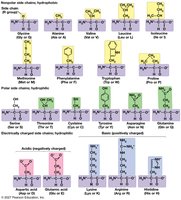
Proteins are made from 20 different amino acids, each with a unique side chain (R group).
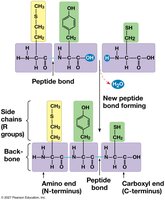
Amino acids are linked by peptide bonds to form polypeptides, which fold into functional proteins.
Protein Structure
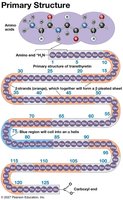
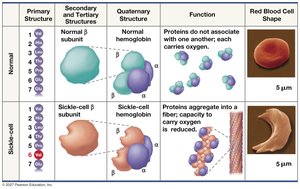
Primary structure: Unique sequence of amino acids.
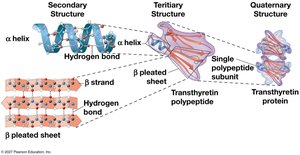
Secondary structure: Coils (α helix) and folds (β pleated sheet) due to hydrogen bonds.
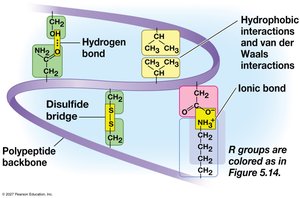
Tertiary structure: Overall 3D shape due to interactions among R groups (hydrogen bonds, ionic bonds, hydrophobic interactions, van der Waals forces, disulfide bridges).
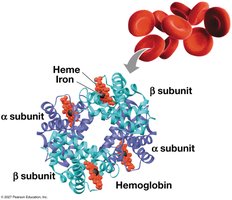
Quaternary structure: Association of multiple polypeptide chains.

Sickle-Cell Disease: A Change in Primary Structure
A single amino acid substitution in hemoglobin causes sickle-cell disease, altering protein structure and function.
Protein Denaturation
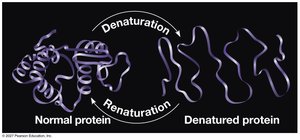
Physical and chemical conditions (pH, salt, temperature) can cause proteins to lose their structure (denaturation), making them inactive.
Denaturation can sometimes be reversed, but not always.
Protein Folding and Structure Determination
Protein folding is complex and often involves several stages. Misfolded proteins are linked to diseases such as Alzheimer's and Parkinson's.
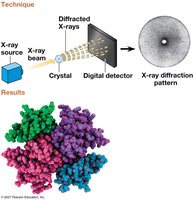
Techniques like X-ray crystallography and cryo-electron microscopy are used to determine protein structures.
Nucleic Acids
Concept 5.5: Nucleic acids store, transmit, and help express hereditary information
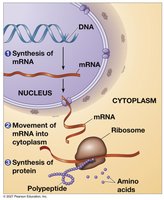
Nucleic acids, including DNA and RNA, are polymers of nucleotides. They store and transmit genetic information and direct protein synthesis.
The Roles of Nucleic Acids
DNA (deoxyribonucleic acid): Stores genetic information and directs its own replication.
RNA (ribonucleic acid): Functions in gene expression, including carrying instructions from DNA to ribosomes for protein synthesis.
The flow of genetic information: DNA → RNA → Protein (gene expression).
Components of Nucleic Acids
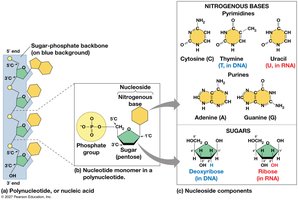
Nucleic acids are polymers called polynucleotides, made of nucleotide monomers.
Each nucleotide consists of a nitrogenous base, a pentose sugar, and one or more phosphate groups.
Nitrogenous bases: Pyrimidines (cytosine, thymine, uracil) and purines (adenine, guanine).
DNA contains deoxyribose; RNA contains ribose.
Nucleotide Polymers and Structure
Nucleotides are linked by phosphodiester bonds, forming a sugar-phosphate backbone.
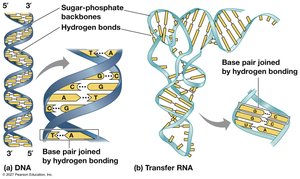
DNA is a double helix with antiparallel strands; RNA is usually single-stranded.
Base pairing: In DNA, A pairs with T, and G pairs with C. In RNA, A pairs with U.
Genomics and Proteomics
Concept 5.6: Genomics and proteomics have transformed biological inquiry and applications
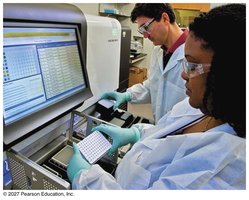
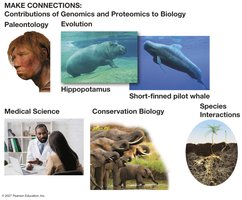
Advances in genomics and proteomics have revolutionized biology by enabling the sequencing and analysis of entire genomes and proteomes. Bioinformatics uses computational tools to analyze large data sets, facilitating discoveries in evolution, medicine, and conservation.
DNA and Proteins as Tape Measures of Evolution
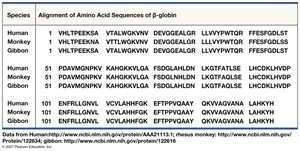
Gene and protein sequences document evolutionary relationships among organisms.
Molecular biology provides tools for studying heredity and evolution at the molecular level.