 뒤로
뒤로Thermodynamics and Kinetics of Biological Reactions: Reaction Coordinate Diagrams, Energy Changes, and Reaction Rates
스터디 가이드 - 스마트 노트
 자료에 맞춘 맞춤형 노트, 핵심 정의, 예시, 맥락을 확장해 제공합니다.
Thermodynamics and Kinetics in Biological Reactions
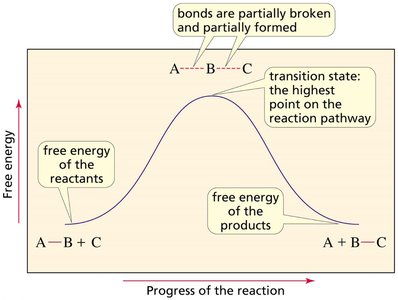
Reaction Coordinate Diagrams
Reaction coordinate diagrams are essential tools for visualizing the energy changes that occur during a chemical reaction. They help us understand the stability of reactants, products, and the transition state, which is the highest energy point along the reaction pathway.
Y-axis: Represents the free energy of the system.
X-axis: Represents the progress of the reaction from reactants to products.
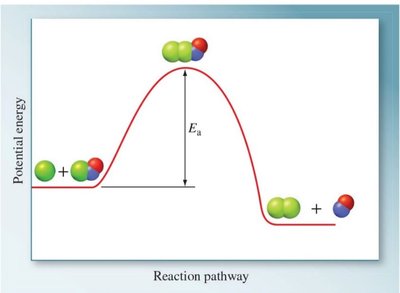
Transition State: The peak of the diagram, where bonds are partially broken and formed. The energy required to reach this state is the activation energy.
Stability: Lower energy corresponds to greater stability.
Thermodynamics: Equilibrium and Stability
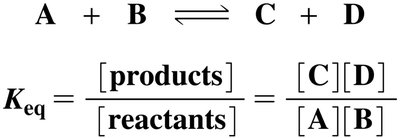
Thermodynamics examines the energy relationships and equilibrium positions of reactions. The equilibrium constant (Keq) quantifies the ratio of product to reactant concentrations at equilibrium.
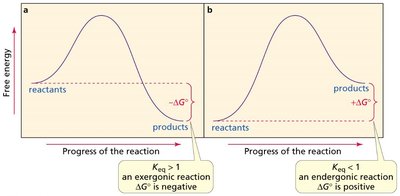
Keq > 1: Products are more stable than reactants; reaction favors products.
Keq < 1: Reactants are more stable; reaction favors reactants.
Enthalpy (ΔH°) and Entropy (ΔS°)
The energy changes in reactions are described by enthalpy and entropy:
Enthalpy (ΔH°): The heat exchanged during a reaction under standard conditions.
Exothermic (ΔH° < 0): More energy is released by forming bonds than is consumed breaking them.
Endothermic (ΔH° > 0): More energy is consumed breaking bonds than is released forming them.
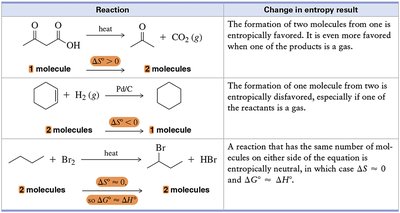
Entropy (ΔS°): A measure of disorder or freedom of motion. Positive ΔS° means increased disorder (more product molecules or more freedom of movement).
Reaction | Change in entropy result |
|---|---|
1 molecule → 2 molecules | ΔS° > 0 (entropically favored) |
2 molecules → 1 molecule | ΔS° < 0 (entropically disfavored) |
2 molecules → 2 molecules | ΔS° ≈ 0 (entropically neutral) |
Gibbs Free Energy (ΔG°)
Gibbs free energy determines whether a reaction is spontaneous under standard conditions. It combines enthalpy and entropy changes:
ΔG° < 0: Reaction is exergonic (spontaneous, energy-releasing).
ΔG° > 0: Reaction is endergonic (non-spontaneous, energy-absorbing).
The relationship between ΔG°, equilibrium, and spontaneity is given by:
where R is the gas constant and T is temperature in Kelvin.
Factors Affecting Reaction Spontaneity
For a reaction to be spontaneous (ΔG° < 0), it is favorable to have a negative ΔH° (exothermic) and a positive ΔS° (increased disorder). Changing temperature, applying Le Châtelier’s principle, or coupling reactions can shift the equilibrium to favor product formation.
Increasing temperature: Can make ΔG° more negative if ΔS° is positive.
Le Châtelier’s Principle: The system shifts to counteract disturbances in equilibrium.
Coupled reactions: Endergonic reactions can proceed if paired with exergonic ones (common in metabolism).
Kinetics: Reaction Rates and Activation Energy
Kinetics studies how fast reactions occur. The activation energy (Ea) is the minimum energy required for reactants to reach the transition state and form products.
Effective collisions: Reactants must collide with proper orientation and sufficient energy.
Transition state: Temporary, high-energy arrangement of atoms at the peak of the energy barrier.

Free Energy of Activation (ΔG‡)
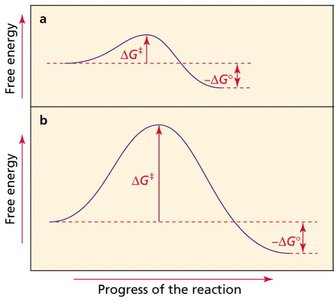
The energy barrier for a reaction is the free energy of activation (ΔG‡). The size of ΔG‡ determines the reaction rate:
Small ΔG‡: Reaction is faster (kinetically unstable).
Large ΔG‡: Reaction is slower (kinetically stable).
Controlling Reaction Rates
Several factors influence the rate of chemical reactions:
Temperature: Higher temperature increases reaction rate by providing more kinetic energy to reactants. The Arrhenius equation describes this relationship:
Concentration and Surface Area: Higher concentration or greater surface area increases the frequency of effective collisions.
Catalysts: Catalysts (including enzymes) lower the activation energy without being consumed, increasing reaction rate but not affecting equilibrium (Keq).
Reaction Mechanism: The physical state and pathway of the reaction influence whether and how quickly it proceeds.
Summary Table: Thermodynamics vs. Kinetics
Aspect | Thermodynamics | Kinetics |
|---|---|---|
Focus | Stability and equilibrium | Reaction rate |
Key Quantity | ΔG°, Keq | ΔG‡, Ea, k |
Spontaneity | ΔG° < 0 (spontaneous) | Small ΔG‡ (fast) |
Control Factors | Energy, entropy, equilibrium | Temperature, concentration, catalysts |
Additional info: These principles are foundational for understanding metabolic pathways, enzyme function, and energy flow in biological systems, as covered in General Biology chapters on metabolism, cellular respiration, and enzyme kinetics.
