 뒤로
Translation: The RNA-Directed Synthesis of ProteinsnPart2
스터디 가이드 - 스마트 노트
 자료에 맞춘 맞춤형 노트, 핵심 정의, 예시, 맥락을 확장해 제공합니다.
Translation: The RNA-Directed Synthesis of Proteins
Overview of Translation
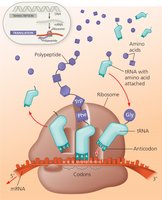
Translation is the process by which genetic information encoded in messenger RNA (mRNA) is used to synthesize a polypeptide (protein). This process occurs in the ribosome and involves several key molecular components, including transfer RNA (tRNA), aminoacyl-tRNA synthetases, and ribosomal subunits.
Translation converts the nucleotide sequence of mRNA into the amino acid sequence of a protein.
It is a fundamental step in gene expression, following transcription.
All 20 amino acids must be available in the cytoplasm for protein synthesis.
Molecular Components of Translation
Transfer RNA (tRNA): Structure and Function
tRNA molecules play a critical role in translation by transferring specific amino acids to the growing polypeptide chain in the ribosome. Each tRNA is responsible for recognizing a particular mRNA codon and delivering the corresponding amino acid.
Function: tRNA translates mRNA codons into amino acids, facilitating protein synthesis.
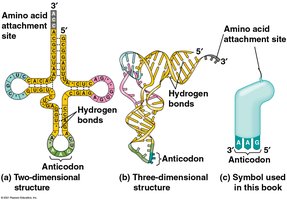
Structure: tRNA is a single RNA strand (~80 nucleotides) that folds into a cloverleaf shape due to base pairing.
One end of the tRNA carries an amino acid; the other end contains the anticodon, which base-pairs with the complementary mRNA codon.
Hydrogen bonds stabilize the three-dimensional L-shaped structure, with the 5′ and 3′ ends near one end.
The 3′ end is the amino acid attachment site.
Key Recognition Steps in Translation
Step One: tRNA–Amino Acid Matching
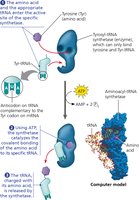
Accurate translation requires the correct pairing of tRNA with its corresponding amino acid. This is accomplished by the enzyme aminoacyl-tRNA synthetase.
There are 20 aminoacyl-tRNA synthetases, each specific for one amino acid.
The enzyme recognizes the correct tRNA and amino acid, catalyzing their covalent attachment using ATP hydrolysis.
The resulting molecule is called aminoacyl-tRNA (charged tRNA).
Equation:
Step Two: Anticodon–Codon Matching
The anticodon of tRNA must correctly base-pair with the codon on mRNA to ensure the correct amino acid is added to the polypeptide chain.
Wobble base pairing: The third base of the mRNA codon allows for flexible pairing, enabling some tRNAs to recognize multiple codons.
This increases efficiency in translation.
The Structure and Function of Ribosomes
Ribosome Composition and Function
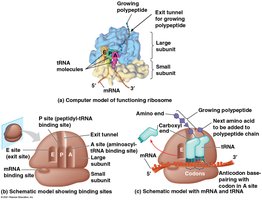
Ribosomes are the molecular machines that facilitate the coupling of tRNA anticodons with mRNA codons during protein synthesis. They are composed of two subunits (large and small), each made of proteins and ribosomal RNAs (rRNAs).
Eukaryotic ribosomes are larger and differ in composition from bacterial ribosomes.
Some antibiotics target bacterial ribosomes, allowing selective inhibition of bacterial protein synthesis.
Ribosomal Binding Sites for tRNA
Each ribosome contains three binding sites for tRNA:
P site (Peptidyl site): Holds the tRNA carrying the growing polypeptide chain.
A site (Aminoacyl site): Holds the tRNA carrying the next amino acid to be added.
E site (Exit site): Site where discharged tRNAs leave the ribosome.
Stages of Translation
Initiation
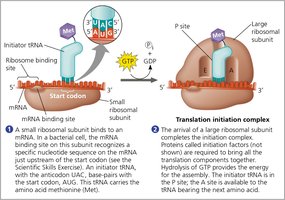
Translation initiation marks the beginning of protein synthesis. It involves the assembly of the ribosomal subunits, mRNA, and initiator tRNA.
The initiator tRNA carries methionine (Met) and recognizes the start codon (AUG).
Initiation factors assist in assembling the initiation complex.
The initiator tRNA occupies the P site of the ribosome.
Elongation
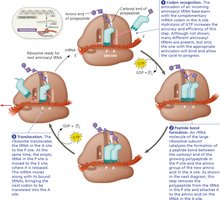
Elongation is the stage where amino acids are added one by one to the C-terminus of the growing polypeptide chain. Elongation factors assist in this process.
Elongation occurs in three steps:
Codon recognition: tRNA anticodon pairs with mRNA codon in the A site.
Peptide bond formation: Peptide bond forms between amino acid in A site and chain in P site.
Translocation: Ribosome shifts along mRNA, moving tRNAs to next sites (A → P → E).
Energy (GTP) is consumed during codon recognition and translocation.
Translation proceeds in the 5′ → 3′ direction along mRNA.
Empty tRNAs are recycled by aminoacyl-tRNA synthetases.
Termination
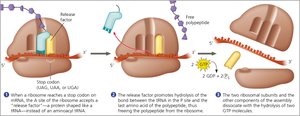
Termination occurs when a stop codon (UAA, UAG, or UGA) reaches the A site of the ribosome. A release factor protein recognizes the stop codon and triggers the release of the completed polypeptide.
The release factor adds a water molecule instead of an amino acid, hydrolyzing the bond between the polypeptide and tRNA.
The translation complex disassembles, completing protein synthesis.
Summary Table: Ribosomal Binding Sites and Functions
Site | Function |
|---|---|
A site (Aminoacyl) | Holds tRNA carrying the next amino acid to be added |
P site (Peptidyl) | Holds tRNA carrying the growing polypeptide chain |
E site (Exit) | Site where discharged tRNAs leave the ribosome |
Practice Questions
What is the function of the enzyme aminoacyl-tRNA synthetase during translation? Answer: Link a tRNA to its corresponding amino acid.
To which structure in a typical tRNA molecule is an amino acid attached? Answer: 3′ end.
On which molecule could you find an anticodon? Answer: tRNA.
What is the purpose of tRNA in translation? Answer: It carries an amino acid to the ribosome to be added to the growing polypeptide.
How many ribosomal binding sites are there and what are their functions? Answer: There are three sites: A site binds aminoacyl-tRNA, P site binds peptidyl-tRNA, E site binds free tRNA before ribosomal exit.
The initiator tRNA carries the amino acid methionine. Answer: True.
Translation occurs in a 3′ → 5′ direction. Answer: False. Translation occurs in a 5′ → 3′ direction.
