 뒤로
Unit 3 Study Guide: Glycolysis, Cellular Respiration, Fermentation, Photosynthesis, and Cellular Reproduction
스터디 가이드 - 스마트 노트
 자료에 맞춘 맞춤형 노트, 핵심 정의, 예시, 맥락을 확장해 제공합니다.
Glycolysis
Overview of Glycolysis
Glycolysis is the first step in cellular respiration, occurring in the cytosol of cells. It is a metabolic pathway that breaks down glucose into pyruvate, generating energy in the form of ATP.
Aerobic vs. Anaerobic: Aerobic processes require oxygen, while anaerobic processes do not.
ATP Yield: Glycolysis nets 2 ATP molecules per glucose.
Location: Glycolysis occurs in the cytosol, not the mitochondria.
Oxygen Requirement: Glycolysis does not require oxygen.
Fates of Pyruvate: Pyruvate can enter aerobic respiration (mitochondria), undergo fermentation (anaerobic), or be converted to other metabolites.
Prokaryotes: Prokaryotes perform glycolysis.
Reactants: Glucose, NAD+, ADP, and inorganic phosphate.
Products: Pyruvate, NADH, ATP.
Fermentation & Cellular Respiration
Fermentation
Fermentation is an anaerobic process that allows cells to regenerate NAD+ and produce ATP when oxygen is unavailable.
ATP Production: Fermentation produces little ATP compared to cellular respiration.
Oxygen Requirement: Fermentation does not require oxygen.
Types: Muscle cells use lactic acid fermentation (producing lactate); yeast uses alcoholic fermentation (producing ethanol).
Evolutionary Importance: Fermentation is ancient and supports glycolysis as a unifying pathway.
NAD+ Regeneration: Fermentation regenerates NAD+ from NADH.
Cellular Respiration
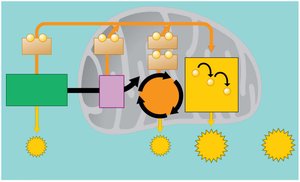
Cellular respiration is a multi-step process that converts glucose into ATP using oxygen. It includes glycolysis, Acetyl CoA synthesis, Krebs cycle, and the electron transport chain (ETC).
Acetyl CoA Synthesis: Reactants: Pyruvate, CoA, NAD+; Products: Acetyl CoA, CO2, NADH. CoA is recycled.
Location: Acetyl CoA synthesis and Krebs cycle occur in the mitochondria.
Krebs Cycle: Reactants: Acetyl CoA, NAD+, FAD, ADP; Products: CO2, NADH, FADH2, ATP.
Citric Acid: The cycle is named for citric acid, which is formed and broken down in the process.
ATP Yield: Krebs cycle nets 2 ATP per glucose.
Folded Inner Membrane: Increases surface area for ETC and ATP production.
Electron Transport Chain (ETC) and Chemiosmosis
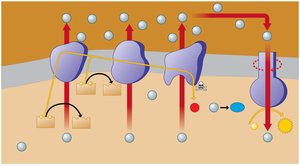
The ETC is a series of protein complexes in the mitochondrial inner membrane that transfer electrons and pump protons to generate ATP.
ATP Synthase: Enzyme that synthesizes ATP from ADP and inorganic phosphate using energy from proton flow.
Energy Source: Energy comes from the movement of H+ ions down their concentration gradient (chemiosmosis).
Electron Carriers: NADH and FADH2 donate electrons to the ETC.
Respiratory Complexes: Four main complexes; some pump H+ ions.
Active Transport: H+ ions are pumped against their gradient, creating potential energy.
ATP Production: ETC alone produces about 28-32 ATP per glucose; total cellular respiration yields about 30-36 ATP.
ETC Details
Electron Flow: Electrons from NADH and FADH2 move through complexes, releasing energy.
CO2 Release: CO2 is released during Acetyl CoA synthesis and Krebs cycle.
NAD+ vs. NADH: NAD+ is the oxidized form; NADH is the reduced, electron-carrying form.
H+ Role: H+ ions are pumped to create a gradient used for ATP synthesis.
Photosynthesis
Overview of Photosynthesis
Photosynthesis is the process by which plants, algae, and some bacteria convert light energy into chemical energy, producing glucose and oxygen.
Location: Occurs in chloroplasts, not human cells.
Wavelengths: Light wavelength affects photosynthesis; green light is less effective because chlorophyll reflects it.
Reactants: CO2, H2O, light energy.
Products: Glucose, O2.
Chlorophyll: Main pigment for capturing light.
Accessory Pigments: Carotenoids and anthocyanins broaden the spectrum of light absorbed.
Thylakoid Membranes: Folded structure increases surface area for light reactions.
Light Reactions and Calvin Cycle
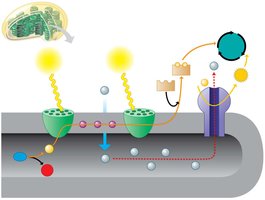
Light Reaction Goal: Convert light energy to chemical energy (ATP, NADPH).
Products: ATP, NADPH, O2.
Photosystems: Chlorophyll is organized into photosystems for efficient energy transfer.
ETC Comparison: Both photosynthesis and respiration use ETCs, but photosynthesis uses light energy and produces NADPH.
ATP Use: ATP from light reactions is used in the Calvin cycle.
Calvin Cycle: Produces G3P (a precursor to glucose); uses ATP and NADPH.
G3P Fates: Can be used to make glucose or regenerate RuBP.
RuBP Cycling: Regenerates the molecule needed for CO2 fixation.
Photosynthesis vs. Respiration: Photosynthesis does not replace respiration; both are essential.
Cellular Reproduction
Overview of Cellular Reproduction
Cellular reproduction is the process by which cells divide to produce new cells, essential for growth, repair, and reproduction.
Types: Occurs in both unicellular and multicellular organisms; bacteria reproduce by binary fission.
Genome: The complete set of genetic material in a cell.
Chromosome: DNA molecule with associated proteins; humans have 46 chromosomes (23 pairs).
Functions of Mitosis: Growth, repair, asexual reproduction.
Sister Chromatids: Identical copies of a chromosome connected at the centromere.
DNA Packing: DNA is wrapped around histones for efficient storage.
Ploidy: Diploid (2n) cells have two sets of chromosomes; haploid (n) cells have one.
Cell Cycle Phases: Interphase (G1, S, G2), Mitotic phase (prophase, metaphase, anaphase, telophase, cytokinesis).
Centromere: Region where sister chromatids are joined.
Spindle Fibers: Facilitate chromosome movement during division.
Cleavage Furrow vs. Cell Plate: Animal cells form a cleavage furrow; plant cells form a cell plate.
Meiosis
Meiosis is the process by which gametes (sperm and egg) are produced, reducing chromosome number by half and increasing genetic diversity.
Cells: Meiosis occurs in germ cells.
Gametes: Haploid reproductive cells.
Daughter Cells: Four non-identical haploid cells.
Meiosis I: Homologous chromosomes are separated.
Meiosis II: Sister chromatids are separated.
Synapsis: Homologous chromosomes pair up.
Crossing Over: Exchange of genetic material between homologs.
Independent Assortment: Random distribution of chromosomes increases variation.
Telomeres: Protective chromosome ends; senescence prevents cancer.
Apoptosis: Programmed cell death.
p53: Tumor suppressor protein.
Cyclins: Proteins regulating cell cycle.
Comparison Table: Mitosis vs. Meiosis
Feature | Mitosis | Meiosis |
|---|---|---|
DNA Replication Rounds | 1 | 1 |
Ploidy of Parent Cell | 2n | 2n |
Rounds of Division | 1 | 2 |
Number of Daughter Cells | 2 | 4 |
Ploidy of Daughter Cells | 2n | 1n |
Identical Daughter Cells? | Yes | No |
Additional info:
Some explanations and context were inferred to ensure completeness and clarity for exam preparation.
