 뒤로
Water and Life: Properties, Structure, and Biological Importance
스터디 가이드 - 스마트 노트
 자료에 맞춘 맞춤형 노트, 핵심 정의, 예시, 맥락을 확장해 제공합니다.
Chapter 3: Water and Life
3.1 The Properties of Water
Water is essential for life due to its unique chemical and physical properties, which arise from its molecular structure and ability to form hydrogen bonds. These properties enable water to support biological processes and maintain environmental stability.
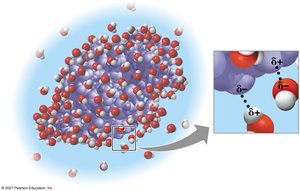
Polarity of Water: Water (H2O) is a polar molecule because the oxygen atom attracts electrons more strongly than hydrogen, resulting in partial negative (δ-) and positive (δ+) charges. This uneven charge distribution allows water molecules to form hydrogen bonds with up to four neighboring water molecules.
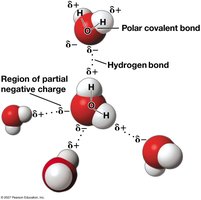
Hydrogen Bonding: Weak attractions between the partial charges of water molecules (hydrogen bonds) are responsible for many of water's emergent properties.
Emergent Properties of Water: Four key characteristics resulting from hydrogen bonding are:
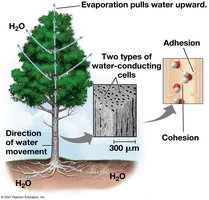
Cohesion: Water molecules stick together, creating high surface tension.
Adhesion: Water molecules are attracted to other substances, aiding capillary action.
Moderation of Temperature: Water absorbs and releases heat slowly, stabilizing environmental and organismal temperatures.
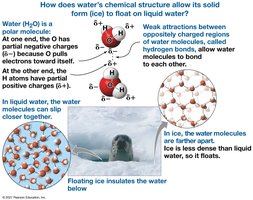
Expansion Upon Freezing: Ice is less dense than liquid water, allowing it to float.
Cohesion and Adhesion in Plants: Cohesion and adhesion enable water to move upward from roots to leaves against gravity, supporting plant life.
Heat vs. Temperature:
Heat: Total kinetic energy in a substance.
Temperature: Average kinetic energy of molecules.
Example: A pot of boiling water has a higher temperature than a swimming pool, but the pool contains more heat due to its larger volume.
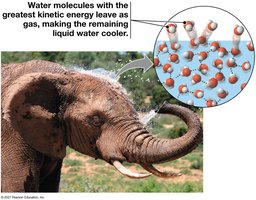
Evaporative Cooling: As water evaporates, molecules with the highest kinetic energy leave, cooling the remaining liquid. This process helps organisms regulate temperature.
Floating of Ice: Water is less dense as a solid because hydrogen bonds form a crystalline lattice, keeping molecules farther apart. This allows ice to float, insulating aquatic environments.
Examples of Water's Properties in Nature
Milder coastal climates: Water's high specific heat moderates temperature changes.
Stable ocean temperatures: Water resists rapid temperature fluctuations.
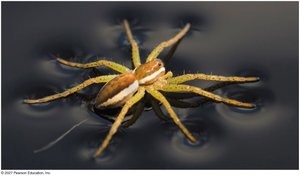
Surface tension: Insects like water striders can walk on water due to cohesion.
Convex water surface: Cohesion causes water to bulge above the rim of a glass.
Paper towel absorption: Adhesion draws water into the towel.
Ice floating: Aquatic life survives under ice in winter.
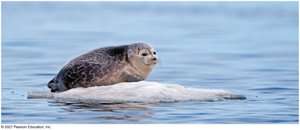
Evaporative cooling: Humans sweat and dogs pant to cool themselves.
Global Warming and Arctic Environments
Global warming reduces ice cover, threatening species that depend on ice for habitat and insulation.
3.2 The Solvent of Life
Water's polarity makes it an excellent solvent, enabling it to dissolve a wide range of substances and support biochemical reactions.
Definitions:
Solute: The substance dissolved in a solution.
Solvent: The dissolving agent (water in aqueous solutions).
Solution: A homogeneous mixture of solute and solvent.
Hydrophilic vs. Hydrophobic:
Hydrophilic: Substances with affinity for water (e.g., salts, sugars).
Hydrophobic: Substances that repel water (e.g., oils, fats).
Making a 1M Solution: To prepare a 1 molar (1M) solution of ethyl alcohol, dissolve 1 mole (46 g) of ethyl alcohol in enough water to make 1 liter of solution.
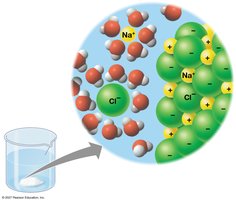
Water as a Solvent: Water dissolves ionic compounds by surrounding ions with hydration shells.
Water can also dissolve large polar molecules, such as proteins, if they have ionic and polar regions.
Astrobiology: Scientists search for extraterrestrial life on planets with water, as its solvent properties are essential for life.
3.3 The Dissociation of Water Molecules
Water molecules can dissociate into ions, affecting the chemistry of biological systems and environmental processes.
Dissociation Products: Water dissociates into hydronium ions (H3O+) and hydroxide ions (OH-). In pure water, their concentrations are both M.
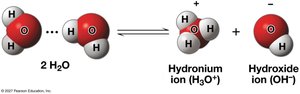
Definitions:
Acid: Substance that increases H+ concentration.
Base: Substance that decreases H+ concentration.
pH: Measure of H+ concentration;
Acids and Bases:
Strong acids/bases dissociate completely; weak acids/bases dissociate partially.
Acids and bases alter H+ concentration directly (by dissociation) or indirectly (by reacting with water).
pH Scale: Ranges from 0 (acidic) to 14 (basic); pure water is neutral at pH 7. Most biological fluids have pH 6–8.
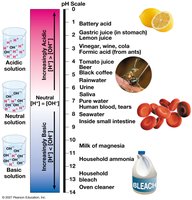
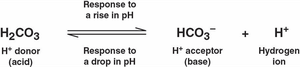
Buffers: Buffers minimize changes in pH by accepting or donating H+ ions. The bicarbonate buffer system is an example:
When pH rises, carbonic acid (H2CO3) donates H+ to lower pH.
When pH drops, bicarbonate (HCO3-) accepts H+ to raise pH.
Environmental Impact: Burning fossil fuels increases acid precipitation and ocean acidification, affecting ecosystems and organisms.
Summary Table: Water's Properties and Biological Importance
Property | Biological Importance |
|---|---|
Cohesion | Enables water transport in plants |
Adhesion | Assists capillary action and absorption |
High Specific Heat | Stabilizes environmental and organismal temperatures |
Expansion Upon Freezing | Ice floats, insulating aquatic life |
Solvent Ability | Supports biochemical reactions |
Buffering Capacity | Maintains pH stability in organisms |
Additional info: The notes expand on brief points by providing definitions, examples, and explanations of water's role in biological systems, as well as environmental impacts.
