 뒤로
뒤로Water Potential and Osmoregulation
스터디 가이드 - 스마트 노트
 자료에 맞춘 맞춤형 노트, 핵심 정의, 예시, 맥락을 확장해 제공합니다.
Water Potential
Water potential is a measure of the concentration and movement tendency of water in a system, such as a cell or solution. It determines the direction in which water will move and is crucial for understanding cellular processes like osmosis and plant water transport.
Water potential (Ψ) is the potential energy of water per unit volume relative to pure water.
Water moves from areas of higher water potential to areas of lower water potential.
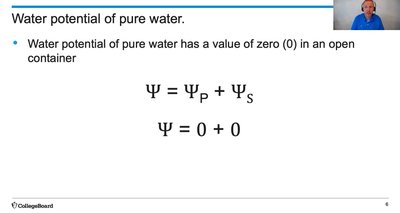
Pure water has a water potential of zero.
Water potential is affected by solute concentration and pressure.
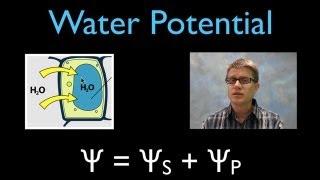
Components of Water Potential
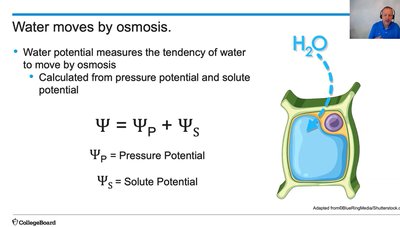
Water potential consists of two main components: solute potential and pressure potential.
Solute potential (Ψs): Also called osmotic potential, it is determined by the concentration of solutes. Adding solutes lowers water potential (makes it more negative).
Pressure potential (Ψp): Results from physical pressure on the system. Can be positive (turgor pressure in plants) or negative (tension).
The equation for water potential is:
Water Potential in Pure Water
In an open container, the pressure potential is zero.
For pure water:
Osmosis and Water Movement
Osmosis and Tonicity
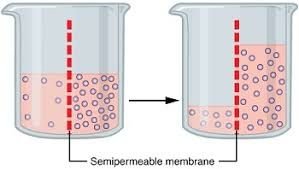
Osmosis is the movement of water across a semipermeable membrane from an area of high water potential to an area of low water potential. Tonicity describes the relative concentration of solutes in solutions.
Hypertonic: More solute, less water, lower water potential.
Hypotonic: Less solute, more water, higher water potential.
Isotonic: Equal solute and water concentrations.
Water moves from hypotonic to hypertonic solutions.
Osmoregulation in Cells
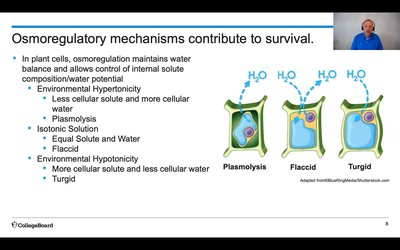
Osmoregulation is the process by which organisms control their internal solute composition and water potential to maintain water balance.
Plant cells can be plasmolyzed (shrunken), flaccid (normal), or turgid (swollen) depending on their environment.
Environmental hypertonicity leads to plasmolysis; isotonic conditions result in flaccid cells; environmental hypotonicity causes turgid cells.
Calculating Water Potential
Solute Potential Formula
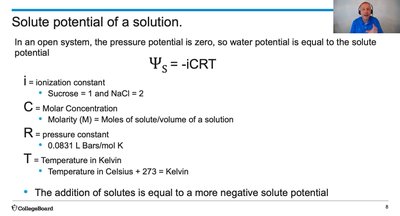
The solute potential of a solution can be calculated using the following formula:
i: Ionization constant (e.g., 1 for sucrose, 2 for NaCl, 3 for MgCl2)
C: Molar concentration (moles of solute per liter)
R: Pressure constant (0.0831 L·bar/mol·K)
T: Temperature in Kelvin (°C + 273)
Sample Calculation
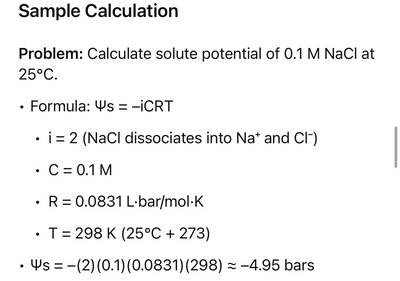
For a 0.1 M NaCl solution at 25°C: bars
Water Potential in Open Systems
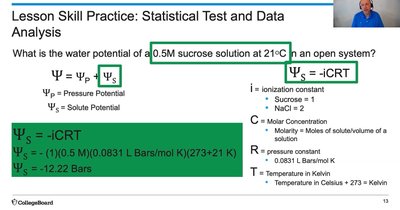
In open systems, pressure potential is zero.
Example: For a 0.5 M sucrose solution at 21°C: bars bars
Water Potential in Plants
Water Movement in Plants
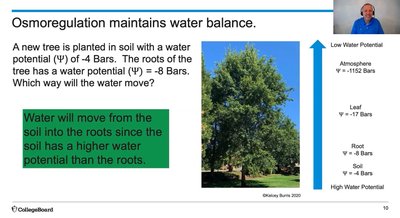
Water moves through plants from regions of higher water potential (soil) to lower water potential (roots, leaves, atmosphere). This movement is essential for nutrient transport and transpiration.
Example: If soil Ψ = -4 Bars and root Ψ = -8 Bars, water moves from soil to roots.
Water always "falls" from high to low water potential.
Diffusion and Surface Area to Volume Ratio
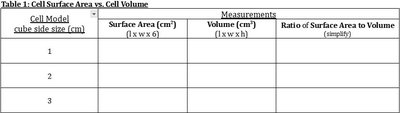
Cell Surface Area vs. Volume
The surface area to volume ratio affects the rate of diffusion in cells. Smaller cells have a higher ratio, allowing for more efficient diffusion.
Surface area is calculated as: side length × width × 6
Volume is calculated as: side length × width × height
Ratio is surface area divided by volume
Cell Model cube side size (cm) | Surface Area (cm2) | Volume (cm3) | Ratio of Surface Area to Volume |
|---|---|---|---|
1 | 6 | 1 | 6:1 |
2 | 24 | 8 | 3:1 |
3 | 54 | 27 | 2:1 |
Key Takeaways
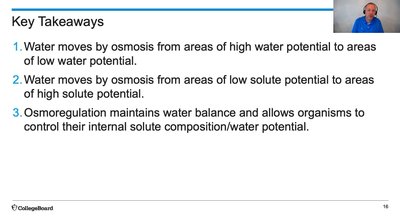
Water moves by osmosis from areas of high water potential to areas of low water potential.
Water moves by osmosis from areas of low solute potential to areas of high solute potential.
Osmoregulation maintains water balance and allows organisms to control their internal solute composition and water potential.
