Ch. 25 - Phylogenies and the History of Life
Freeman - Biological Science 8th Edition
Freeman8th EditionBiological ScienceISBN: 9780138276263당신이 사용하는 게 아니라요?교과서 변경
25장, 문제 2

Critique the following statement: The absence of a trait cannot be used as a synapomorphy in phylogenetic analysis; only shared derived traits that are present in the clade can be used.

검증된 단계별 안내
1
Understand the terms: A synapomorphy is a characteristic shared by two or more taxa that is inherited from their most recent common ancestor. Phylogenetic analysis involves the study of the evolutionary relationships among groups of organisms.
Analyze the statement: The statement claims that only traits that are present and derived (newly evolved traits that distinguish a clade) can be used as synapomorphies in phylogenetic analysis, implying that absent traits cannot serve this purpose.
Consider exceptions: Think about cases where the absence of a trait could be a derived condition if the ancestor had the trait and the derived taxa lost it. This absence could potentially be considered a synapomorphy if it provides information about evolutionary relationships.
Evaluate the relevance of absent traits: Determine if the absence of a trait can be reliably identified as a derived condition rather than a primitive condition (a trait that was absent in the ancestor). This is crucial for its use in phylogenetic analysis.
Conclude the critique: While the statement holds in scenarios where the absence of a trait cannot be clearly identified as a derived condition, there are cases where an absent trait can be a synapomorphy if it represents a derived state that helps clarify evolutionary relationships among taxa.

비슷한 문제에 대한 검증된 영상 답변:

이 영상 해법은 위 문제에 도움이 된다고 튜터들이 추천한 것입니다.
영상 길이:
1m

주요 개념

질문에 올바르게 답하기 위해 반드시 이해해야 하는 핵심 개념들은 다음과 같습니다.

Synapomorphy

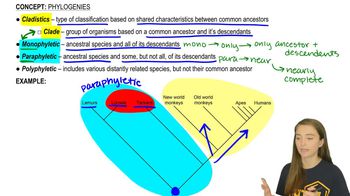
A synapomorphy is a shared derived trait that is used to infer evolutionary relationships among organisms. It is a characteristic that is present in an ancestor and its descendants but absent in more distant relatives. In phylogenetic analysis, synapomorphies help define clades, which are groups of organisms that share a common ancestor.
추천 영상:
15:46
Cladistics

Phylogenetic Analysis

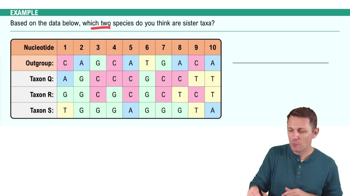
Phylogenetic analysis is a method used to study the evolutionary relationships between different species or groups. It involves constructing a phylogenetic tree, which visually represents these relationships based on shared traits, genetic data, or other characteristics. The accuracy of this analysis relies heavily on identifying synapomorphies and understanding the evolutionary history of the organisms involved.
추천 영상:
가이드 코스
04:13
Building Phylogenetic Trees Example 2

Clade

A clade is a group of organisms that includes an ancestor and all its descendants, forming a branch on the tree of life. Clades are defined by synapomorphies, which are traits that are unique to that group. Understanding clades is essential for interpreting phylogenetic trees and recognizing how different species are related through common ancestry.
추천 영상:
15:46
Cladistics