Ch. 25 - Phylogenies and the History of Life
Freeman - Biological Science 8th Edition
Freeman8th EditionBiological ScienceISBN: 9780138276263당신이 사용하는 게 아니라요?교과서 변경
25장, 문제 3

Which of the following best characterizes an adaptive radiation?
a. Descendant species occupy a large geographic area.
b. A single lineage diversifies rapidly, and descendant species occupy many habitats and ecological roles.
c. Natural selection is particularly intense, because disruptive selection occurs.
d. Species recover after a mass extinction.

검증된 단계별 안내
1
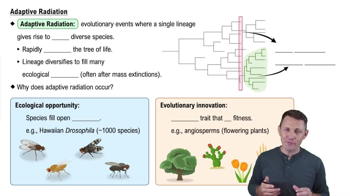
Understand the concept of adaptive radiation: Adaptive radiation is an evolutionary process where a single ancestral species rapidly diversifies into a variety of new forms. This typically occurs when the species encounters a new environment with diverse ecological niches.
Identify the key characteristics of adaptive radiation: It involves rapid diversification, and the resulting species occupy different habitats and ecological roles. This is often seen in environments with little competition, such as islands or after a mass extinction event.
Analyze each option: a) Descendant species occupy a large geographic area - This does not necessarily imply rapid diversification or occupation of different ecological roles. b) A single lineage diversifies rapidly, and descendant species occupy many habitats and ecological roles - This directly describes the process of adaptive radiation. c) Natural selection is particularly intense, because disruptive selection occurs - While natural selection can be a factor, it does not specifically define adaptive radiation. d) Species recover after a mass extinction - This can lead to adaptive radiation, but it is not a defining characteristic.
Compare the options to the definition: Option b aligns most closely with the definition of adaptive radiation, as it emphasizes rapid diversification and occupation of various ecological niches.
Conclude by selecting the best characterization: Based on the analysis, option b best characterizes an adaptive radiation.

비슷한 문제에 대한 검증된 영상 답변:

이 영상 해법은 위 문제에 도움이 된다고 튜터들이 추천한 것입니다.
영상 길이:
5m

주요 개념

질문에 올바르게 답하기 위해 반드시 이해해야 하는 핵심 개념들은 다음과 같습니다.

Adaptive Radiation

Adaptive radiation refers to the rapid evolution of diversely adapted species from a common ancestor when introduced to new environments. This process often occurs when a species encounters varied ecological niches, leading to the development of distinct traits that allow them to exploit different habitats and roles within an ecosystem.
추천 영상:
가이드 코스
05:24
Adaptive Radiation

Ecological Niches

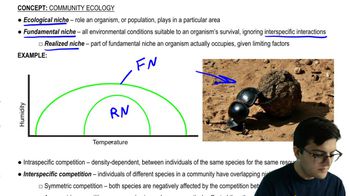
An ecological niche is the role and position a species has in its environment, including how it obtains resources, interacts with other organisms, and contributes to the ecosystem. Understanding niches is crucial in adaptive radiation, as species diversify to fill different niches, reducing competition and increasing survival chances.
추천 영상:
02:48
Ecological Niches and Competition

Disruptive Selection

Disruptive selection is a type of natural selection that favors extreme values of a trait over intermediate values, leading to increased genetic diversity within a population. While it can drive speciation, it is not the primary mechanism in adaptive radiation, which is more about diversification into new ecological roles rather than just trait variation.
추천 영상:
가이드 코스
04:43
Natural Selection