 뒤로
Applications of the Derivative: Extrema, Optimization, Implicit Differentiation, and Differentials
스터디 가이드 - 스마트 노트
 자료에 맞춘 맞춤형 노트, 핵심 정의, 예시, 맥락을 확장해 제공합니다.
Applications of the Derivative
Absolute Extrema
The concept of absolute extrema is fundamental in calculus, especially for optimization problems. Absolute maximum and absolute minimum refer to the highest and lowest values a function attains on a given domain, respectively. These are also known as global extrema.
Absolute Maximum: is the absolute maximum of on if for all in D.
Absolute Minimum: is the absolute minimum of on if for all in D.
Extreme Values: The maximum and minimum values of are called extreme values.
Absolute extrema may include endpoints of the interval.
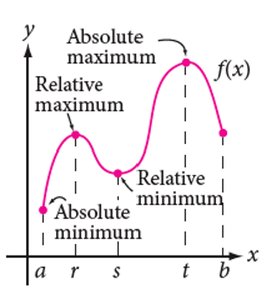
Finding Absolute Extrema
To find absolute extrema for a function continuous on a closed interval :
Find all critical numbers for in .
Evaluate at all critical numbers in .
Evaluate at the endpoints and .
The largest value is the absolute maximum; the smallest is the absolute minimum.
Applications of Extrema
Optimization problems use extrema to maximize or minimize quantities in applied contexts. The process involves constructing a function to represent the quantity to be optimized and then applying calculus techniques.
Step 1: Identify given information and what needs to be found.
Step 2: Assign variables to each quantity.
Step 3: Construct a function to be optimized.
Step 4: Reduce the function to one variable if necessary.
Step 5: Use differentiation to find critical numbers and test for absolute extrema.
Implicit Differentiation
Implicit differentiation is used when a function is not given explicitly as , but rather as an equation involving both and . The process allows us to find even when y is not isolated.
Step 1: Differentiate both sides with respect to .
Step 2: Collect all terms involving on one side.
Step 3: Factor .
Step 4: Solve for .
Differentials: Linear Approximation
Linear approximation uses the tangent line at a point to estimate values of a function near that point. The tangent line provides a good approximation when is close to .
Linearization: If is differentiable at , the linearization is .
Standard Approximation: , where is the linearization.
Center of Approximation: is the center.
Differentials
Differentials formalize the idea of linear approximation. For , the differential is any nonzero real number, and represents the change in the linearization.
Change in y:
Differential:
Approximation: when is small.
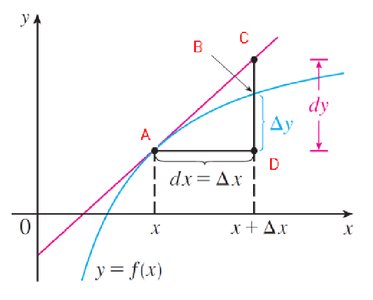
Error Analysis
Maximum Error: , the possible error in the dependent variable.
Relative Error: Ratio of propagated error to actual measurement; used to find percent error.
