 뒤로
Business Calculus Study Guide: Integration and Its Applications
스터디 가이드 - 스마트 노트
 자료에 맞춘 맞춤형 노트, 핵심 정의, 예시, 맥락을 확장해 제공합니다.
Antiderivatives and Indefinite Integrals
Definition and Basic Properties
The concept of the antiderivative (or integral) is fundamental in calculus. If F(x) is a function whose derivative is f(x), then F(x) is an antiderivative of f(x). The indefinite integral represents the family of all antiderivatives of a function:
Indefinite Integral:
Constant of Integration: is an arbitrary constant.
Integrand: The function being integrated, f(x).
Differential: indicates the variable of integration.
Integral of a Constant:
Integral of a Power Function: For ,
Integral of a Constant Times a Function:
Integral of a Sum or Difference:
Indefinite Integrals of Exponential Functions
,
,
,
Integration by Substitution
Substitution Method
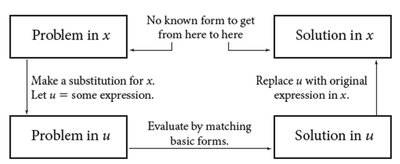
The substitution method is used to simplify integrals by changing variables. This is especially useful when the integrand is a composite function or involves quotients, exponentials, powers, or radicals.
Step 1: Make a substitution for x. Let u = some expression in x.
Step 2: Rewrite the integral in terms of u.
Step 3: Integrate with respect to u.
Step 4: Replace u with the original expression in x.
Suggestions for Substitutions:
If the integrand involves a quotient, let u = denominator.
If the integrand involves an exponential, let u = exponent.
If the integrand involves a power or radical, let u = base or radicand.
Definite Integrals and Area
Definition and Properties
The definite integral of a function f(x) over the interval [a, b] is defined as:
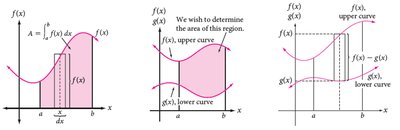
The definite integral represents the area under the curve f(x) from x = a to x = b.
Area:
Total Change: If f(x) gives the rate of change of F(x), then the total change in F(x) from a to b is .
Properties of the Definite Integral
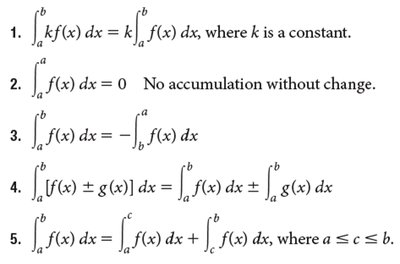
, where k is a constant.
(No accumulation without change.)
, where
The Fundamental Theorem of Calculus
Statement and Application
The Fundamental Theorem of Calculus connects differentiation and integration. If F(x) is an antiderivative of f(x) on [a, b], then:
Lower limit: a; Upper limit: b
Area Between Two Curves
Definition and Calculation
The area bounded by two continuous functions f(x) and g(x) on [a, b], where f(x) is greater than or equal to g(x), is:
Consumer's and Producer's Surplus
Definitions
Supply Function: p = S(x) gives the price per unit at which producers supply x units.
Demand Function: p = D(x) gives the price per unit consumers are willing to pay for x units.
Consumer's Surplus
The consumer's surplus is the area between the demand curve and the equilibrium price:
Producer's Surplus
The producer's surplus is the area between the equilibrium price and the supply curve:
Applied Problems
Marginal Cost: Integrate the marginal cost function to find total cost.
Revenue Streams: Integrate revenue functions over time to find accumulated revenue.
Investment and Maintenance: Use definite integrals to calculate total costs or profits over specified intervals.
