 뒤로
Graphs and the Derivative: Applications in Business Calculus
스터디 가이드 - 스마트 노트
 자료에 맞춘 맞춤형 노트, 핵심 정의, 예시, 맥락을 확장해 제공합니다.
Graphs and the Derivative
Increasing and Decreasing Functions
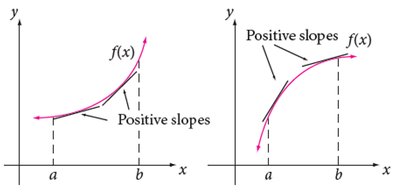
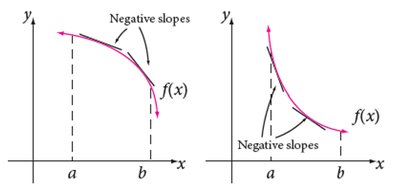
The behavior of a function—whether it is increasing or decreasing—can be determined using its first derivative. This is fundamental in business calculus for analyzing trends and optimizing functions.
Increasing Function: If for every value of in an interval , then is increasing on (a, b). Conversely, if f(x) is increasing, then f'(x) > 0.
Decreasing Function: If for every value of in , then is decreasing on (a, b). Conversely, if f(x) is decreasing, then f'(x) < 0.
Constant Function: If for every value of in , then is constant on (a, b).
Critical Numbers of a Function
A critical number of is a value where or is undefined, provided f(x) is defined at c. Critical numbers are important for identifying potential maxima, minima, or points of inflection.
To find critical numbers, solve or find where is undefined.
Test for Increasing and Decreasing
To determine where a function is increasing or decreasing:
Locate critical numbers and points where is undefined.
Divide the domain into intervals based on these points.
Test the sign of in each interval to determine if is increasing or decreasing.
Relative Extrema
Relative Maxima and Minima
Relative extrema are points where a function reaches a local maximum or minimum. These are crucial in business applications for identifying optimal values.
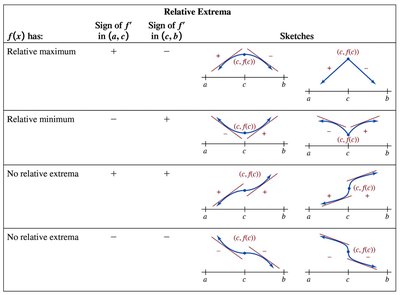
Relative Maximum: is a relative maximum if for near .
Relative Minimum: is a relative minimum if for near .
Endpoints are not considered relative extrema.
Note: Not all critical values produce relative extrema.
First Derivative Test
The first derivative test helps classify critical points:
If before and after $c$, is a relative maximum.
If before and after $c$, is a relative minimum.
If does not change sign, there is no relative extremum at .
Higher Derivatives, Concavity, and the Second Derivative Test
Higher Derivatives
Higher-order derivatives provide information about the rate of change and curvature of functions.
Second Derivative: is the derivative of , denoted as .
Third Derivative: is the derivative of , denoted as .
nth Derivative: is obtained by differentiating times.
Interpreting Higher-Order Derivatives
If and have the same sign, changes at an increasing rate.
If and have opposite signs, changes at a decreasing rate.
Concavity and Points of Inflection
Concavity describes how a function bends. Points of inflection are where the concavity changes.
Concave Upward: If on , is concave upward.
Concave Downward: If on , is concave downward.
Inflection Point: is an inflection point if or is undefined and the concavity changes at .
Test for Concavity
If for all in , is concave upward.
If for all in , is concave downward.
Second Derivative Test
The second derivative test is used to classify critical points:
If and , then is a relative minimum.
If and , then is a relative maximum.
If or is undefined, the test fails; use the first derivative test instead.
Graphical Applications
Graphs are essential for visualizing increasing/decreasing behavior, relative extrema, and points of inflection.
Applications in Business
These concepts are used to analyze revenue, cost, and profit functions. For example, the point of diminishing returns in advertising can be found using the second derivative test.
